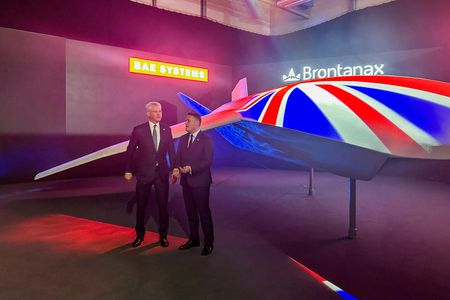

British defense giant BAE Systems made a major splash at the Farnborough Airshow on Wednesday, unveiling a model of its new unmanned fighter aircraft — a jet it calls Brontanax, a name rooted in the ancient Greek words for thunder and king.
The aircraft is comparable in size to a Hawk trainer jet. BAE said it expects to begin flight testing next year and that the plane could be operational by 2030. The company has already completed a fully assembled version of the jet at its Warton facility in northwest England, a project it has been developing alongside the Royal Air Force since 2022.
The unveiling places BAE squarely in a fast-growing and increasingly competitive market for what the defense industry calls Collaborative Combat Aircraft, or CCAs — often nicknamed “loyal wingmen.” These unmanned jets are built to fly alongside piloted aircraft and are expected to cost about one-third as much as a conventional fighter. Other major players competing in this space include Airbus, Boeing, Anduril, and General Atomics.
Britain’s newly appointed Defence Secretary Wes Streeting, who took on the role just two days before the airshow, called the moment “groundbreaking.” He announced the government’s intention to move forward with the aircraft, saying, “We will adopt this as our operational concept demonstrator, and we’re going to get it in the air in 2027.”
BAE moved forward with the project by putting up its own money rather than waiting for government co-investment, which typically supports the development of new military platforms. CEO Charles Woodburn spoke candidly about the company’s approach: “We’ve put our money where our mouth is.” He added, “We could see where the market was going,” and expressed confidence in securing a UK order while noting that countries in Europe and the Middle East have already shown interest.
In terms of performance, BAE said Brontanax is designed to deliver 70% to 80% of a traditional fighter jet’s capabilities at less than 25% of the cost — potentially putting its price tag around $25 million. The company also highlighted the aircraft’s stealth features, claiming it offers greater stealth than competing models. Its modular design and open architecture are intended to allow for straightforward software updates and hardware changes, with BAE also looking to non-military suppliers to assist in production.
For comparison, Boeing’s MQ-28 Ghost Bat — also on display at Farnborough — has already begun flight testing and could be flying missions for Australia as early as 2028.
Earlier this month, Britain outlined in its defence investment plan that it would commit an initial £300 million, roughly $401 million, to launch a sovereign CCA program it has named Storm Fighter.
The push for unmanned combat aircraft comes as global tensions rise and western nations increase military spending. Defense leaders have pointed to the ongoing war in Ukraine as a stark reminder that controlling the skies is essential to avoiding the kind of grinding, trench-based warfare that has defined that conflict.