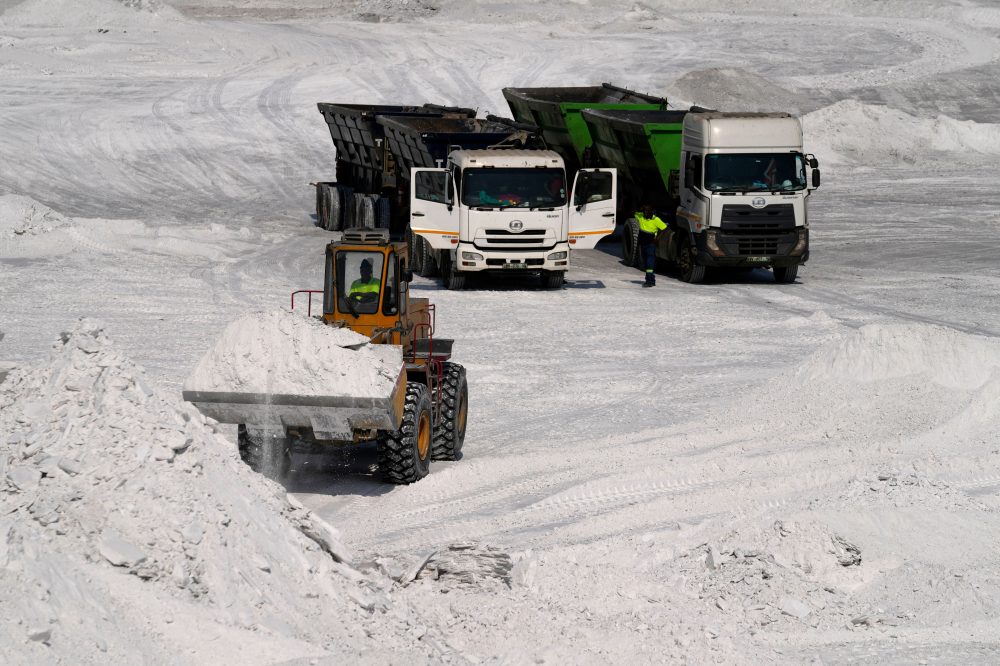

PHALABORWA, South Africa — Two massive sand-like mounds at a former chemical facility in South Africa have become the focal point of a U.S.-supported initiative to harvest valuable rare earth minerals from discarded industrial materials.
The Phalaborwa Rare Earths Project receives American backing through a $50 million equity investment from the International Development Finance Corporation, representing part of intensified U.S. initiatives to decrease dependence on China for minerals essential to manufacturing electronic equipment, robotics, defense technology, electric cars and other advanced products.
Nations worldwide have designated numerous minerals, including copper, cobalt, lithium and nickel, as critical due to their importance in emerging technologies. The 17 rare earth elements represent a specialized category within this group.
President Donald Trump has prioritized expanding American access to critical minerals, particularly rare earth elements, as a key strategy to challenge China’s dominance. The Trump administration announced this year it would allocate nearly $12 billion to establish its own strategic stockpile.
The DFC originated during Trump’s first presidency and approved its investment in the Phalaborwa initiative in 2023 under former President Joe Biden’s leadership.
The current Trump administration has continued supporting the project despite significant diplomatic tensions with South Africa, which emerged when Trump returned to office and signed an executive order last February suspending all financial aid to the nation.
However, the administration has demonstrated that specific economic priorities take precedence. The DFC has highlighted its participation in the Phalaborwa project as part of efforts to tap Africa’s mineral resources “while advancing U.S. strategic interests.”
Rainbow Rare Earths is developing the Phalaborwa project. The DFC’s funding flows through partner TechMet, a firm that describes itself as focused on securing critical mineral supplies for Western nations. South Africa’s government holds no direct ownership in the venture.
Rainbow Rare Earths CEO George Bennett told The Associated Press they hope to supply predominantly the U.S., saying its interest in the project was largely related to defense systems.
The company indicates it plans to provide rare earth elements neodymium, praseodymium, dysprosium, terbium and others from its South African operation. These materials are utilized in high-performance magnets for wind turbines, electric vehicles, defense applications and emerging uses, including robotics.
The Phalaborwa project plans to begin harvesting rare earths from the two enormous mounds in 2028. The mounds contain 35 million tons of phosphogypsum, a waste product from mining operations and phosphate rock processing for acid and fertilizer manufacturing.
Rainbow Rare Earths expects the project to run for 16 years. The $50 million DFC funding will only be released once Rainbow Rare Earths begins building its processing facility in Phalaborwa, expected in early 2027.
Rare earths exist in relative abundance but typically appear in low concentrations and prove challenging to separate, making extraction expensive.
Neha Mukherjee, research manager at Benchmark Mineral Intelligence, said that while the Phalaborwa project was unique, with its experimental above-ground mineral extraction process, its potential remains unknown.
“It looks like a fairly low-cost asset in terms of operational cost,” she said. “Even the capital requirement is not very high … which is a good sign.”
Mukherjee added that the project is important because “we do not have enough projects to meet the entire demand outside of China.”
Rainbow Rare Earths claims mineral harvesting from the mounds will utilize up to 90% renewable energy and cost significantly less than conventional rare earth mining.
Bennett stated Phalaborwa would become a low-cost producer competitive with Chinese operations.
“(Former owners) crushed it, they milled it, they put energy into it, put heat into it, all that to make the phosphogypsum, which is what’s needed to make rare earths,” said Rainbow Rare Earths project director Alberto Bruttomesso, referring to the processes the waste previously underwent. “Heating is the most expensive part of the process. It’s what costs the most money.”
The Trump administration has also funded critical mineral mining within the U.S. and pursued agreements to secure access to these materials internationally, including in Ukraine. Greenland’s rare earth deposits partially explain Trump’s interest in acquiring the Arctic territory.
The Phalaborwa project represents one of multiple mineral ventures in Africa receiving DFC investment.
Patience Mususa, a mining specialist at the Nordic Africa Institute in Sweden, said the U.S. was “trying to catch up in terms of investment in mining” on the African continent, where China dominates mining operations.
In February, the U.S. Trade and Development Agency signed a formal agreement to provide $1.8 million for a feasibility study at the Monte Muambe rare earths project in Mozambique.
In Africa, the Trump administration continues U.S. financial backing for the Lobito Corridor, a Biden administration program to construct an 800-mile railway connecting mineral-rich areas of Congo and Zambia to Africa’s Atlantic coastline.