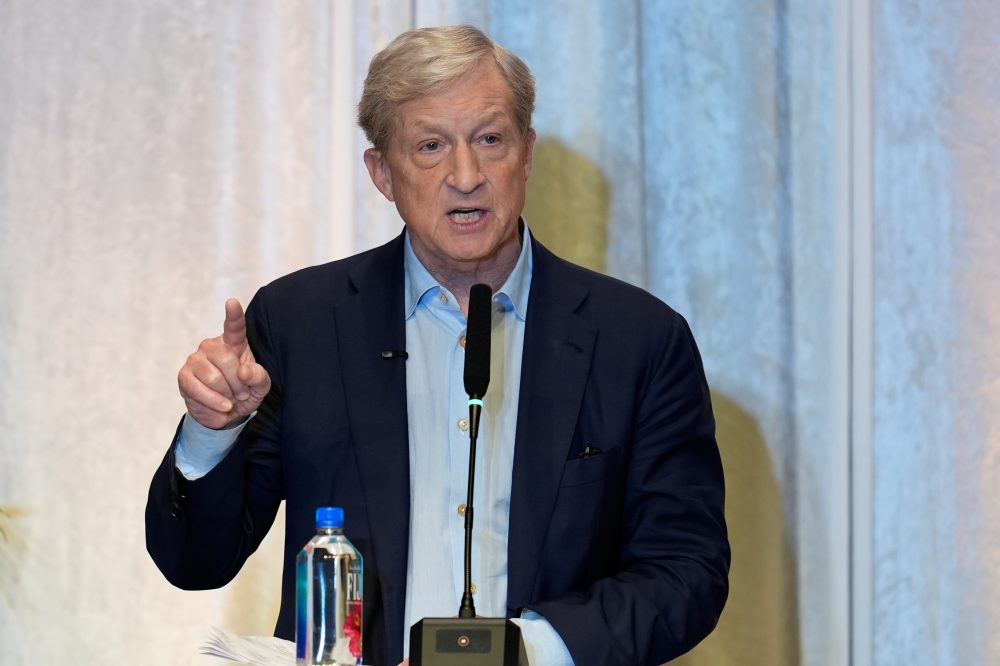

LOS ANGELES — Wealthy businessman Tom Steyer is unleashing an unprecedented financial assault in California’s gubernatorial contest, flooding airwaves and digital platforms with his personal fortune.
The former hedge fund executive turned progressive advocate is deploying his massive wealth to dominate television screens and smartphone displays with campaign messages, prompting rivals to criticize him for attempting to purchase the state’s highest office through sheer financial power.
Throughout heavily Democratic Los Angeles, California’s most significant media hub, Steyer’s commercials — featuring pledges to reduce living expenses and criticism of federal immigration enforcement actions — have become virtually unavoidable. According to data from AdImpact, an advertising monitoring service, Steyer has invested or reserved more than $115 million for broadcast television, cable, and radio advertisements — approximately 30 times what his closest Democratic opponent has spent.
Should Steyer advance past the June 2 primary contest, he could surpass the 2010 spending record established by Republican candidate Meg Whitman, who invested $178.5 million of largely personal funds in an unsuccessful gubernatorial campaign that represented the nation’s most expensive statewide race at that time.
When combining advertising expenditures from all major candidates plus independent committee purchases supporting various contenders, Steyer’s financial outlay still exceeds the entire field by tens of millions.
“Billionaire money is flooding our state in an attempt to buy this election,” former U.S. Representative Katie Porter, among Steyer’s primary challengers, cautioned her supporters recently.
Voter mail-in ballots will be distributed next month. Steyer joins numerous candidates seeking prominence following former Democratic U.S. Representative Eric Swalwell’s sudden campaign withdrawal amid sexual assault accusations he disputes.
While Steyer’s poll numbers have improved during his advertising campaign, he hasn’t separated himself from competitors, causing observers to question his return on investment.
“If your first round of ads doesn’t move you dramatically (in the polls), the third, fourth, fifth, six, seventh and eighth rounds won’t either,” explained seasoned Democratic consultant Bill Carrick, longtime advisor to the late Democratic U.S. Senator Dianne Feinstein. “There is something inherently holding Steyer back.”
In previous gubernatorial campaigns at this point, a frontrunner typically emerged to dominate the race. This cycle, voters seem disengaged with a competition lacking a standout figure among seven prominent Democrats and two Republicans.
“Somehow the campaign is frozen,” Carrick observed.
Past elections demonstrate that financial resources don’t guarantee electoral victory.
Real estate mogul Rick Caruso invested over $100 million in 2022 pursuing the Los Angeles mayoral position, primarily using personal funds, yet suffered a decisive loss to Mayor Karen Bass, who spent considerably less. Former New York City Mayor Michael Bloomberg committed more than $1 billion of personal wealth to his 2020 presidential campaign before withdrawing. Steyer’s financial resources failed to elevate his standing in the 2020 presidential race, leading to his early exit following disappointing results in South Carolina’s primary.
Steyer has no prior elected office experience.
During a 2019 Associated Press interview, when asked about accusations of attempting to purchase the presidency, Steyer responded:
“I don’t think that’s possible,” before adding, “I’m never going to apologize for succeeding in business. That’s America, right?”
His campaign declined direct comment regarding similar criticism of his gubernatorial bid.
“Tom now stands as the only Democrat with the grassroots energy, institutional backing and resources to advance to the general election,” campaign spokesperson Kevin Liao stated.
Two recent developments reshaped the governor’s contest: Swalwell’s abrupt campaign suspension and congressional resignation following sexual assault allegations, and President Donald Trump’s endorsement of conservative broadcaster Steve Hilton.
No clear frontrunner has emerged.
Late March and early April polling by the nonpartisan Public Policy Institute of California revealed tight competition among several candidates: Democrats Steyer and Porter, Republicans Hilton and Chad Bianco, plus Swalwell. Other contenders lagged behind. This polling occurred before Swalwell’s withdrawal.
Democrats worry their numerous candidates could result in complete exclusion from November’s general election, since California’s primary system advances only the top two vote recipients regardless of party affiliation.
Prominent Democrats claim gaining support since Swalwell’s departure. Steyer secured a significant endorsement from the powerful California Teachers Association, which previously supported Swalwell.
Steyer’s advertisements promise to “abolish” U.S. Immigration and Customs Enforcement, currently conducting raids throughout California. Another commercial addresses the state’s crushing housing expenses: “Everybody needs an affordable place to live,” he declares.