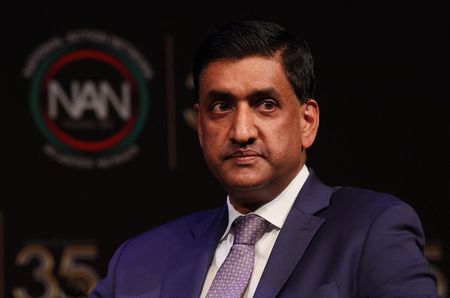

U.S. Democratic Congressman Ro Khanna says he was detained by armed Israeli settlers while visiting the West Bank this week, describing the encounter as a firsthand look at the consequences of Israeli occupation as he considers running for president in 2028.
Speaking to reporters on Thursday in a Palestinian village, Khanna recounted how a van carrying his group was surrounded the previous day by settlers holding M4 rifles in a part of the southern West Bank where Palestinian residents regularly face settler violence.
“We were at a village that Israeli settlers had destroyed, they had destroyed the school, they had destroyed that village, and we were just looking at it,” said Khanna, a progressive lawmaker from California in the U.S. House of Representatives.
“And these hoodlums come in with machine guns — M4, an American-made machine gun — and they detain us. They block off the road. And then they call the IDF and the IDF is on their side, not on the side of the Americans,” Khanna said, referring to the Israeli military.
Cameron Kasky, an aide to Khanna who was present during the incident, said the group was held for over an hour and reached out to the U.S. Embassy in Jerusalem for assistance. He said a group of officers who appeared to be police eventually stepped in and secured their release.
The Israeli military confirmed that troops and police responded after receiving a report of settlers blocking vehicles near Khirbet Zanuta, a small Palestinian hamlet whose residents were forcibly displaced following violent settler raids after the 2023 Hamas attacks on Israel. “Upon their arrival, the troops dispersed the Israeli civilians and allowed the vehicles to continue on their way,” the military stated.
Israel’s police did not respond to a request for comment, and neither did the U.S. Embassy in Jerusalem.
Khanna is the second Democrat considering a White House bid to visit the region this week. In Tel Aviv on Wednesday, Rahm Emanuel — who served as chief of staff to former President Barack Obama — said Israeli policies toward Palestinians were weakening support for the U.S.-Israeli alliance.
When asked whether he plans to run for president, Khanna responded: “I’m strongly considering it and I’m more resolved to consider it after this trip.”
Israel’s treatment of Palestinians has become a divisive issue within the Democratic Party ahead of November’s U.S. midterm elections, contributing to primary losses for some sitting lawmakers who were challenged by left-leaning opponents accusing them of backing Israel’s right-wing government.
A Reuters/Ipsos poll found that Israel’s favorability among Democrats dropped sharply, falling from 59% in 2018 to just 22% as of May.
While Israel has historically enjoyed broad bipartisan backing in the U.S., a growing number of congressional Democrats are now pushing to cut military aid, which totals $3.8 billion annually and covers items such as M4 rifles and missile interceptors that Israel used during the Iran war.
Standing near Turmus Ayya — a village home to thousands of Palestinian American dual nationals — and overlooking a valley with settler outposts visible in the distance, Khanna said he felt his party’s leadership was “clueless about how much of a moral test Palestine, Gaza and Israel have become.”
He explained that he deliberately structured his visit around the West Bank only, with Palestinian-led programming, to gain an unfiltered perspective on territory Israel captured during the 1967 Middle East war.
“If you’re unwilling to speak up for Palestinian human rights, if you’re unwilling to speak up against the genocide in Gaza, the apartheid in the West Bank, then you are morally compromised,” Khanna said.
Israel rejects claims that it has carried out a genocide in Gaza or operates an apartheid system in the West Bank, which has a population of roughly 3 million Palestinians and approximately 500,000 Jewish settlers.
The majority of countries and the United Nations consider Israeli settlements in the West Bank to be illegal under international law, based on the Fourth Geneva Convention’s prohibition against moving a civilian population into occupied territory. Israel disputes this, arguing the West Bank is contested land with a Jewish presence spanning thousands of years. Palestinians consider the West Bank, along with Gaza and East Jerusalem, to be part of a future Palestinian state.
Republican support for Israel remains strong, though some factions within the broader conservative coalition have also called for ending U.S. aid.