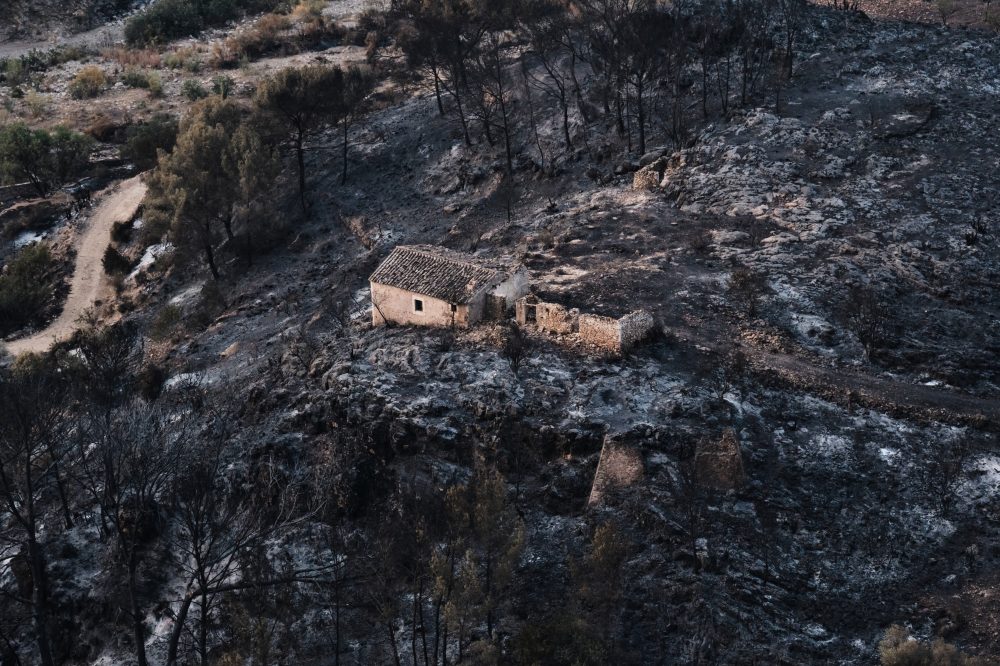

BEJAR, SPAIN — Hundreds of firefighters, supported by helicopters and fixed-wing aircraft, spent Saturday racing to contain one of the most deadly wildfires Spain has seen in years, a blaze that has now claimed at least 12 lives.
Antonio Sanz, who leads Andalusia’s emergency services, said that lighter winds and higher humidity were giving crews some relief, but the enormous scale of the fire continued to make the battle difficult. The blaze has burned through approximately 66 square kilometers — about 25 square miles — of forest and farmland, an area comparable in size to Manhattan.
Sanz said firefighters conducted controlled burns overnight along the fire’s edges in an effort to slow its spread. The fire first ignited late Thursday in a dry, semi-arid region near the Sierra de Los Filabres mountains in Almeria province, striking just as Spain was enduring a brutal heat wave.
Authorities say most of the victims are believed to be foreign nationals who lost their lives after disregarding instructions to shelter in place. Seven of the dead were found on foot, having abandoned their vehicles. Four of those killed are thought to be British citizens — investigators identified the likely nationality based on the right-side steering wheel found in their burned vehicle, consistent with British cars.
Sanz confirmed Saturday that autopsies had been completed and DNA samples collected to help formally identify the victims.
In total, authorities evacuated 1,448 residents from roughly 11 different areas as a precaution.
Jeffrey and Christine Kember were relaxing at their Los Pinos farmhouse watching a favorite television program when a blaring siren warned them of the approaching fire. Jeffrey Kember described how both he and his wife jumped into separate cars, while also trying to assist a neighbor who had two young toddlers with her.
The couple became separated during the chaos, and Jeffrey had no way to reach his wife because she had left without her phone.
“I’m driving through the flames. It was actually flames. I thought, ‘I can’t stop, I just gotta go,’” Jeffrey Kember told the Associated Press, his wife standing beside him outside an evacuation center.
“It was eerie because all of a sudden I came out of the flames and it was all bright sunshine. It was like surreal. Ridiculous!”
Spanish authorities also arrested two individuals who defied evacuation orders and returned to a high-risk zone, according to Spain’s official EFE news agency. Search crews continue to comb through the Bédar area looking for any additional victims.
Spain has faced increasingly severe and frequent heat waves in recent years, with temperatures regularly topping 40 degrees Celsius, or 104 degrees Fahrenheit. A combination of high heat, wind, and dry conditions can quickly turn small fires into massive, uncontrollable blazes.
Justice Minister Félix Bolaños pointed to a “climate emergency” as the driving force behind the fire’s intensity on Saturday, noting that at its most ferocious, the blaze was advancing at a rate of 100 meters — roughly 328 feet — per minute.
This past June, Spain suffered through several days of record-breaking heat that contributed to more than 1,000 excess deaths.
According to the European Union’s Copernicus Climate Change Service, Europe is warming faster than any other continent — temperatures there have risen at twice the global average rate since the 1980s. Parts of Western Europe are currently enduring their third heat wave in just six weeks. Globally, 2025 ranked as the third-hottest year ever recorded, bringing with it a series of intense heat events across Europe.
France was also battling multiple active wildfires Saturday as temperatures spiked across the country. Interior Minister Laurent Nunez announced that 32 people have been arrested in France since the start of summer in connection with wildfire-related offenses.
“Those unacceptable acts, which have disastrous consequences and mobilize our firefighters at the risk of their lives, now fall into the hands of the justice system,” Nunez said. “We will continue our determined action and will not let anything slide.”
French President Emmanuel Macron also weighed in, noting in a post on X that nine out of every ten wildfires are sparked by human activity. More than 25,000 hectares — roughly 62,000 acres — have burned in France so far in 2026, approximately double the area burned during the same stretch last year.
France is currently at the height of its third heat wave this summer, with temperatures hitting 40 degrees Celsius across western and central regions, and around 37 degrees Celsius — about 98 degrees Fahrenheit — in Paris. Last month was France’s hottest June on record, with deaths climbing by nearly a third during the peak heat week.
Wildfires are not new to Spain. Last year’s fire season scorched more than 393,000 hectares — around 971,000 acres — an area twice the size of London, according to the European Forest Fire Information System. Four people died in those fires.
Spain’s deadliest wildfire on record occurred in 1979, when 21 people were killed in Lloret de Mar, a coastal town roughly an hour north of Barcelona. In neighboring Portugal in 2017, a wildfire killed 66 people in Pedrogao Grande, located about 200 kilometers — or 120 miles — northeast of Lisbon. In that disaster, 47 of the victims died on a single road while attempting to flee in their cars, much like several of the victims in this week’s Spanish blaze.