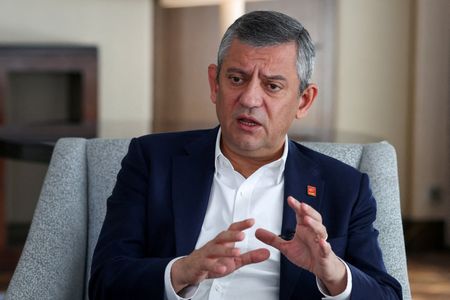

Turkey’s political landscape is shifting dramatically after opposition leader Ozgur Ozel announced he would launch a new political party to take on President Tayyip Erdogan. The move comes amid a deepening split in the opposition that analysts say could actually help Erdogan extend his 23-year hold on power when the country next heads to the polls.
A court removed Ozel in May as head of the main opposition Republican People’s Party, known as the CHP. The party has been significantly weakened by an unprecedented legal crackdown that began in 2024. Despite that, Erdogan faces a constitutional hurdle of his own — if he wants to run for president again, elections would need to happen before the currently scheduled date in 2028.
WHEN ARE TURKEY’S ELECTIONS SCHEDULED?
Presidential and parliamentary elections in Turkey occur every five years. The next round is currently set for May 14, 2028. However, both the president and parliament have the authority to call for an earlier vote.
WHAT IS ERDOGAN’S CONSTITUTIONAL SITUATION?
Erdogan first held power as prime minister before being elected president in 2014 under Turkey’s former parliamentary system. Following a 2017 referendum that established a new executive presidency, he won re-election as president in both 2018 and 2023. Under the presidential system, he has now reached the two-term limit. However, the constitution does allow him to seek another term if parliament triggers an early election while he is still serving his current term.
HOW WOULD AN EARLY ELECTION BE CALLED?
Calling an early election requires a three-fifths majority in parliament — that means 360 out of 600 lawmakers must vote in favor. Erdogan’s ruling Justice and Development Party, the AKP, along with its coalition partners currently holds 328 seats. That leaves the ruling bloc 32 votes short, making it a significant challenge to reach the required threshold.
In terms of the opposition’s makeup, the CHP holds 135 seats, with the majority of those expected to follow Ozel to his new party. The pro-Kurdish DEM Party and its allies account for 63 seats, the nationalist IYI Party holds 29, smaller opposition parties together have 26, and there are 11 independent members of parliament.
WHERE DO THE PARTIES STAND ON EARLY ELECTIONS?
The AKP and its nationalist coalition partner, the MHP, have publicly stated they have no intention of calling an early election, insisting the vote will happen “on time.” AKP officials have also noted that any election held before May 14, 2028 would legally qualify as an early election, which would open the door for Erdogan to run again.
Ozel, the ousted CHP leader, has repeatedly pushed for an earlier vote — partly to give voters a chance to respond to the legal actions taken against his party. He has also cautioned, though, that an early election cannot be called too close to the 2028 scheduled date, after which Erdogan would be constitutionally required to step down.
At least 90 of the CHP’s 135 lawmakers are believed to support Ozel, who formally resigned from the party on Tuesday. It remains unclear whether Kemal Kilicdaroglu, who was reinstated as CHP chairman by court order, would support a push for early elections.
Some political analysts suggest that Erdogan’s ruling alliance might look to the DEM Party for support. While DEM has historically been a fierce opponent of Erdogan’s nationalist and Islamist-rooted AKP, the party has since late 2024 played a role in facilitating peace efforts between the Turkish government and the outlawed Kurdistan Workers’ Party, known as the PKK.
ARE THERE OTHER PATHS FOR ERDOGAN?
There is another, more complicated route that could allow Erdogan to run again: changing the constitution. If 400 of the 600 members of parliament supported a constitutional amendment, it could take effect immediately — though reaching that number is considered unlikely for Erdogan’s alliance.
Alternatively, a constitutional amendment could be sent to a national referendum if at least 360 lawmakers approved it. Public opinion polls indicate Turks are divided on the question, which represents a political risk for the government. Although the CHP has previously opposed any constitutional changes that would benefit Erdogan, the party’s current fragmentation could shift some lawmakers’ positions.
MHP leader Devlet Bahceli, Erdogan’s nationalist ally, has said a constitutional amendment deserves consideration, but the ruling coalition has not yet introduced any formal draft proposal for such a change.