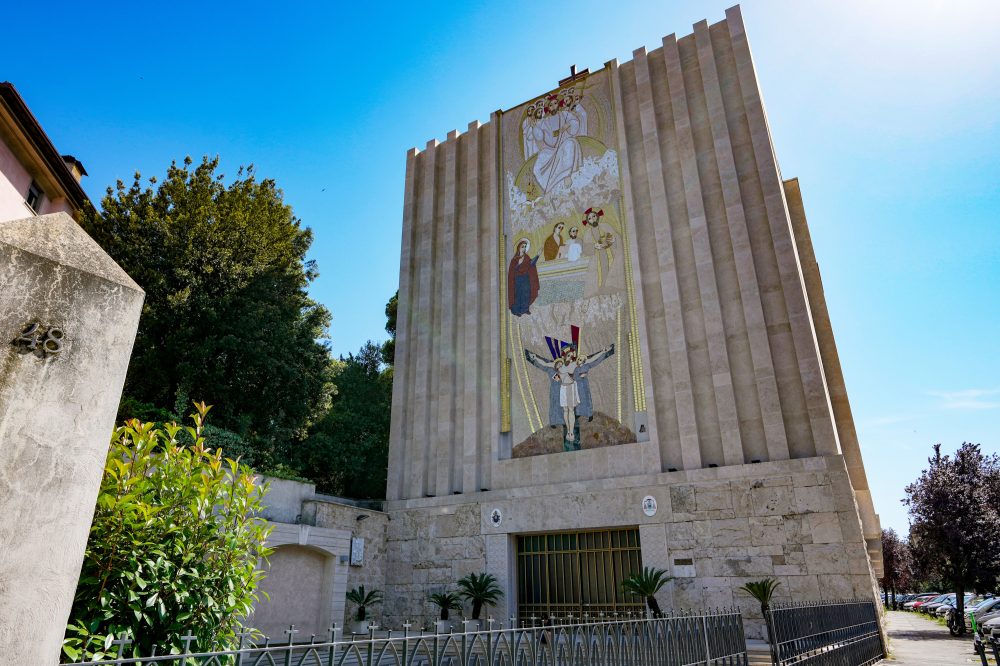

ROME — The attorney representing five women who claim they were sexually and spiritually abused by a former Jesuit priest and internationally celebrated religious artist has issued a blistering condemnation of the Vatican’s closed-door legal process, one in which her clients have no right to any information about the proceedings against him.
Attorney Laura Sgro sent a letter to the Vatican on Tuesday demanding to know where things stand in the church’s investigation of the Rev. Marko Ivan Rupnik. Her demand came after an Italian blog, Messa in Latino, published a report Monday claiming Rupnik had been cleared in a canonical trial.
The Vatican has never publicly disclosed what specific charges Rupnik faces in its internal church court, making it impossible to determine whether he may have been cleared on some counts while the broader investigation continues on others. Vatican officials stated Tuesday that the case remains active.
The Rupnik affair has emerged as one of the most delicate issues facing the Holy See in recent memory. Questions have swirled for years about whether the Slovenian priest was shielded for more than three decades by his Jesuit superiors and the Vatican’s own leadership, including Pope Francis.
Rupnik was once among the most prominent contemporary religious artists in the Catholic world, creating distinctive mosaic works that adorn churches and basilicas across the globe, including at Lourdes and the Vatican itself.
The controversy burst into public view in late 2022, when Italian blogs began reporting allegations of misconduct against him by women and nuns. Those claims, which dated back to the 1990s, had long been brushed aside by church officials.
The Jesuits later acknowledged that Rupnik had been briefly excommunicated in 2020 for committing one of the Catholic Church’s gravest offenses — using the confessional to absolve a woman with whom he had engaged in sexual activity.
Despite that, the Vatican declined to pursue claims brought by other women, saying those allegations were too old and involved adult women rather than minors at the time the alleged abuse occurred.
The Jesuit order expelled Rupnik in 2023 after more than two dozen women came forward alleging he had abused them — sexually, spiritually, or psychologically — over a span of 30 years. Some said the abuse occurred while they were working alongside him on art projects.
Rupnik remains a priest, and those who support him have denied any wrongdoing. Maria Campatelli, director of the Rome-based Aletti Center that Rupnik founded, has described the allegations as “defamatory and unproven” and characterized the media attention as a form of “lynching.”
Amid growing suspicion that he had protected a fellow Jesuit, Francis in 2023 waived the statute of limitations on the older allegations, allowing the Vatican to open a formal canonical trial.
It took the Vatican two years to name judges for the case. Late last year, Pope Leo XIV confirmed the trial had officially begun. While referring to Rupnik’s accusers as “victims,” he called on them to be patient with the process.
“Processes for justice take a long time and I know it’s very difficult for the victims to ask that they be patient but the church needs to respect the rights of all people,” Leo said on November 4. “The principle of innocent until you’re proven guilty is also true in the church. And hopefully this trial that is just beginning will be able to give some clarity and justice to all those involved.”
Because of the case’s sensitivity — and how its resolution could shape Francis’ legacy — any developments in the Rupnik trial have been closely tracked by victims and their advocates.
Sgro took direct aim at the church’s secretive handling of the case and its refusal to either confirm or deny what the blog had reported.
In her letter to the head of the Vatican office that oversees sex abuse cases, Sgro said no one from the Vatican had ever responded to her phone calls or emails seeking updates, and that her clients had never even been interviewed as part of the process.
“How can what is happening be reconciled with the concepts of law, truth, justice, and fairness? With the words that the Holy Father constantly speaks on behalf of the victims of abuse?” Sgro wrote to Cardinal Victor Manuel Fernández, prefect of the Vatican’s doctrine office.
“I therefore ask you once again, Your Eminence, to answer some simple, basic questions regarding a criminal trial involving victims who first filed complaints more than thirty years ago: Has the trial begun? If so, what is the current status of the case? Who are the judges? What has become of my clients’ requests to be admitted as injured parties in the trial? Why were these women not called to testify?”
Under church law, victims in canonical abuse cases are treated only as outside witnesses. They are barred from participating in any part of the confidential proceedings, have no access to case documents, and have no legal right to even know whether an investigation has been opened — let alone its current status.
A reform implemented by Francis in 2019 grants victims the right to learn the final outcome of their case, but nothing beyond that.
International commissions and inquiries into clergy abuse have repeatedly condemned the lack of rights afforded to victims in canonical proceedings, finding that the church’s secretive procedures cause additional harm to survivors. A core part of the problem is that church law was never designed with abuse survivors in mind. The system’s stated purpose is focused on the institution: restoring justice, reforming the offender, and addressing scandal.
French experts who conducted a sweeping review of the clergy abuse crisis in France concluded in 2021 that the Vatican’s handling of canonical investigations put it in violation of its obligations as a United Nations observer state and member of the Council of Europe — both of which require upholding the basic human rights of victims.