
Twenty years of government investment have positioned Turkey as a significant supplier of military drones and defense equipment worldwide, with the NATO alliance member seeking to capitalize on this growth as Western nations boost military spending and security partnerships evolve.
The country, which previously depended heavily on international arms manufacturers, now provides military equipment to approximately 40 nations, primarily throughout the Gulf region, Africa, Asia, and portions of Europe. Customers view Turkish weapons as more affordable, quicker to obtain, and easier to modify compared to other options.
Following Russia’s military action in Ukraine, European nations are reevaluating their security dependencies and questioning the reliability of U.S. security commitments. This has led many NATO partners to view Turkey not just as a strategic military position on the alliance’s southeastern border, but also as a valuable industrial collaborator.
The Turkish government anticipates that hosting U.S. President Donald Trump and fellow NATO leaders at next month’s summit will boost arms sales and collaborative manufacturing in Western markets, especially within the European Union. Turkish companies currently encounter significant obstacles there, including defense programs limited to EU members and political opposition stemming from various diplomatic disagreements.
Trade data examined by Reuters reveals that Turkish defense sales, which include the prominent armed drones utilized by Ukrainian military forces, have increased more than threefold since 2021, reaching $10 billion in the previous year. This represents approximately 3.7% of the major emerging economy’s total export revenue.
Sales to Europe and the United States nearly quadrupled during this timeframe, totaling $5.6 billion.
This expansion demonstrates the maturation of Turkey’s domestic defense sector, which encompasses drone manufacturer Baykar, Turkish Aerospace Industries, and smaller companies like Arca Defense and Kale.
Industry experts indicate that consistent government support, adaptable supply networks, and willingness to tailor systems for customers have enabled these companies to rapidly enter markets where Western manufacturers face production limitations or extended purchasing processes.
CONFLICT CREATES CHALLENGES AND OPPORTUNITIES
Turkey’s defense agency reports the country seeks to double defense exports within two years, potentially creating essential income as it works to reduce debt and finance additional development.
Located between two significant conflicts — Ukraine to the north and Iran to the southeast — Turkey’s security interests are also involved, considering its defensive gaps in air protection and aircraft and tank engines that could be resolved through commercial and technology agreements.
Can Kasapoglu, senior fellow at the Hudson Institute, stated Turkey’s defense industry had achieved a “major leap” through exporting sophisticated systems, particularly aerial drones.
He explained that the Ukrainian conflict demonstrated modern combat relies not only on advanced equipment but also on manufacturing capacity and sustainability — areas where Turkey has established credibility.
NATO GATHERING HIGHLIGHTS CAPABILITIES
Turkey provides roughly 65% of armed drones utilized globally and serves as a significant ammunition exporter. The country also manufactures, or intends to manufacture, naval vessels, an aircraft carrier, air defense systems, and armored vehicles. Indonesia announced last year it would purchase 48 Turkish fighter aircraft currently in development.
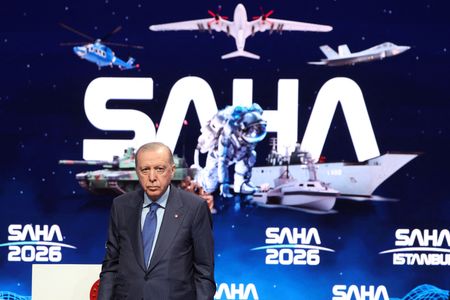
Turkey’s goals also present political and image-related challenges. Recently, the country revealed a prototype domestic intercontinental ballistic missile at an Istanbul defense exhibition, drawing criticism from some specialists regarding practicality and messaging after a promotional video showed a theoretical launch that seemed to target North America.
Turkish representatives indicate the defense industry will be emphasized at the NATO conference in Ankara on July 7–8. Alliance leader Mark Rutte has described a scheduled defense industry forum there as NATO’s most extensive to date.
EUROPEAN OBSTACLES
U.S. demands for NATO partners to increase their defense responsibilities, including plans to remove thousands of soldiers from Germany, present both possibilities and uncertainty for Turkey, which maintains the alliance’s second-largest armed forces.
Defense Minister Yasar Guler stated in April that European allies should eliminate security arrangements excluding non-EU NATO members like Turkey, contending such policies might “harm Europe’s security and resilience more than the U.S. reduction of forces in Europe”.
Turkey remains mostly excluded from the EU’s Security Action for Europe (SAFE) programme, while certain governments have maintained distance from Ankara due to regional policy disagreements and concerns regarding democratic decline, including an extensive legal campaign against the primary opposition party.
Despite this, Turkish companies have obtained defense contracts with Poland, Spain, Portugal, and Romania, while Baykar has purchased Italy’s Piaggio Aerospace and formed partnerships with Leonardo for production.
WORLDWIDE MILITARY INVESTMENT SURGE
International military expenditure increased 24% to almost $2.9 trillion over five years through 2025, including a 75% rise in Europe, based on Stockholm International Peace Research Institute data.
During the same timeframe, Turkey’s defense agency expanded the number of supported research and development projects to over 1,400, doubling the previous amount.
Defense analyst Arda Mevlutoglu indicated conditions exist for enhanced cooperation with Europe if political barriers can be addressed.
“Europe needs solutions that can be implemented rapidly … but high-level political will is needed for this cooperation to move healthily,” he stated. “Turkey is in a process of realignment and recalibration toward both Europe and … NATO.”