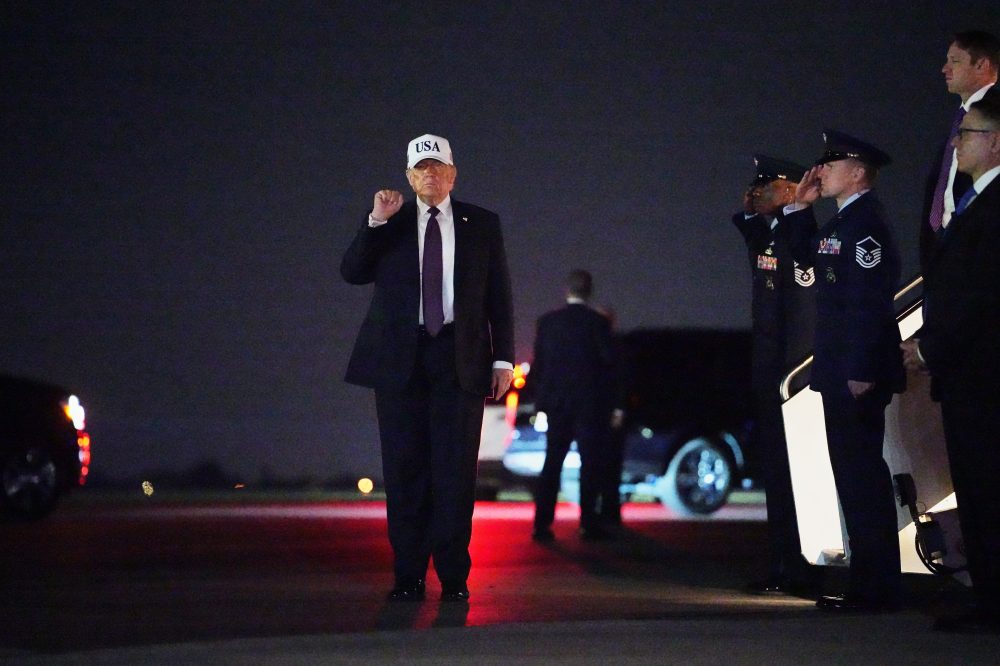

WEST PALM BEACH, Fla. — President Donald Trump’s military strikes against Iran on Saturday marked a striking transformation in his willingness to take risks, showing how dramatically his approach shifted in just eight months regarding the use of American military force against Tehran’s religious leadership.
Traditional constraints were abandoned as Trump collaborated with Israeli Prime Minister Benjamin Netanyahu on a military strategy that targeted Iran’s top officials, including 86-year-old Supreme Leader Ayatollah Ali Khamenei, whose elimination Trump proudly declared on social media following the launch of military operations.
This action represented a complete reversal from Trump’s position eight months earlier. During Israel’s 12-day conflict with Iran in June, he had agreed to Israel’s request to deploy B-2 bombers against three critical Iranian nuclear facilities — but firmly refused when Israeli officials proposed assassinating Khamenei.
Back in June, the president had issued barely concealed threats suggesting he could eliminate the supreme leader if he chose to. However, he ultimately turned down the Israeli assassination proposal due to fears it would create regional instability.
That careful approach disappeared on Saturday when Trump declared Khamenei’s death, while Israeli forces announced they had eliminated Iran’s defense minister and Revolutionary Guard commander. As of Saturday evening, Iran had not yet confirmed their Supreme Leader’s demise.
“Khamenei was unable to avoid our Intelligence and Highly Sophisticated Tracking Systems and, working closely with Israel, there was not a thing he, or the other leaders that have been killed along with him, could do,” Trump said. “This is the single greatest chance for the Iranian people to take back their Country.”
Trump had spent months attempting diplomatic engagement with Iran. Administration sources told reporters they had presented Iran with numerous pathways to maintain a peaceful nuclear program for civilian use, including an offer to provide nuclear fuel at no cost indefinitely.
However, these officials, speaking anonymously because they lacked authorization for public comment, indicated it became apparent that Iran sought enriched uranium for weapons development. One official characterized Iran’s response to their proposals as “games, tricks, stall tactics.”
The strike authorization came merely two days after Trump sent special representatives Steve Witkoff and Jared Kushner for additional negotiations with Iranian leadership. Middle Eastern and European partners were pushing the U.S. administration to allow more time for diplomatic solutions as Trump showed increasing impatience.
“The consequences are likely to be as far-reaching as they are uncertain: Within the system that has held power for nearly five decades, between the government and a dissatisfied populace, and between Iran and its adversaries,” said Ali Vaez, Iran project director at the International Crisis Group. “And although the regime is weakened, a sense that this showdown is an all-or-nothing struggle for its very survival could lead it to respond with every tool still at its disposal.”
Saturday’s military action followed a pattern of increasingly aggressive moves against Iran that produced minimal retaliation, which appeared to influence Trump’s risk assessment, according to Aaron David Miller, who advised both Democratic and Republican administrations on Middle Eastern affairs for twenty years.
In 2018, Trump withdrew from the Iran nuclear agreement that Democratic President Barack Obama’s administration had negotiated. Two years later, Trump authorized a drone attack that killed senior Iranian General Qassem Soleimani.
The Soleimani assassination, targeting the leader of Iran’s elite Quds Force, represented perhaps the most aggressive U.S. military move in the Middle East since President George W. Bush initiated the 2003 Iraq War to remove Saddam Hussein.
Then in June, Trump authorized attacks on Iran’s nuclear infrastructure, which he declared had “obliterated” their program.
“He did all of these things without cost or consequence to him,” said Miller, currently a senior fellow at the Carnegie Endowment for International Peace. “He’s been risk-ready. That’s the nature of his personality.”
Trump administration representatives had openly demanded Tehran abandon its nuclear weapons and ballistic missile development while ceasing support for regional militant groups. However, administration sources said Tehran refused to address the missile and proxy issues.
Iran’s inflexibility, occurring while its economy suffered under decades of sanctions and its military remained weakened from last year’s conflict, surprised Trump.
Before Thursday’s negotiations concluded, indicators suggested Trump was moving toward military intervention.
During Tuesday’s State of the Union address, Trump asserted that Iran was developing ballistic missiles capable of reaching American territory — a rationale he repeated Saturday while announcing the bombardment had begun.
Iran has not confirmed it is developing or pursuing intercontinental ballistic missile capabilities. However, the U.S. Defense Intelligence Agency stated in an unclassified report last year that Iran could potentially develop a militarily effective intercontinental ballistic missile by 2035 “should Tehran decide to pursue the capability.”
Secretary of State Marco Rubio informed reporters Wednesday that Iran’s unwillingness to discuss its ballistic missile program created a “big problem.” Rubio avoided addressing the DIA assessment that Iran remained years away from developing missiles capable of reaching the United States.
Vice President JD Vance, a former Marine who served in Iraq and has questioned U.S. military interventions, told The Washington Post on Thursday that Trump had not yet decided on striking Iran. However, he provided reassurances that any military action would not involve the United States in an extended conflict.
“The idea that we’re going to be in a Middle Eastern war for years with no end in sight — there is no chance that will happen,” Vance said.
By Friday, Trump was expressing renewed frustration with Iran’s negotiating stance.
“I’m not happy with the fact that they’re not willing to give us what we have to have,” Trump said. “I’m not thrilled with that. We’ll see what happens.”
Congressional leadership received advance notice Saturday morning about the impending strikes. Trump observed the operation from his Mar-a-Lago estate in Palm Beach, Florida, alongside his national security advisors.
Trump’s earlier successful military operation this year that captured Venezuelan leader Nicolás Maduro and transported him and his spouse to New York City for federal drug conspiracy charges may have encouraged the president, suggested Jonathan Schanzer, a former Treasury Department official now serving as executive director of the Foundation for Defense of Democracies, a hawkish Washington research organization.
Trump had threatened military intervention last month but delayed action as Iran conducted a violent suppression of demonstrations. The protests initially focused on economic complaints but evolved into a nationwide anti-government movement challenging the religious leadership.
While human rights organizations reported thousands killed during Iran’s crackdown, Trump promised protesters assistance was coming, though it did not materialize immediately and the demonstrations eventually subsided.
Schanzer noted that Trump’s decision to postpone action last month provided his team additional time to position the substantial fleet of fighter aircraft and naval vessels now deployed in the region — similar to preparations made in the Caribbean before the Venezuela operation.
This military presence represented leverage Trump hoped would force Khamenei to surrender. However, the Supreme Leader refused to yield.
“The way this unfolded was inevitable, because there was no way that the Ayatollah was going to show flexibility,” Schanzer said.