
President Donald Trump announced Saturday on Truth Social his intention to send a hospital ship to Greenland, claiming residents there are ill and lacking proper medical attention. However, both of the U.S. Navy’s hospital vessels are currently being repaired at an Alabama shipyard.
Trump’s statement has sparked a response from Greenland’s prime minister, who defended the territory’s healthcare infrastructure. This latest development adds to ongoing tensions as Trump continues discussing his desire to acquire Greenland, a semi-autonomous region under NATO partner Denmark.
In his social media post, Trump referenced his Arctic special envoy, stating: “Working with the fantastic Governor of Louisiana, Jeff Landry, we are going to send a great hospital boat to Greenland to take care of the many people who are sick, and not being taken care of there.”
However, no widespread illness outbreaks have been documented in Greenland recently, and Trump’s post didn’t specify what health crisis he was addressing.
Greenland’s 57,000 residents receive medical services primarily through Queen Ingrid Hospital located in capital city Nuuk, supplemented by multiple regional healthcare facilities, according to the Danish Medical Journal. The territory provides comprehensive free healthcare to citizens and permanent residents, covering everything from general practice visits to specialist care, hospital treatment, medications, dental services, and home nursing assistance, as reported by the Nordic Council of Ministers.
Greenlandic Prime Minister Jens-Frederik Nielsen responded by highlighting their universal healthcare approach while contrasting it with America’s system. “We have a public health care system where treatment is free for citizens. That is a deliberate choice — and a fundamental part of our society,” Nielsen stated. “That is not how it works in the USA, where it costs money to see a doctor.”
While healthcare access is free, the Center for Public Health in Greenland acknowledges significant public health obstacles exist across the expansive island territory. These issues stem largely from the rapid transformation “from a hunting society to a modern industrial and knowledge society” occurring within a compressed timeframe. Contemporary health problems increasingly include obesity, diabetes, and heart disease.
Healthcare staffing shortages persist in certain areas. Anna Wangenheim, Greenland’s health and disability minister, recently made an “urgent” Facebook appeal seeking dentists for three communities: Aasiaat, Paamiut, and Nanortalik.
Despite accessibility challenges in isolated regions and personnel shortages, Greenland has made significant healthcare progress since taking control of its medical system in 1992, according to University of Greenland professor Lene Seibæk. “In 2020, life expectancy in Greenland was approximately 71 years for men and 77 years for women, representing an increase of approximately six years for men and five to six years for women since the 1990s and exceeding the global average,” Seibæk explained.
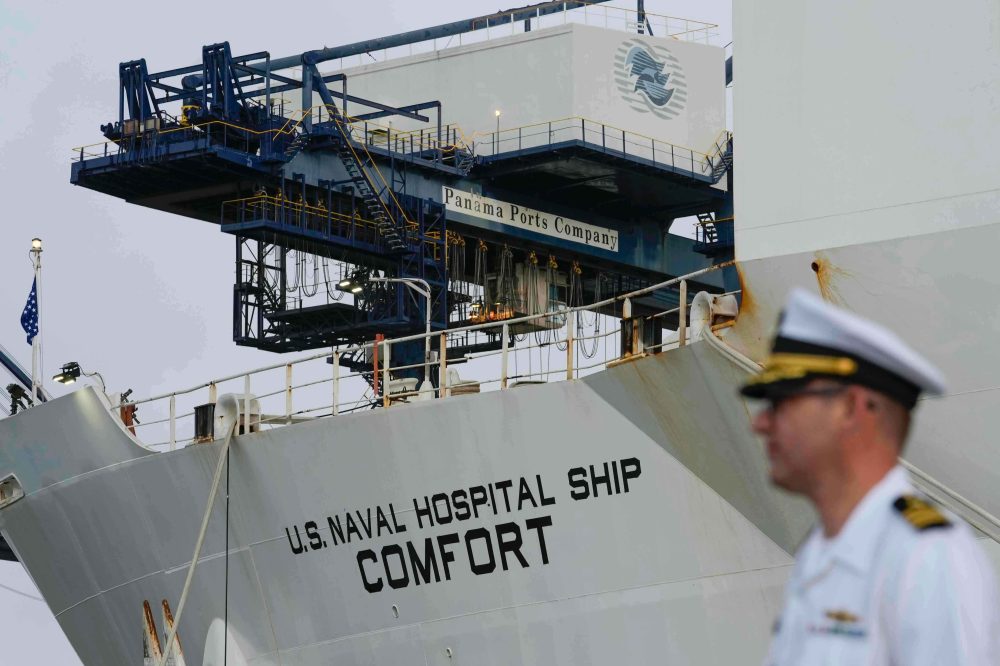
Trump claimed in his post that a hospital ship was already “on the way” to Greenland. In reality, both the USNS Mercy and USNS Comfort remain at a Mobile, Alabama shipyard, as confirmed by recent facility social media posts and public vessel tracking information.
The Comfort docked at the Alabama facility on January 23rd and is scheduled to remain there until April for contracted maintenance work. The Mercy has been there since August, with repairs extending beyond original timelines. Additional maintenance work for the Mercy is planned for March at an Oregon shipyard.
Even if either vessel were expedited from repairs, significant preparation time would be required before deployment. Hospital ships operate with basic crews that must be supplemented with medical personnel from nearby hospitals at their Norfolk, Virginia, or San Diego home ports. Each ship contains 12 operating theaters and 1,000 hospital beds requiring full medical staffing.
Louisiana Governor Landry, serving as Trump’s Arctic envoy, supported the president’s assertions Sunday on X, claiming “many villages and small towns lack basic services that Americans often take for granted.” Landry added that “small settlements are without permanent doctors, diagnostic tools, or specialist care — forcing residents to travel great distances for vital treatments that should be available at home.”
While some remote settlements may lack on-site medical facilities, Greenland utilizes telemedicine extensively for distant communities. Patients requiring unavailable local care can be transported to the national hospital or regional centers. Complex medical cases warrant flights to Denmark, with government coverage for both transportation and treatment costs.
Rural American communities face comparable healthcare access challenges, often more severe due to financial barriers and travel distances. These problems have intensified over the past decade with maternity ward closures, pharmacy struggles, and rural hospitals preparing for potential federal Medicaid reductions.
Since 2010, 152 rural hospitals across America, particularly in southern states, have either eliminated inpatient services or closed completely, based on University of North Carolina at Chapel Hill data. While telehealth expansion helps address some disparities, it cannot solve universal access issues as many rural areas experience provider shortages and unreliable internet connectivity.
Louisiana exemplifies these challenges, with most parishes being fully or partially rural. According to the state health department, 73% of Louisiana residents live in areas lacking adequate primary care providers, 86% without sufficient dental providers, and 93% without enough mental health professionals.