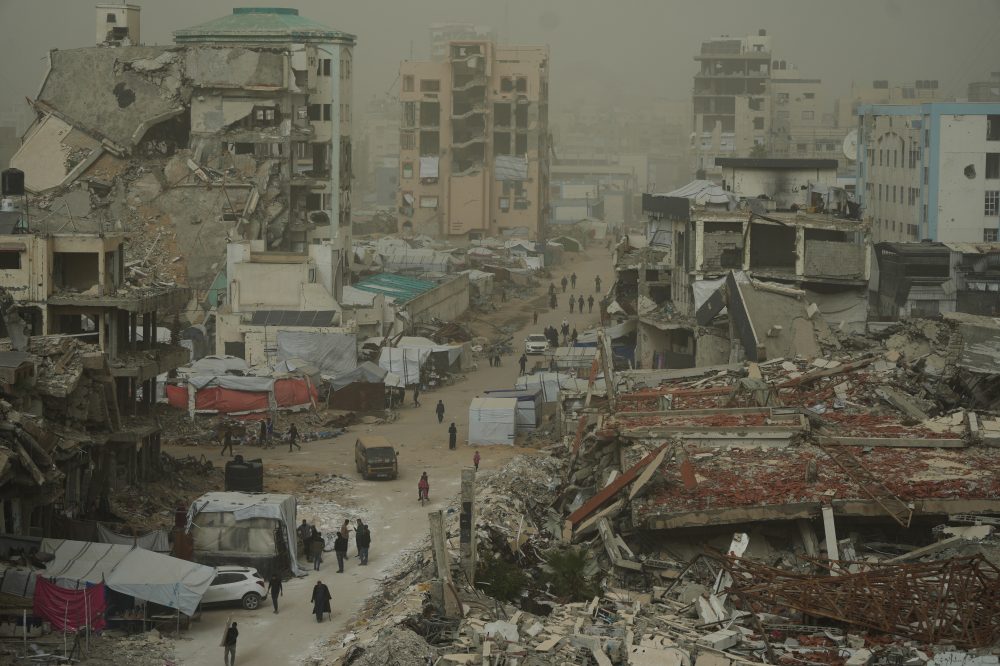

JERUSALEM — President Donald Trump’s newly established Board of Peace will convene for its inaugural session Thursday in Washington, marking an initial challenge for one of his signature foreign policy programs as it attempts to strengthen the fragile Gaza ceasefire agreement.
The president’s expansive vision for this board ranges from overseeing Gaza’s reconstruction into a modern metropolis to competing with the United Nations Security Council in international conflict resolution. However, these grand plans may face harsh realities given the limited headway made in achieving even basic ceasefire objectives in Gaza.
Deadly incidents continue almost daily, with Israel conducting strikes it claims target militants who pose threats to or attack Israeli troops, resulting in Palestinian casualties including non-combatants. The militant group Hamas remains armed, international peacekeeping forces have yet to arrive, and a Palestinian administrative committee intended to replace Hamas leadership remains stranded in Egypt.
“If this meeting does not result in fast, tangible improvements on the ground — and particularly on the humanitarian front — its credibility will quickly crumble,” said Max Rodenbeck, Israel-Palestine Project Director at the International Crisis Group, a global think tank.
Over two dozen countries have joined as charter members of the board.
The membership roster features Israel and other regional powers involved in ceasefire discussions, along with nations from beyond the Middle East whose leadership either backs Trump or seeks his approval. Notable U.S. partners including France, Norway and Sweden have chosen not to participate.
Israeli officials express concern about Qatar and Turkey’s participation, given their established relationships with Hamas. Palestinian leaders oppose the arrangement because no Palestinian representatives received invitations to join the board, despite its authority over territory housing approximately 2 million Palestinians.
Trump, who has designated himself as the board’s chairman, announced earlier this week that member nations had promised $5 billion for Gaza reconstruction and would provide thousands of personnel for peacekeeping and law enforcement duties. Neither financial commitments nor this week’s meeting agenda have been disclosed publicly.
“We want to make it successful. I think it has the chance to be the most consequential board ever assembled of any kind,” Trump told reporters on Monday. He repeated his disapproval of the U.N.’s track record in settling international conflicts.
Trump — working alongside son-in-law Jared Kushner and envoy Steve Witkoff — has outlined bold reconstruction plans for Gaza using international investment.
During a Davos presentation last month, Kushner proposed completing reconstruction within three years, despite U.N. projections indicating that debris removal and mine clearance alone could require significantly more time.
Kushner’s presentation depicted a rebuilt Gaza featuring beachfront tourism areas, manufacturing districts and technology centers. He acknowledged that reconstruction would only start in weapons-free zones and that security would be crucial for attracting investors.
Current joint calculations by the U.N., European Union and World Bank estimate reconstruction costs at approximately $70 billion.
Israeli Prime Minister Benjamin Netanyahu has declared that reconstruction cannot proceed until Hamas surrenders its weapons, creating uncertainty for Palestinians amid widespread destruction.
The ceasefire agreement has stopped large-scale military campaigns, secured the release of remaining hostages held by Hamas and increased humanitarian aid shipments to Gaza. However, a permanent end to the conflict that began with Hamas’ October 7, 2023 assault on Israel remains uncertain.
The agreement envisions Hamas surrendering its arsenal and Israeli forces leaving Gaza while international troops arrive. It left certain questions unresolved and established no timeline, essentially postponing difficult decisions to avoid immediate confrontation.
Israel and the U.S. consider Hamas’ weapon surrender essential for progress in other areas. Arab and Muslim Board of Peace members have criticized Israel for weakening the ceasefire through daily military actions and want the U.S. to restrain its ally. While they have urged Hamas to disarm, they emphasize that Israeli withdrawal is equally crucial.
Israel’s definition of demilitarization encompasses everything from heavy weaponry like rocket launchers down to standard rifles. Netanyahu stated Sunday that Hamas must surrender approximately 60,000 automatic weapons.
Although Hamas accepted the ceasefire terms, the group has only made unclear or conditional promises regarding disarmament as part of a process toward Palestinian statehood. Senior Hamas leaders have indicated their security personnel must keep some weapons to maintain order during the transition period.
Potential solutions being considered include Hamas “securing” weapons in monitored storage facilities under external oversight or surrendering heavy arms while retaining some handguns for police work, according to two regional officials familiar with the talks. One official noted that disarmament represents a complex process potentially lasting months. The officials spoke anonymously due to the sensitive nature of negotiations.
Whether Israel or the United States would accept such arrangements remains highly uncertain.
The ceasefire terms also establish a temporary International Stabilization Force composed of troops from Arab and Muslim-majority nations to screen, train and assist a new Palestinian police organization. While its specific duties aren’t fully detailed, responsibilities would include protecting aid deliveries and preventing arms trafficking.
Nations asked to contribute troops demand that any deployment be characterized as peacekeeping. They have rejected involvement in Hamas disarmament, viewing it as potentially dangerous work. Another worry involves the presence of Israeli-allied armed groups.
Indonesia has started preparing up to 8,000 soldiers for the force, though its foreign minister stated last week they would not participate in disarmament operations.
According to the ceasefire terms, Hamas must transfer authority to a transitional committee of politically neutral Palestinian officials. The U.S. has selected a 15-person committee and appointed former U.N. envoy Nickolay Mladenov to supervise them as the board’s Gaza representative.
The committee, headed by former Palestinian Authority deputy minister Ali Shaath, has not yet received Israeli authorization to enter Gaza from Egypt. Israeli officials have not addressed the situation.
Mladenov stated last week that the committee cannot function unless Hamas relinquishes control and ceasefire violations end.
“We’re only embarrassing the committee and ultimately making it ineffective,” he said at the Munich Security Conference. “All of this needs to move very fast.”