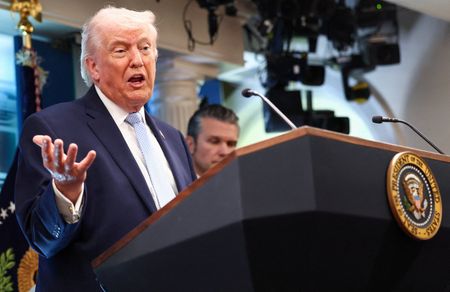

WASHINGTON – President Donald Trump’s warning that he would obliterate Iran unless the nation met his conditions has triggered widespread condemnation internationally and created anxiety among some Republican supporters, while White House officials maintain the harsh language represents a strategic bargaining approach to pressure Tehran into submission.
“A whole civilization will die tonight, never to be brought back again. I don’t want that to happen, but it probably will,” Trump posted on social media early Tuesday morning, before his 8 p.m. Eastern Time ultimatum for Iran to reach an agreement with the United States.
At 6:32 p.m. Eastern Time, the president announced he had reached a two-week ceasefire agreement with Iran.
However, Trump’s warning had already generated severe criticism worldwide. Congressional Democrats labeled the president “completely unhinged,” while Iran’s United Nations representative described Trump’s threat as “deeply irresponsible” and “profoundly alarming.” Pope Leo declared that threats targeting Iran’s population are “unacceptable.”
Several Republicans, including former Representative and previous Trump supporter Marjorie Taylor Greene, publicly voiced their concerns, although many others supported his strategy.
“It’s about time we had a President willing to defend Americans,” the Senate Republican Conference posted on social media.
Two White House officials, speaking anonymously about internal discussions, indicated that Trump’s inflammatory language was viewed primarily as a negotiation strategy rather than a genuine plan to destroy Iran or deploy nuclear weapons.
“He’s creating leverage through unpredictability,” one official explained. “He wants Tehran to blink.”
The official revealed that multiple White House staff members helped develop Tuesday morning’s social media message, though the civilization-ending language originated from Trump personally.
Trump has insisted that Iran must reopen the Strait of Hormuz, a vital international shipping corridor that Iran blocked following U.S.-Israeli military actions, and cease supporting militant groups across the Middle East. Without Iranian cooperation, Trump has threatened that American forces would target Iran’s infrastructure including bridges and power facilities.
A second White House official acknowledged some internal concern regarding the high-pressure deadline. Both officials indicated the president might actually follow through on threats against Iranian bridges and power plants, which international law experts and world leaders have criticized as potentially illegal attacks on primarily civilian infrastructure.
“As President Trump has said, Iran can never have a nuclear weapon, and the Iranian people welcome the sound of bombs because it means their oppressors are losing,” White House spokesperson Anna Kelly stated. “Greater destruction can be avoided if the regime understands the seriousness of this moment and makes a deal with the United States.”
In his Tuesday evening announcement, Trump specified that the ceasefire agreement depends on Iran’s commitment to suspend its oil and gas supply blockade through the strait.
Senate Democratic leadership issued a Tuesday statement calling it “unconscionable” for the president to threaten Iranian civilization’s end, arguing such threats “makes Americans less safe, further destabilizes our nation and economy, and puts at greater risk U.S. service members.”
Trump originally characterized the conflict as a “short-term excursion” designed to quickly address American concerns, emphasizing preventing Iran from acquiring nuclear weapons as a primary objective. Recently, he has alternated between claiming the war is “ahead of schedule” and “we won” while simultaneously promising he will continue until Iran faces “decisive defeat.”
His rhetoric has become progressively more hostile, reflecting what aides described as his intention to conclude the unpopular conflict and reopen the Strait of Hormuz during a period of increasing fuel costs, economic uncertainty, and questions about Republican congressional control in November elections.
Another White House insider reported “substantial support” within the administration for the president’s messaging approach.
“Staffers are definitely cheering him on,” the source said.
Trump’s civilization threat has generated resistance from within his own party.
Senator Lisa Murkowski of Alaska, a regular Trump critic despite her Republican affiliation, posted on social media that Trump and Iran “must de-escalate their unprecedented saber-rattling before it is too late.”
Some prominent media figures influential with the president’s supporters, including conservative commentator Tucker Carlson, have criticized Trump’s rhetoric.
Carlson on Monday described the president’s Iran statements, including a profanity-laden Easter threat, as “vile” on “every level.”
Greene, a Georgia Republican who previously ranked among Trump’s strongest advocates, suggested potentially using the 25th Amendment to the Constitution. This amendment permits the vice president and cabinet members to attempt declaring a president incapable of fulfilling official duties.
This constitutional provision has never been implemented and would require congressional majorities, an improbable outcome with Republicans controlling both chambers.
“Not a single bomb has dropped on America. We cannot kill an entire civilization,” Greene posted on social media, adding, “This is evil and madness.”