
WASHINGTON — President Donald Trump has shattered long-standing diplomatic norms by actively campaigning for foreign political candidates, wielding his influence in ways unprecedented for an American president.
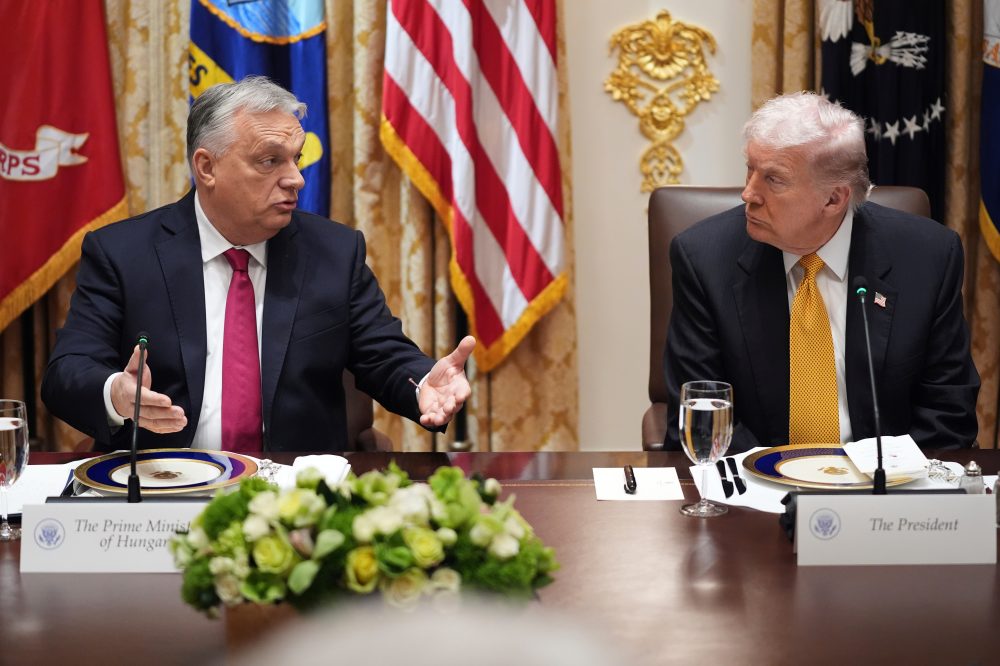
From supporting Hungary’s far-right leader Viktor Orbán with social media posts and high-profile visits, to threatening Argentina with the loss of $20 billion in financial aid if elections didn’t favor his preferred candidate, Trump has transformed foreign policy into a personal political tool.
In Honduras, the president endorsed a conservative mayoral candidate while pardoning a politician from the same party just as citizens prepared to cast their ballots.
Trump’s second-term approach represents a dramatic departure from traditional American diplomacy, where presidents typically avoided direct interference in other nations’ democratic processes. Critics argue this strategy prioritizes political loyalty over genuine U.S. national interests.
“The impact of that is to really cheapen a relationship,” explained David Pressman, who served as U.S. ambassador to Hungary under the Biden administration. Pressman witnessed Orbán’s public support for Trump in 2024 and noted that Hungarian foreign policy positions seemed “infused through a political U.S. rubric” rather than representing independent sovereign decisions.
The ultimate measure of Trump’s international political influence arrives this Sunday when Hungarian voters decide whether to grant Orbán a fifth consecutive term. Orbán became the first European leader to endorse Trump in 2016 and maintained their alliance even during Trump’s time out of office, visiting him in Florida and backing his 2024 presidential campaign.
“I love Hungary and I love that Viktor,” Trump declared this week while Vice President JD Vance put him on speakerphone during a Budapest rally attended by over 1,000 Orbán supporters.
The president has embraced his role as an international kingmaker, extending the influence he wields within the Republican Party to global politics.
“I love it when I give endorsements and people win,” Trump told Latin American leaders he had supported during a recent summit.
Trump typically endorses candidates who share his policy positions, including immigration hardliners like Orbán and Japanese Prime Minister Sanae Takaichi, or Argentina’s Javier Milei, who famously wielded a chainsaw to symbolize his commitment to cutting government spending.
The Conservative Political Action Conference has become a regular platform for promoting Trump’s international political allies.
At last year’s CPAC event in Warsaw, then-Homeland Security Secretary Kristi Noem encouraged Polish voters to support conservative candidate Karol Nawrocki, suggesting America’s military presence in Poland could depend on the election results. Nawrocki ultimately won.
During last month’s CPAC gathering in Hungary, Trump addressed attendees via video from the Oval Office, urging support for Orbán.
“The prime minister has been a strong leader who’s shown the entire world what’s possible when you defend your borders, your culture, your heritage, your sovereignty and your values,” Trump stated. “I hope he wins, and I hope he wins big.”
White House spokesperson Anna Kelly defended the president’s strategy as transparent leadership.
“President Trump is a great American statesman who will speak or work with anyone, and he makes no secret about those he likes or supports,” Kelly said. “Many individuals who align with President Trump’s ideology are getting elected to top offices around the world because everyone wants to replicate his immeasurable success on behalf of the American people.”
No foreign leader has received more Trump administration support than Orbán. The president has published multiple Truth Social posts promoting the Hungarian prime minister, whose authoritarian governing style and unwavering loyalty during Trump’s political exile have earned presidential favor.
“Hungary: GET OUT AND VOTE FOR VIKTOR ORBÁN,” Trump posted Thursday evening. Friday brought promises that his administration “stands ready to use the full Economic Might of the United States” to assist Hungary’s economy if needed.
Secretary of State Marco Rubio previously expressed concerns about “democratic erosion” under Orbán while serving in the Senate. Despite these past reservations, Rubio endorsed the Hungarian leader in February, highlighting the “very, very close personal relationship and working relationship” between Trump and Orbán.
During Vance’s Budapest visit this week, he explicitly endorsed Orbán while simultaneously criticizing European Union interference in foreign elections.
“Of course we’re going to work with whoever wins the Hungarian election because we love the people of Hungary and it’s an important relationship,” Vance told reporters. “But Viktor Orbán is going to win the next election in Hungary, so I feel very confident about that and about our continued positive relationship.”
However, independent polling shows Orbán trailing before Sunday’s election, and Trump’s unpopularity across Europe—stemming from his Greenland acquisition efforts and Iran military actions—may limit his influence.
While previous administrations have influenced foreign governments through covert operations, such as the CIA’s role in Guatemala’s 1954 coup under President Eisenhower, Trump’s open political engagement abroad remains unprecedented.
Former President Clinton’s support for Russian President Boris Yeltsin’s 1993 parliamentary dissolution represents one of the few historical examples of explicit presidential endorsement of foreign political actions.
James Lindsay, a distinguished senior fellow at the Council on Foreign Relations, emphasized Trump’s unique approach.
“Trump is just different than other presidents, and he’s viewed differently than other presidents, and that is a strength you can take advantage of,” Lindsay observed.
Senator Tim Kaine of Virginia connects Trump’s election interference to what the administration calls the “Trump Corollary” to the Monroe Doctrine, outlined in December’s national security strategy. The original 1823 Monroe Doctrine has historically justified U.S. military interventions throughout Latin America.
Kaine, who worked as a missionary in Honduras during extensive covert American involvement in the region, condemned the doctrine as “poison language.”
“It’s violating best practice,” he said. “America has been deeply involved in regime support, opposition and regime change in the Americas for centuries, and it is not a legacy that we should be proud of.”
Trump’s foreign endorsements often extend beyond mere political support.
In October, the president explicitly threatened to withdraw assistance from Argentina if Milei’s coalition failed in legislative elections. This ultimatum came shortly after finalizing a $20 billion currency swap agreement that had drawn criticism from American farmers and Democratic legislators.
“If he loses, we are not going to be generous with Argentina. OK?” Trump told reporters while hosting Milei at the White House.
During Honduras’s recent elections, Trump not only endorsed Nasry Asfura but warned that “the United States will not be throwing good money after bad” if his preferred candidate lost. Both Milei and Asfura won their respective races.
Trump also pardoned former Honduran President Juan Orlando Hernandez, who faced U.S. drug trafficking and weapons convictions.
“This cannot be allowed to happen, especially now, after Tito Asfura wins the Election, when Honduras will be on its way to Great Political and Financial Success,” Trump wrote on social media.
The president has repeatedly suggested pardoning Israeli Prime Minister Benjamin Netanyahu, both in formal correspondence and during an address to Israel’s parliament. Netanyahu faces corruption charges including fraud, breach of trust, and bribery allegations, with a challenging reelection campaign expected this year.
Vance’s recent speech at the Munich Security Conference created diplomatic tensions with Germany when he criticized mainstream German parties for refusing to collaborate with far-right political groups.
German Chancellor Friedrich Merz responded that it was inappropriate for American leadership to “say something like that to us in Germany.”
“I wouldn’t do it in America, either,” Merz added.