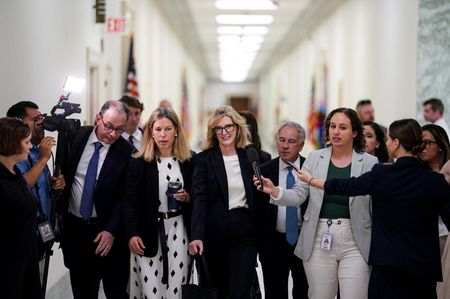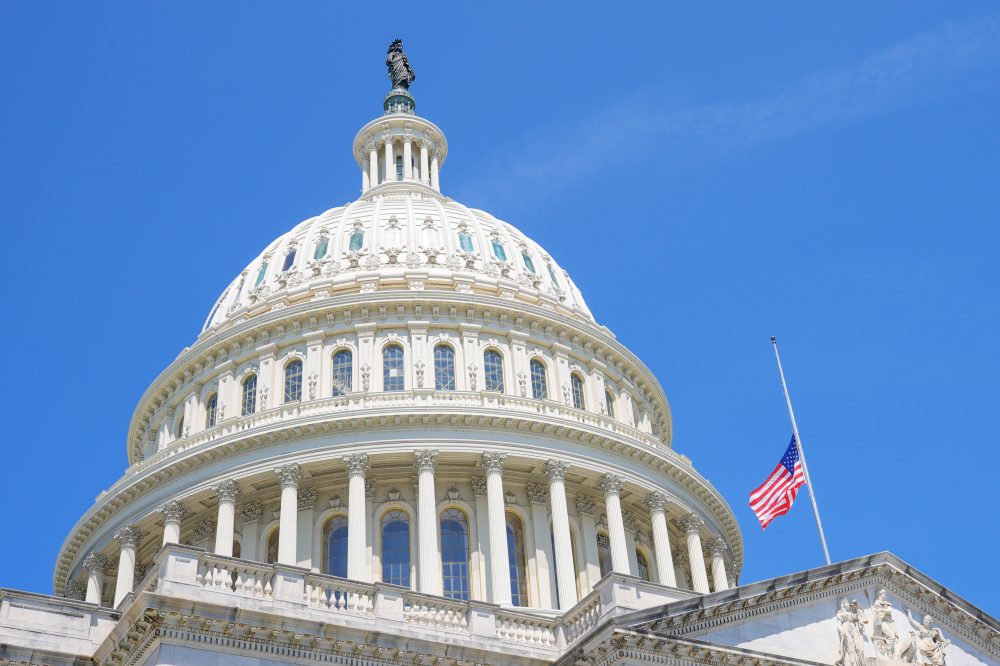

The leadership struggles at the nation’s top public health agency reached another crossroads Wednesday, when a U.S. Senate committee took up the nomination of Dr. Erica Schwartz to head the Centers for Disease Control and Prevention.
Schwartz, 54, is being considered to lead the Atlanta-based CDC, the federal agency responsible for shielding Americans from preventable health dangers.
Much of her professional career was spent in the military, including a leadership role with the U.S. Coast Guard, where she managed a network of 41 clinics and 150 sick bays and helped shape vaccination policies for service members. She later served as deputy surgeon general, where she helped guide uniformed medical professionals working at the CDC and other federal health agencies serving the broader public.
The CDC was once regarded as a gold standard in global public health, but the agency has been in disarray since President Trump returned to the White House last year. More than 3,000 employees — representing over a quarter of the agency’s total workforce — have departed through layoffs and resignations. A string of mostly temporary directors has cycled through the top job, with many political appointees filling key roles despite limited backgrounds in medicine or public health.
“There’s still really good people who work there (at the CDC). They are doing their best to navigate choppy waters,” said Dr. David Margolius, who leads Cleveland’s health department and serves as a leader in a national coalition of big-city health departments. He added that the CDC no longer appears to be the authoritative, communicative force it once was during disease outbreaks and other public health crises.
“Basically everybody’s got to kind of choose their own adventure, as opposed to being led by a national public health department,” Margolius said.
The CDC falls under the oversight of Health Secretary Robert F. Kennedy Jr., who was a prominent figure in the anti-vaccine movement before being chosen to lead the CDC and other federal health agencies. Kennedy had pledged not to alter the country’s vaccination schedule, but shortly after taking office he announced plans to examine the childhood vaccine schedule and later attempted significant changes to vaccine recommendations for children. A federal judge earlier this year put some of those efforts on hold.
The administration’s original choice to run the CDC was former Florida congressman Dr. David Weldon, but his Senate confirmation hearing in March 2025 was called off about an hour before it was set to start. Weldon said he was told at the time that there weren’t enough senators willing to vote in his favor.
The White House then turned to Susan Monarez, who had been serving as acting CDC director. Monarez was confirmed by the Senate but was removed from the position in under a month. Administration officials said she was not in step with their agenda.
Several senior CDC scientific leaders resigned in response, saying Monarez’s removal had crushed their hopes that a confirmed director could protect the agency’s scientific work from political interference.
Following her departure, the acting director role has been handed from one Washington-based official at the Department of Health and Human Services to another. Most recently, National Institutes of Health Director Jay Bhattacharya has been overseeing the CDC.
Trump nominated Schwartz in April, describing her as “incredibly talented.” At a congressional hearing that same month, Kennedy said he supported the pick but declined to commit to backing whatever vaccine guidance Schwartz might eventually put forward.
Last month, Schwartz submitted financial disclosure letters to the government. She indicated that if confirmed, she would leave her current position at UnitedHealth Group, where she earns roughly $850,000 in salary and bonuses, and would cash out her stock options. She also said she would step down from the board of directors of Butterfly Network Inc., a Massachusetts-based maker of ultrasound devices; from the board of Atlanta-based Aveanna Healthcare, a home medical care company; and from the board of the Florida-based Searching for Solutions Institute.
Wednesday’s hearing also included consideration of Sean Kaufman’s nomination to serve as Assistant Secretary for Preparedness and Response, a position that oversees the country’s readiness for and response to public health emergencies and disasters.
Last year, the Trump administration announced plans to fold those responsibilities into the CDC, but that major restructuring of the Department of Health and Human Services has not taken place.
The assistant secretary’s office plays a role in decisions about funding for next-generation vaccines targeting pandemic flu and other infectious disease threats. In LinkedIn posts, Kaufman has made statements welcomed by vaccine skeptics, including arguing against hepatitis B vaccinations for newborns and noting that he served as an expert witness on behalf of people who declined the COVID-19 vaccine.