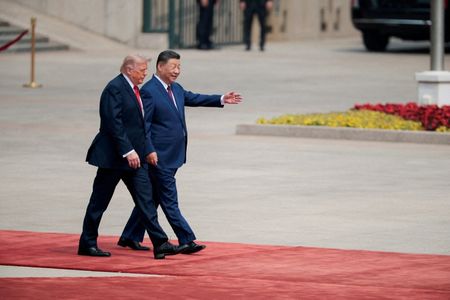

President Trump’s recent diplomatic trip to Beijing this week delivered limited achievements by typical standards for U.S.-China meetings, but analysts say it demonstrated a clear advantage for China: following last year’s intense trade conflict, both nations have returned to their customary economic and strategic deadlock.
The two-day discussions between Trump and Chinese leader Xi Jinping emphasized that even following Trump’s “Liberation Day” tariffs and the subsequent trade détente reached in late 2024, Washington and Beijing remain engaged in the same competitive struggle that Trump faced when beginning his second presidential term.
From America’s perspective, this means the most concerning elements of the bilateral relationship — including what Washington views as Beijing’s mercantilist trade practices and China’s efforts to expand military influence in the Indo-Pacific region — continue without significant resolution.
However, for Xi, the situation provides some relief and a return to more manageable challenges. He seemed to characterize this shift during the week by introducing a new framework for bilateral relations that he termed “constructive strategic stability.”
China emerged with advantages, considering the step back from the Trump administration’s aggressive trade stance from early 2025, according to Scott Kennedy, a China expert at Washington’s Center for Strategic and International Studies.
“Compared to where we were a year ago, with 145% tariffs and the U.S. really trying to push China and the rest of the world to fundamentally change, we’ve had a counterrevolution and we’re back at stability,” Kennedy said.
Trump brought some of America’s most influential business leaders to the Thursday-Friday summit, including Tesla’s Elon Musk and Nvidia’s Jensen Huang, though most had limited concrete results to demonstrate beyond attending an elaborate state dinner.
The discussions also failed to obtain any public pledge from China to assist the U.S. in ending the conflict in Iran that has disrupted international markets and affected Trump’s public approval numbers.
“The summit projected stability but it left the stalemate intact,” said Craig Singleton, a China expert at the Foundation for Defense of Democracies. It “produced modest, marketable and managed outcomes, which is about all the U.S.-China relationship can bear right now.”
When asked for response, a White House official said, “President Trump leveraged his positive relationship with President Xi of China in order to bring home deliverables for the American people,” pointing to Boeing aircraft sales and agricultural deals designed to boost American exports.
A spokesperson with the Chinese embassy in Washington described the meetings between Xi and Trump as “candid, in-depth, constructive and strategic,” noting they “explored the right way for two major countries to get along with each other.”
Through last year’s trade conflict, Trump seems to have overestimated tariffs’ ability to force China into one-sided compromises, according to policy experts. Beijing responded with retaliatory tariff increases and threatened to restrict supplies of essential minerals required by U.S. industries, creating an uncomfortable standoff.
Following that period, the White House has demonstrated reluctance to accept the economic costs that would accompany using other forms of U.S. financial and technological pressure, including sanctions targeting China’s major banking institutions.
Demonstrating the shift in approach, this week’s meetings included no public discussion of many persistent U.S. demands, including calls for China to address industrial overcapacity that trading partners claim unfairly saturates their markets with inexpensive products.
China seems satisfied with the delicate ceasefire as it manages a struggling domestic economy while working to strengthen technologies it believes will provide advantages in long-term rivalry with the U.S.
Top Trump administration officials had minimized expectations for major breakthroughs even before the meeting began, indicating no urgency to extend a trade ceasefire set to expire in five months, which the leaders negotiated following discussions in South Korea in October.
A person with knowledge of the trade discussions said China sought a longer extension of the ceasefire than the Trump administration was prepared to offer, along with guarantees regarding pending U.S. investigations likely to restore some tariffs on imports that were eliminated by the Supreme Court this year.
In general, neither country offered substantial proposals for the summit, the source informed Reuters, noting that some business agreements might be reserved for autumn, when Xi is anticipated to make a return visit to the White House.
The source asked for anonymity to discuss the negotiations openly.
The summit’s limited commercial achievements stand in contrast to Trump’s 2017 China visit, when accompanying businesses signed agreements and memorandums valued at $250 billion.
This week’s meetings produced no progress on selling Nvidia’s advanced H200 artificial intelligence chips to China, likely satisfying Republican and Democratic China critics in Washington who had cautioned the administration against supporting China’s AI advancement.
While not yet confirmed, Trump announced that Boeing had completed an agreement for China to buy 200 aircraft, significantly less than the 500 that were expected and the 300 Beijing committed to purchase during the 2017 visit.
The White House official mentioned that the U.S. had created a new Board of Trade that U.S. officials had referenced as a joint mechanism to reduce tariffs on non-sensitive products, but provided limited specifics.
Wendy Cutler, a former acting deputy U.S. Trade Representative, described the economic outcomes as “way below expectations.”
For China, though, the meetings represented positive progress toward realistic competition, according to Cui Shoujun, a professor of international affairs at Renmin University in Beijing.
The summit demonstrated that Washington and Beijing are “no longer aspiring to pull China-U.S. relations back to a cooperative golden age, but instead acknowledging the long-term nature of competition and disagreement,” he said.