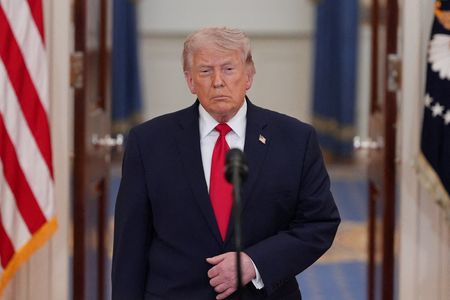

WASHINGTON — During his inaugural national television address since military operations commenced more than a month ago, President Donald Trump declared Wednesday evening that American forces would complete their mission in Iran within the coming weeks, stating that “core strategic objectives are nearing completion.”
The prime-time speech provided Trump with a platform to clarify war objectives after weeks of shifting goals and conflicting statements about whether military operations would wind down or escalate — all while Iran continued launching attacks against Israel and Persian Gulf nations amid ongoing airstrikes on Tehran.
However, much of the president’s remarks echoed previous statements from recent weeks, while indicating the United States was approaching completion of its primary military goals within an estimated two to three week timeframe. He vowed American forces would maintain intense pressure on Iran.
“For years, everyone has said that Iran cannot have nuclear weapons. But in the end, those are just words if you’re not willing to take action when the time comes,” Trump said.
The commander-in-chief stated, “In these past four weeks our armed forces have delivered swift, decisive, overwhelming victories on the battlefield” and criticized decades of previous U.S. foreign policy, declaring that former presidents “made mistakes and I am correcting them.”
“The situation has been going on for 47 years and should’ve been handled long before I arrived in office,” he said.
Trump also recognized increasing oil costs and unstable financial markets, but maintained these effects would be short-lived.
Current polling indicates many Americans believe U.S. military actions in Iran have exceeded appropriate limits — despite additional American troops deploying to the region for a potential ground campaign. Trump chose not to deliver such remarks closer to when the U.S. and Israel initially launched their offensive, raising questions about whether his message can now effectively reach the public.
Iranian missiles struck Dubai in the United Arab Emirates and Israel shortly before Trump’s televised remarks.
During an Easter lunch Wednesday afternoon, the president commented about Iran: “We could just take their oil. But you know, I’m not sure that the people in our country have the patience to do that, which is unfortunate.”
“Yeah, they want to see it end. If we stayed there, I prefer just to take the oil,” Trump said. “We could do it so easily. I would prefer that. But people in the country sort of say: ‘Just win. You’re winning so big. Just win. Come home.’ And I’m OK with that, too, because we have a lot of oil between Venezuela and our oil.”
Media representatives were barred from observing the president’s lunch remarks, though the White House initially posted video footage online before removing it. White House officials did not respond to Associated Press inquiries about the video or its removal.
In a Wednesday social media message, Trump maintained an aggressive stance, demanding Iran cease blocking the Strait of Hormuz — a crucial waterway for global oil transport — or face U.S. bombing that would send the Islamic Republic “back to the Stone Ages.” The president has also stated the U.S. “will not have anything to do with” protecting ships navigating Hormuz, seemingly retreating from earlier threats to attack Iran’s electrical infrastructure if the strait remained closed past April 6.
During the same Easter gathering, the president repeated criticisms of NATO partners for their hesitation to help secure the Strait of Hormuz while suggesting China, Japan and South Korea could assist in reopening the waterway.
“Let South Korea, you know, we only have 45,000 soldiers in harm’s way over there, right next to a nuclear force — let South Korea do it,” Trump said regarding efforts to reopen the strait. “Let Japan do it. They get 90% of their oil from the strait. Let China do it.”
In another morning social media post, Trump claimed that “Iran’s New Regime President” sought a ceasefire. The reference remained unclear since Iran maintains the same president. Iran’s Foreign Ministry spokesman, Esmail Baghaei, denounced Trump’s assertion as “false and baseless,” according to Iranian state television reports.
Speaking to Al Jazeera earlier, Iranian Foreign Minister Abbas Araghchi indicated Tehran’s determination to continue fighting. “You cannot speak to the people of Iran in the language of threats and deadlines,” he said. “We do not set any deadline for defending ourselves.”
Prior to Trump’s address, Iranian President Masoud Pezeshkian published an extensive English-language letter on his X account, appealing directly to American citizens and emphasizing that his nation had pursued diplomatic negotiations before the U.S. abandoned that approach. “Exactly which of the American people’s interests are truly being served by this war?” he wrote.
Since operations began February 28, Trump has presented varying objectives and repeatedly suggested the conflict could end quickly while simultaneously threatening to expand it. Thousands of additional U.S. military personnel are currently en route to the Middle East, generating widespread speculation about their purpose.
Trump has also threatened strikes against Iran’s Kharg Island oil export facility. Additionally, the U.S. might deploy military forces to secure Iran’s uranium reserves — a complicated and dangerous mission involving radiation and chemical hazards, according to experts and former government officials.
Further complicating matters is uncertainty about Israel’s role — which has conducted bombing campaigns alongside the U.S. — in any of these potential scenarios.
Trump faces mounting pressure to conclude the war that has driven up gasoline, food and other commodity prices. Brent crude oil, the international benchmark, has increased more than 40% since hostilities began.
The United States has presented Iran with a 15-point ceasefire proposal, including demands to reopen the strait and scale back its nuclear activities.
Iran maintains its nuclear program serves peaceful purposes. Last week, Iranian state television’s English-language service quoted an unnamed official stating Iran had its own conditions for ending hostilities, including maintaining sovereignty over the strait.
In the Al Jazeera interview, Araghchi confirmed receiving direct communications from U.S. Middle East envoy Steve Witkoff. However, he emphasized no direct negotiations were occurring and expressed zero confidence that discussions with the U.S. could produce results, stating “the trust level is at zero.”
He cautioned against any U.S. ground invasion attempt, declaring “we are waiting for them.”
In an apparent diplomatic gesture, U.S. officials have provided “clear assurances” that Araghchi and Iran’s Parliamentary Speaker Mohammad Bagher Qalibaf would not be targeted, according to three officials speaking anonymously because they lack authorization to discuss the matter publicly.