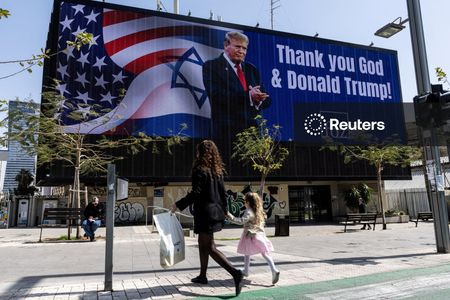

President Donald Trump has turned to religious language and biblical references to shore up support for the Iran conflict among his evangelical base, as polling shows most Americans oppose the military action, according to political and religious analysts.
The president declared a two-week ceasefire on Tuesday amid declining public backing for the war, which has led to rising fuel costs, military casualties on both sides, and damaged Trump’s approval ratings with voters.
Trump has increasingly incorporated faith-based messaging into his war rhetoric, describing the recovery of a downed American pilot in Iran as an “Easter miracle” and implying divine approval for joint U.S.-Israeli military operations. Defense Secretary Pete Hegseth has taken this approach even further, referencing biblical passages to defend the use of “overwhelming violence” against adversaries he claims “deserve no mercy.”
Conservative Christian pastors across the country have echoed this messaging, from high-profile Trump allies like Texas pastor Robert Jeffress to local clergy in small communities. Many emphasize the religious importance of Israel in their sermons, which numerous evangelicals connect to biblical prophecies about Christ’s return.
Jackson Lahmeyer, a Tulsa, Oklahoma evangelical pastor seeking a congressional seat and Trump backer, explained his approach during an interview. He has addressed his congregation on Sundays about warfare as fundamentally a conflict between righteousness and wickedness, with Iran representing the latter.
“Evil people exist, and if you don’t deal with them, they’ll deal with you,” Lahmeyer stated. “Good and evil, that’s the story of the Bible. The good news is that at the end good always wins.”
White evangelical voters represent Trump’s most loyal constituency, with over 80% supporting him in 2024 elections based on exit polling data. Surveys indicate this demographic comprises roughly one-third of his overall support network.
Political analysts say this electoral math explains why Trump and his administration are increasingly adopting religious language when discussing the conflict.
“Look at Mr. Trump’s standing in the polls and recognize he only has a little more than a third of the public on his side. A big part of that constituency is made up of white evangelical Christians,” explained Jim Guth, a Furman University political science professor who researches religion’s role in American politics.
The White House declined to comment on Trump’s use of Christian messaging, but spokesperson Taylor Rogers issued a statement saying the president had acted decisively “to eliminate the threat of this terrorist regime, which will protect the American people for generations to come.”
While American presidents have historically referenced Christian faith during wartime, scholars interviewed say the Trump administration’s explicit religious justification for violence represents something unprecedented.
“It’s the same language as the crusades of the Middle Ages. You know, we must stop the infidel, we must defeat the wicked,” said John Fea, a Messiah University history professor who has authored books about evangelicals in politics. “We’ve never seen anything like this in American history.”
The religious messaging has faced pushback from Democratic politicians and progressive Christian voices, who view it as inappropriate use of faith to support an unpopular five-week conflict that has claimed 13 American military lives and thousands of Iranian casualties.
During Palm Sunday services at St. Peter’s Square before tens of thousands of Catholics worldwide, Pope Leo condemned the fighting as “atrocious” and declared that Jesus’ name should never be used to promote warfare.
Doug Pagitt, a progressive evangelical minister, believes the administration is employing “a very specific Christian narrative” to maintain evangelical loyalty and preserve Trump’s political coalition.
“What they are saying is Trump is on God’s side. You can rest easy at night,” Pagitt observed. “Because without the Christian coalition, the MAGA support base gets very fractured.”
A recent Reuters/Ipsos survey found 60% of Americans disapprove of military strikes against Iran, revealing sharp partisan divisions with 74% of Republicans supporting the war compared to just 22% of Democrats.
Prominent evangelist Franklin Graham has endorsed the Iranian strikes using biblical language and compared Trump to Queen Esther from scripture, a Jewish ruler who the Bible says God positioned to rescue her people from destruction in ancient Persia, the region now known as Iran.
Ken Peters, who leads the Patriot Church in Tennessee, shared this message with his congregation last Sunday, expressing hopes the war would create “a pro-Israel, pro-America Iran” — remarks that generated applause from attendees, according to video footage the pro-Trump minister provided.
“We see Trump as a man of the world that God is using to help us,” Peters said in an interview, adding his support for casting the conflict in religious terms.
Hegseth has been particularly vocal in using faith-based language about the war. Last Sunday, he compared the rescued American airman’s return to Jesus Christ’s resurrection on Easter.
“A pilot reborn, all home and accounted for, a nation rejoicing,” Hegseth declared. “God is good.”
Pentagon spokesperson Kingsley Wilson defended the approach, noting that wartime leaders have long invoked Christianity, citing former President Franklin D. Roosevelt’s distribution of Bibles to World War Two soldiers.
“Secretary Hegseth, along with millions of Americans, is a proud Christian. Encouraging the American people to pray for our troops is not controversial,” Wilson stated.
Religious leaders close to Trump used similar language during a White House Easter gathering last week. Televangelist Paula White-Cain, a senior adviser to the White House Faith Office, drew parallels between Trump and Jesus, saying both were “betrayed and arrested and falsely accused.”
Jeffress, the First Baptist Church pastor from Texas who participated in laying hands on Trump during the meeting, told reporters he doesn’t view the Iran war as targeting Islam or Muslims, but rather “a spiritual war between good and evil, between the kingdom of God and the kingdom of Satan.”