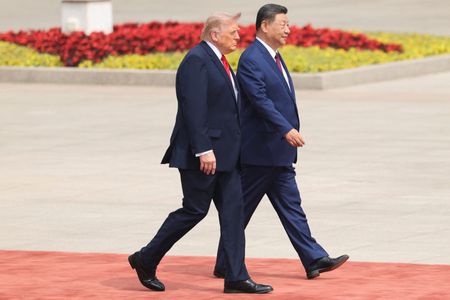

President Trump arrived in Beijing Thursday seeking Chinese assistance to resolve the ongoing conflict with Iran, as diplomatic efforts to end the war remain at a standstill and global economic impacts continue mounting.
The Iran conflict is dominating Trump’s discussions with Chinese President Xi Jinping during his first presidential visit to China since 2017, though experts doubt he will receive the backing he’s seeking from Beijing.
More than a month has passed since a fragile ceasefire was implemented, yet diplomatic initiatives have failed to advance toward ending a conflict that has claimed thousands of lives, altered Middle Eastern partnerships, and increased prices for oil and other essential commodities worldwide.
The United States is demanding that Tehran abandon its nuclear program and release its grip on the Strait of Hormuz, a critical shipping route that handled approximately 20% of global oil and liquefied natural gas transport before hostilities commenced on February 28.
Tehran is seeking war damage payments, an end to the American blockade of Iranian ports, and cessation of combat on all battlefronts, including Lebanon where Israel is fighting Iran-supported Hezbollah. Trump has called Tehran’s demands “garbage.”
Trump’s China trip, taking place while Beijing maintains strong relations with Tehran and purchases significant amounts of Iranian oil, occurs as the war drives up domestic inflation and creates political risks for Trump’s Republican Party ahead of November’s midterm elections.
America hopes to persuade China “to play a more active role in getting Iran to walk away from what they’re doing now and trying to do now in the Persian Gulf,” Secretary of State Marco Rubio stated on Fox News’ “Hannity” program in footage released Wednesday.
“We’ve made clear to them that any support for Iran would obviously be detrimental for our relationship. That obviously is going to come up in this conversation on trade,” Rubio added during the Air Force One interview while traveling to China.
The administration announced Tuesday that senior American and Chinese officials agreed last month that no nation should impose fees on regional traffic, as Iran has threatened. China has not challenged this statement.
Ship-tracking information revealed Wednesday that a Chinese supertanker loaded with 2 million barrels of Iraqi crude passed through the Strait of Hormuz, representing the third confirmed Chinese oil tanker transit since the war started.
Additional nations are considering shipping agreements similar to Tehran’s arrangements with Iraq and Pakistan, sources indicated, potentially solidifying Tehran’s dominance over the waterway that typically carries fertilizers, petrochemicals, and other bulk materials essential to global supply networks.
Tracking data from LSEG showed Thursday that a Panama-flagged crude oil tanker operated by Japanese refining company Eneos has navigated the Strait of Hormuz, marking the second known Japan-connected vessel to cross the strait.
Japan depended on the Gulf region for roughly 95% of its oil imports before the conflict began.
Wednesday reports demonstrated how the Iran war has accelerated political realignment throughout the region.
Israel announced that Prime Minister Benjamin Netanyahu made a secret March journey to the UAE for discussions with Sheikh Mohammed bin Zayed, which Israel described as producing a “historic breakthrough” in bilateral relations.
The nations restored diplomatic ties in 2020 through the Trump-supported Abraham Accords, and their partnership has grown stronger since the UAE faced Iranian attacks.
However, the UAE’s foreign ministry rejected claims about the visit, stating “any claims regarding unannounced visits or undisclosed arrangements are entirely unfounded.”
Iran, which has targeted the UAE more heavily than other Gulf states in response to American-Israeli strikes, cautioned the Emiratis against becoming adversaries.
“Enmity with the Great People of Iran is a foolish gamble. Collusion with Israel in doing so: unforgivable. Those colluding with Israel to sow division will be held to account,” Foreign Minister Abbas Araqchi posted on X.
Reuters also reported that Saudi military aircraft attacked Iran-backed militias in Iraq, part of a wider pattern of Gulf nation military responses during the war that have stayed concealed. Sources said retaliatory attacks were also conducted from Kuwait into Iraq.
Vice President JD Vance said Wednesday he believes advancement is occurring in talks to conclude the war.
“The fundamental question is, do we make enough progress that we satisfy the president’s red line?” Vance told White House reporters. “And the red line is very simple. He needs to feel confident that we put a number of protections in place such that Iran will never have a nuclear weapon.”
Iran denies pursuing nuclear weapons.