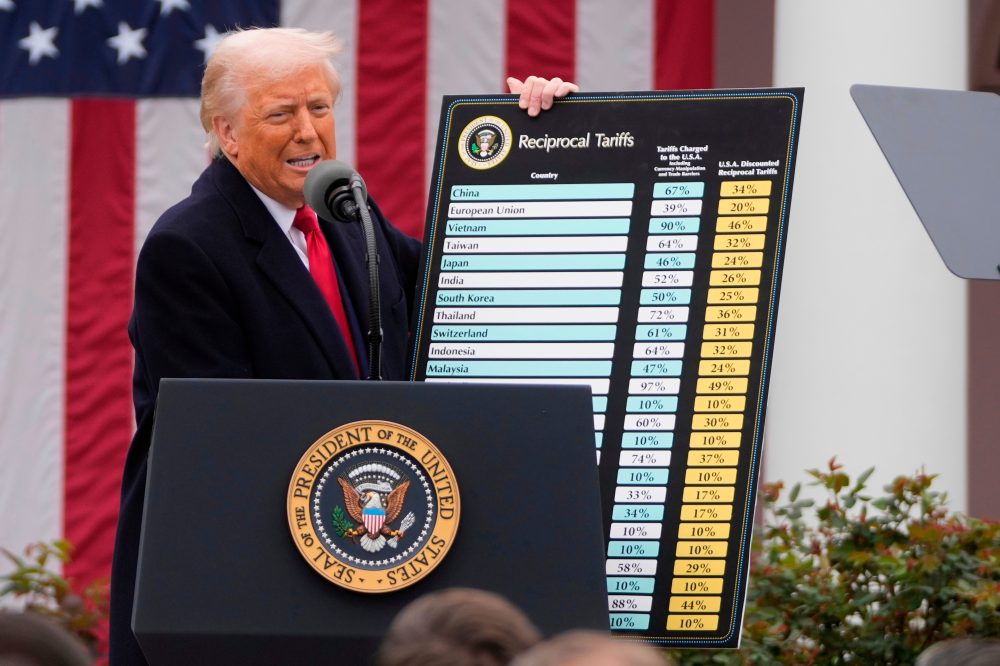

WASHINGTON — President Donald Trump is pressing ahead with a new wave of double-digit import taxes on dozens of U.S. trading partners, timed to kick in just as his temporary stopgap tariffs run out Friday.
Starting at 12:01 a.m. Friday, the United States will impose taxes ranging from 10% to 12.5% on goods coming in from 60 countries that together account for 99% of all U.S. imports. The administration says those nations have not done enough to stop products made through forced labor from entering global markets.
U.S. Trade Representative Jamieson Greer defended the move, stating: “The United States has had a forced labor import ban for nearly a century, and rigorously enforces it; it’s well past time for our trading partners to do the same. Today’s action will begin to correct what is both a human rights abuse and distortive trade practice to improve the welfare of workers everywhere.”
The timing is no coincidence. These new tariffs are designed to replace temporary 10% worldwide tariffs that expire Friday — levies Trump had put in place after the Supreme Court struck down his broader tariff plan in February. That earlier effort had used the 1977 International Emergency Economic Powers Act to impose tariffs on nearly every country, but the Court ruled that law did not give the president authority to do so. That ruling forced the administration to issue refunds to importers who had already paid those tariffs.
The new tariffs are built on firmer legal ground — Section 301 of the Trade Act of 1974, which allows the president to impose import taxes on countries found to engage in trade practices deemed “unjustifiable,” “unreasonable,” or “discriminatory.” Trump used the same legal authority to impose large tariffs on China during his first term, and those tariffs held up in court.
More Section 301 tariffs could be coming. The U.S. Trade Representative’s office has opened a separate investigation into whether 16 countries — representing 70% of U.S. imports — have flooded global markets with overproduced goods, undercutting American businesses. That probe has not yet been completed.
A senior administration official, speaking anonymously, said some countries have already strengthened their forced labor enforcement since the tariffs were first proposed last month, earning them lower rates. For instance, India’s tariff was originally set at 12.5% but has since been reduced to 10%.
Certain products are carved out from the new tariffs, including oil, natural gas, and fertilizer. Goods that qualify for duty-free treatment under the US-Mexico-Canada Agreement — the North American trade deal Trump negotiated during his first term — are also exempt.
It’s worth noting that tariffs are not paid by foreign governments — they are paid by American companies that import goods. Those businesses typically pass the added cost on to consumers through higher prices. With many Americans already feeling the pinch of rising costs, the administration is taking a political risk by introducing new tariffs ahead of the November 3 midterm elections.
Human rights advocates have mixed views. While some are skeptical of the administration’s true motivations, many agree the tariffs could put real pressure on the problem of forced labor globally.
The International Labor Organization defines forced labor as “all work or service which is exacted from any person under the menace of any penalty and for which the said person has not offered himself (or herself) voluntarily.” According to the ILO — a United Nations agency focused on labor and human rights — approximately 27.6 million people worldwide were trapped in forced labor on any given day in 2021.
Martina Vandenberg, founder and president of The Human Trafficking Legal Center, said her organization has long supported import bans as a tool against forced labor. “We’ve gone on record for years now advocating for import bans, not as a magic bullet, it’s not a silver bullet, but as a potentially effective tool in combating forced labor across the globe,” she said.
Vandenberg acknowledged that broad tariff criticism is valid, but added: “It’s possible to be extremely critical of tariffs, as we are, and to be very concerned about blanket tariffs used as bludgeons against countries. And yet I think it’s undeniable that there is a significant response in terms of the adoption of import bans.”
Still, she urged a phased approach to give countries time to build real enforcement systems. “Our concern is that the import bans will be thin slips of paper with no enforcement,” she said. “Countries need time to build import ban mechanisms that are meaningful and enforceable.”
Kenya Davis, a partner at Boies Schiller Flexner, pointed to the Uyghur Forced Labor Prevention Act — a 2021 federal law banning imports from China’s Xinjiang region — as the most significant forced labor legislation passed before these tariffs. “The level of effectiveness is certainly up for debate, but it certainly has drawn attention to the issue of labor trafficking and forced labor,” she said. “And so, if nothing else, these import bans will serve that function of bringing greater awareness to forced labor.”
Without a comprehensive approach that includes transparency and support for countries building enforcement programs, Davis said she remains cautious. “I’m very cautious in my enthusiasm about the (tariffs),” she said.
Isabelle Glimcher, senior research scientist for global labor at the NYU Stern Center for Human Rights, noted one structural flaw: the tariffs are based on what countries import, not what they produce domestically. Even so, she said the looming threat of tariffs has already prompted several nations — including India — to update their trade policies to include forced labor import bans. She also noted that European Union forced labor regulations set to take effect next year are adding additional pressure.
“Not all of these things are necessarily or wholly attributable to the Section 301 investigations, but does seem like countries are responding and starting to take all of this seriously,” Glimcher said.