
MUNSTER, Germany — For the second time in recent years, President Donald Trump has suggested the United States might withdraw its military forces from Germany, one of America’s most important NATO partners and Europe’s economic powerhouse. European officials say they’ve heard similar warnings before.
The president’s Wednesday social media message came after German Chancellor Friedrich Merz criticized the U.S., saying Tehran was “humiliating” America through slow diplomatic progress regarding the ongoing U.S.-Israel conflict with Iran.
This isn’t the first time Trump has floated the idea of pulling American troops from German soil, and he has recently criticized NATO allies for not supporting the U.S. in its two-month military engagement.
NATO partners have been anticipating potential troop withdrawals since the Trump administration took office, with warnings that European nations would need to handle their own defense responsibilities, including protecting Ukraine.
Currently, between 80,000 and 100,000 American military personnel are typically deployed across Europe, with numbers fluctuating based on training exercises, operations, and troop rotations. NATO officials expect that forces deployed following Russia’s 2022 invasion of Ukraine would likely be withdrawn first.
Germany houses multiple crucial U.S. military installations, including European and Africa command headquarters, Ramstein Air Base, and the Landstuhl medical facility that treats wounded American service members from conflicts in regions like Afghanistan and Iraq. The country also hosts U.S. nuclear weapons.
Ed Arnold, a European security specialist at London’s Royal United Services Institute, believes America benefits significantly from its German military presence through logistics support and coordination for Middle Eastern operations, making a complete withdrawal unlikely.
Arnold characterized Trump’s latest statement as probable “bluster.”
“There is a difference between the military view and the political view,” Arnold said. “The issue with some of these threats is that they are not quite as galling as they were a couple of years ago.”
Neither NATO leadership nor German officials provided immediate responses to the president’s comments.
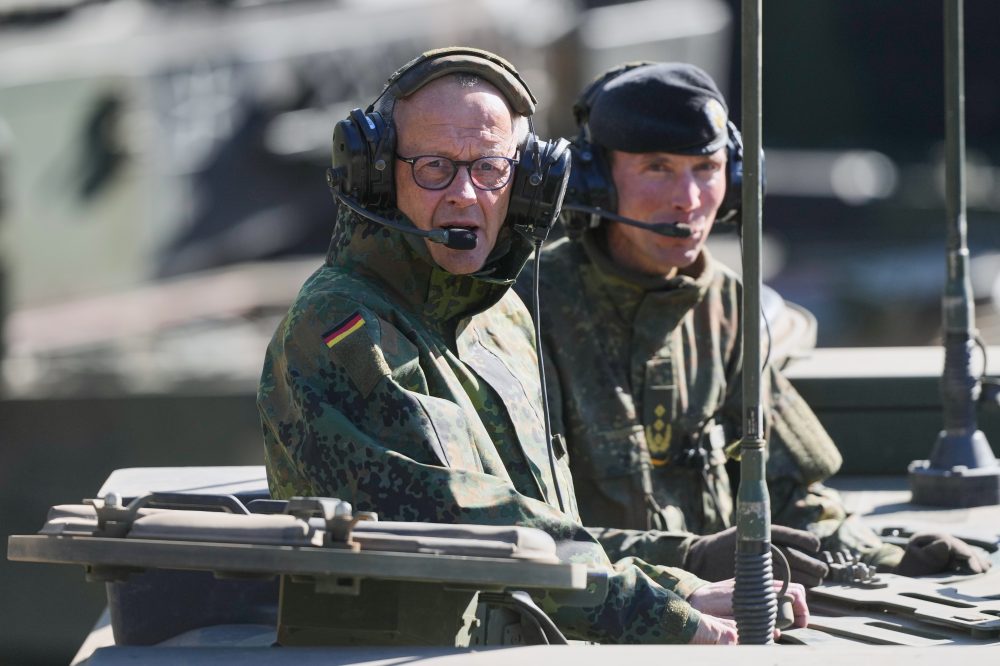
While visiting military personnel at a training facility in northern Germany’s Munster on Thursday, Chancellor Merz avoided directly addressing Trump’s remarks but referenced working “shoulder to shoulder for mutual benefit and in deep trans-Atlantic solidarity.” He emphasized his administration’s efforts over the past year to “strengthen Germany’s security.”
According to Arnold, European leaders are more worried about practical concerns like the U.S. moving Patriot missile systems and ammunition from Germany to Middle Eastern operations, plus notifications to countries like Estonia about delays in American weapons deliveries due to U.S. government priorities.
A high-ranking Western official told The Associated Press they weren’t aware of any ongoing discussions between the U.S. and Germany or other allies about potential German troop reductions.
The official, speaking anonymously about sensitive diplomatic matters, pointed out that Europe and Germany are assuming greater responsibility for continental security, with Germany recently unveiling its updated military strategy.
Last October, the U.S. confirmed plans to reduce forces along NATO’s Ukrainian border. The decision to cut 1,500 to 3,000 troops came with little advance notice and concerned ally Romania, where NATO operates an air facility.
The current administration informed allies early last year about reviewing its military “posture” throughout Europe and other regions. Results from that assessment were expected to be released by late 2025 but haven’t been made public.
Nevertheless, the U.S. promised to give allies advance warning about any modifications to prevent security vulnerabilities while Russia remains increasingly aggressive.
Multiple European leaders worry that Russian President Vladimir Putin might attempt attacks elsewhere in Europe before the decade ends, particularly if he succeeds in Ukraine.
The U.S.-Israel conflict with Iran has increased withdrawal possibilities, prompting numerous meetings between administration officials, NATO Secretary-General Mark Rutte, and European leaders since fighting began February 28.
Throughout the past year, European allies and Canada have recognized they’ll need to provide Europe’s conventional defense capabilities. America’s primary NATO deterrence contribution going forward will likely be nuclear weapons presence and limited troop deployment.
The Trump administration has previously created European confusion with defense support announcements.
In September, plans to suspend some security assistance funding for European countries bordering Russia caused confusion when Baltic defense officials said they hadn’t received official notification.
Beyond uncertainty about American personnel levels, allies have adapted to Trump’s public outbursts, enduring insults like being called “cowards” or hearing NATO described as a “paper tiger” by their strongest ally in recent weeks.
Continuous threats about complete withdrawal or issues related to defense spending have made them less sensitive to social media posts suggesting Trump might be considering various actions.
The most significant damage to NATO unity came from Trump’s focus on Greenland and his intention to annex the island, which is a semi-autonomous territory of ally Denmark, including sending family members and administration officials there.