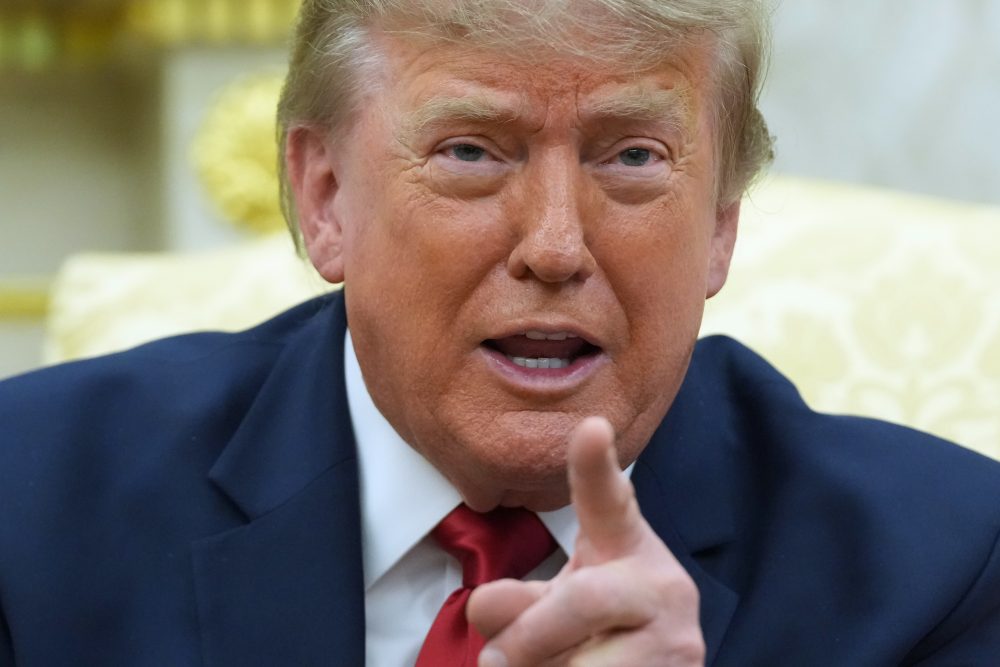

President Donald Trump announced Saturday that he believes there’s an equal likelihood the United States will either negotiate a diplomatic solution with Iran or launch renewed military operations, as Israeli Prime Minister Benjamin Netanyahu convened security meetings over concerns about proposed agreement terms.
Speaking with Axios reporter Barak Ravid, President Trump described the odds as a “solid 50/50” chance of either achieving what he called a “good” deal or to “blow them to kingdom come.” Trump indicated the proposed deal should tackle uranium enrichment and Iran’s current stockpile, though Axios noted these matters likely wouldn’t be immediately resolved under the current memorandum being considered.
The president announced plans to meet with envoys Steve Witkoff and Jared Kushner, alongside Vice President JD Vance.
“I think one of two things will happen: either I hit them harder than they have ever been hit, or we are going to sign a deal that is good,” he said.
Trump also noted that some administration officials favor diplomatic solutions while others support renewed military operations. He rejected suggestions that Netanyahu was “worried,” but acknowledged the Israeli leader was “torn” about the proposed deal.
On Saturday, President Trump conducted a phone conference with leaders from Saudi Arabia, Qatar, the UAE, Bahrain, Kuwait, Oman, Egypt, Jordan and Turkey to discuss the revised memorandum of understanding. Pakistan also joined the conversation, according to Reuters, while Israel did not participate.
Israeli broadcaster N12 reported that Netanyahu called together his security cabinet regarding what he considered a proposal that would disadvantage Israel.
An Israeli official quoted in the report stated that Witkoff was heavily promoting the agreement and “wants a deal at almost any price, and is placing immense pressure on Trump not to resume the war.”
The report indicated the proposed conditions would require Iran to reopen the Strait of Hormuz in return for economic incentives, while talks about Iran’s nuclear program and enriched uranium reserves would occur at a later time. Iran’s ballistic missile program was reportedly excluded from the negotiations.