
WASHINGTON – President Donald Trump is launching a series of major sporting spectacles this week in the nation’s capital, as the commander-in-chief seeks to display American power both domestically and internationally.
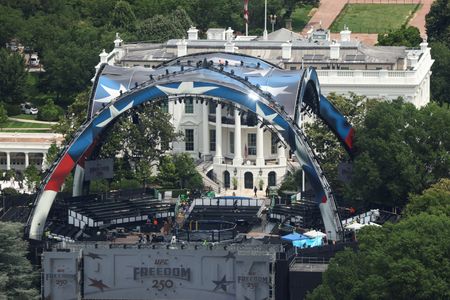
At Trump’s request, the Ultimate Fighting Championship will present a series of mixed martial arts competitions on the White House lawn this Sunday. The timing aligns with Flag Day, a rarely celebrated national holiday honoring America’s flag adoption, as well as Trump’s 80th birthday.
Trump has also convinced IndyCar to conduct a Grand Prix race through the National Mall in Washington, D.C. during the upcoming summer months. Additionally, the FIFA World Cup, which was granted to the United States, Canada and Mexico in 2018 while Trump served his first term, commenced this week.
“We’re going to showcase our country that whole weekend because of the surroundings that we have,” stated Bud Denker, chair of the Freedom 250 Grand Prix and president of Penske Corp. “I really think it excites him (Trump) that it provides this positivity to our country when we need it.”
American officials aim to leverage these events’ energy to promote the 2028 Summer Olympics in Los Angeles while boosting the president’s international standing.
While Congress formed a bipartisan commission to organize the nation’s 250th anniversary celebrations, the Trump administration established its own organization, Freedom 250, which has arranged events including the UFC competitions and automobile race.
International leaders have noticed Trump’s sports enthusiasm. In December 2025, FIFA President Gianni Infantino presented Trump with its first FIFA Peace Prize. The next month, Trump authorized a military operation in Venezuela to remove its leader, Nicolás Maduro, followed weeks later by strikes against Iran.
Shortly after the UFC mixed martial arts competitions conclude, Trump is set to travel to France for a G7 leaders’ summit. French officials postponed the gathering’s start to prevent scheduling conflicts with the UFC event, according to local media reports.
Trump has described the UFC fights as “the greatest show on Earth” and compared the UFC’s “Claw” arena towering over the White House’s South Lawn to Paris’ Eiffel Tower.
Several critics charge the president with “sportswashing,” or utilizing athletic competitions to enhance his reputation while facing criticism over human rights issues, immigration policies and international conflicts.
“We tend to talk about sportswashing when we talk about dictators or oil-rich countries,” said Nick Watanabe, who studies sport and entertainment management at the University of South Carolina. “It definitely applies to the United States.”
U.S. Secretary of State Marco Rubio characterized the UFC’s expansion and the White House fights as “the definition of American soft diplomatic power.” He announced a public-private partnership with UFC to integrate combat sports into the State Department’s diplomatic initiatives. Rubio did not detail the financial arrangements.
Critics have made comparisons to Gulf nations that fund combat sports organizations, including UFC, to extend influence and divert attention from their human rights records.
“It’s him using this opportune moment and it’s him trying to place himself at the forefront of 250 years of the American republic,” Watanabe said. “There’s nothing subtle about it, I think. He wants to show everybody that America is great, and he is the one leader.”
Trump’s supporters said the events demonstrate Trump’s longtime passion for athletics, his business skills and his efforts to establish his legacy as a transformational president. White House representatives did not respond to multiple Reuters requests for comment.
Julia Friedland, a spokesperson for Freedom 250, said: “Sports have long served as a common language that brings Americans together, and that spirit is reflected throughout the nation’s 250th anniversary celebrations.”
The UFC event has attracted critics simply due to its Trump connection, said Mark Teixeira, a Texas Republican and former Major League Baseball star. “If you’re getting bent out of shape about a sporting event in Washington, D.C. — we have a lot bigger problems in our country,” he said.
Trump’s involvement with mixed martial arts began before his political career. UFC conducted its first officially sanctioned event at Trump’s Taj Mahal casino in Atlantic City, New Jersey, in 2000. Trump also tried MMA promotion personally in 2008 and 2009, and UFC’s early events occurred at his casino.
Outside of MMA, Trump has repeatedly tried to buy National Football League teams. He once owned a franchise in a failed football league that competed with the NFL for players and audiences.
Some political rivals with athletic backgrounds voiced concerns about the White House event.
Representative Sharice Davids, a Kansas Democrat who competed in two professional MMA matches, said the image of a massive, temporary arena constructed at the White House troubles her during a period of rising consumer prices and ongoing U.S. military involvement. She told Reuters she also fears that Trump’s UFC association could damage the sport.
“My main concern is seeing the politicization of a sport that I hope continues to grow and that people continue to find and fall in love with,” she said.
UFC competitors told Reuters they had varying approaches for managing the ceremony and politics.
Lightweight fighter Michael Chandler, who has publicly supported Trump previously, said he would attempt to ignore the atmosphere and approach the fight like any other. Canadian bantamweight fighter Aiemann Zahabi anticipates facing boos and criticism while fighting American Sean O’Malley, a declared Trump supporter.
However, Zahabi said he would seek opportunities to recognize the event and the president.
“It’s something that’s probably never going to be repeated again,” Zahabi said. “It’s a one-off, and you know, Trump’s an eccentric guy, and you know, he loves MMA. He loves UFC… I think of it (as) just one big celebration.”
Advocacy organizations express concern that the venue atmosphere introduces politics and Trump deference into the sporting competition.
“Rising authoritarianism, large-scale conflicts, and global retreat from multilateralism all have direct consequences to sport,” said Andrea Florence, executive director of the Sport & Rights Alliance, a nonprofit human rights group.
“Global actors vie for power, but they use sports as a weapon, and we have seen Donald Trump and the U.S. under his administration using sports in different ways.”