
WASHINGTON — President Donald Trump’s commitment to reducing American military forces stationed in Germany is drawing fresh attention to the United States’ military role across Europe.
Between 80,000 and 100,000 American service members are typically stationed across the European continent, including more than 36,000 based in Germany. Following the Pentagon’s Friday announcement of plans to withdraw 5,000 German-based troops, Trump indicated the following day he intends to go “a lot further” with reductions.
America’s European military footprint dates back to World War II, when U.S. forces helped stabilize and reconstruct Europe, continuing through the Cold War era as a defense against Soviet expansion. In recent years, these deployments have become crucial for supporting operations across the Arctic, Africa and Middle East, including ongoing tensions with Iran.
However, Trump has departed from decades of bipartisan agreement, openly criticizing NATO allies in Europe and acting on previous threats to scale back America’s security commitment to the region. The latest announcement follows rising tensions with German Chancellor Friedrich Merz, who recently claimed the U.S. was being “humiliated” by Iran while questioning Washington’s strategic clarity.
The U.S. European Command, established in 1947 and called EUCOM, represents one of 11 combat commands under the Defense Department, spanning approximately 50 nations and territories.
Beyond Germany’s 36,000-plus troops, Italy houses over 12,000 American service members while the United Kingdom hosts another 10,000, based on December Pentagon data.
Pentagon officials have provided limited information regarding which specific troops or operations would face cuts under Friday’s announced reduction.
American forces in Europe expanded after Russia began its comprehensive invasion of Ukraine four years ago. NATO partners including Germany have anticipated for more than a year that these additional troops would be among the first to depart.
Beyond serving as a deterrent against Russia, America’s European military presence enables Washington to project influence worldwide.
U.S. Gen. Alexus Grynkewich, who leads both American and NATO forces in Europe, emphasized the advantages of maintaining a substantial continental presence during March testimony before the Senate Armed Services Committee.
“It is having capabilities in Europe, munitions in Europe that allow us to help U.S. Africa Command to target terrorists in Africa, or to help U.S. Central Command as they execute Operation Epic Fury,” he explained to legislators, referencing the Iran conflict. “The distances are shorter, it’s less expensive and it’s much easier to project power.”
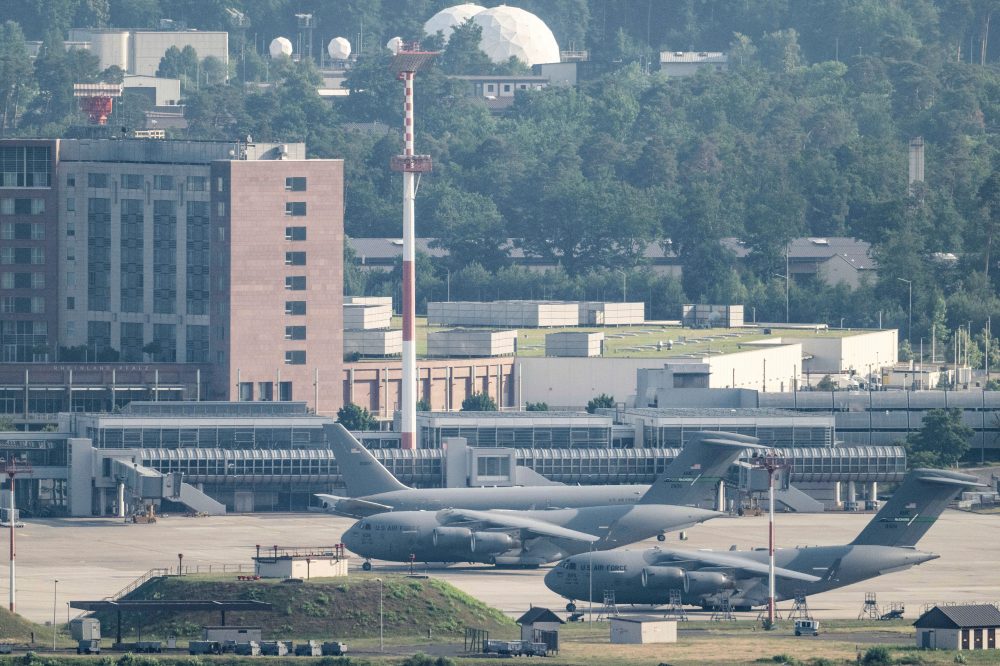
Germany houses headquarters for both U.S. European and Africa commands, along with Ramstein Air Base and Landstuhl medical facility, where wounded soldiers from Iraq and Afghanistan conflicts received treatment. American nuclear weapons are also positioned within German territory.
Approximately 100 U.S. nuclear weapons are deployed at European installations for aircraft delivery, according to March estimates from the Federation of American Scientists. The organization’s analysis indicates these weapons are located at facilities in Belgium, Germany, Italy, the Netherlands and Turkey, with possible placement at a United Kingdom base.
Before Trump’s Saturday remarks to media, Republican leaders from both congressional armed services committees voiced opposition to the Pentagon’s strategy, cautioning that premature European reductions would signal “the wrong message to Vladimir Putin” as Russia’s leader continues his Ukrainian campaign.
Mississippi Senator Roger Wicker and Alabama Representative Mike Rogers advocated for relocating troops to Eastern European installations rather than complete withdrawal.
The legislators also noted that allies have made “substantial investments to host U.S. troops.”
Wicker and Rogers revealed that following Friday’s announcement, the Pentagon has also chosen to halt the planned German deployment of a U.S. Army long-range fires battalion, which operates ground-based missile systems.
Within its January National Defense Strategy — a comprehensive document outlining approaches from Chinese deterrence to cyber defense to disrupting Iran’s nuclear programs — the administration declared Europe must increase its own defense efforts.
While “we are and will remain engaged in Europe, we must — and will — prioritize defending the U.S. Homeland and deterring China,” the strategy stated.
The document acknowledged that Europe’s economic influence, though relatively declining globally, remains substantial, noting Germany’s economy alone “dwarfs that of Russia.”
“Fortunately, our NATO allies are substantially more powerful than Russia — it is not even close,” the strategy observed, highlighting recent NATO commitments to increase national defense spending to 5% of GDP collectively, an initiative championed by Trump.
Germany has worked to modernize its historically underfunded military, known as the Bundeswehr, since Russia’s 2022 Ukrainian invasion. That year, officials established a 100 billion euro ($117 billion) special fund for Bundeswehr enhancement, with most resources dedicated to acquiring new equipment.
In late 2024, Merz’s administration revealed intentions to expand military personnel to 260,000, up from approximately 180,000 currently. During 2001, when Germany maintained conscription, total numbers reached 300,000 — over one-third being conscripts.
Berlin indicates it will require around 200,000 reservists, more than doubling present figures.
Defense Minister Boris Pistorius, speaking with German news agency dpa after Friday’s Pentagon announcement, recognized Europe’s need for greater security responsibility while noting Bundeswehr expansion, accelerated military procurement, and infrastructure development.