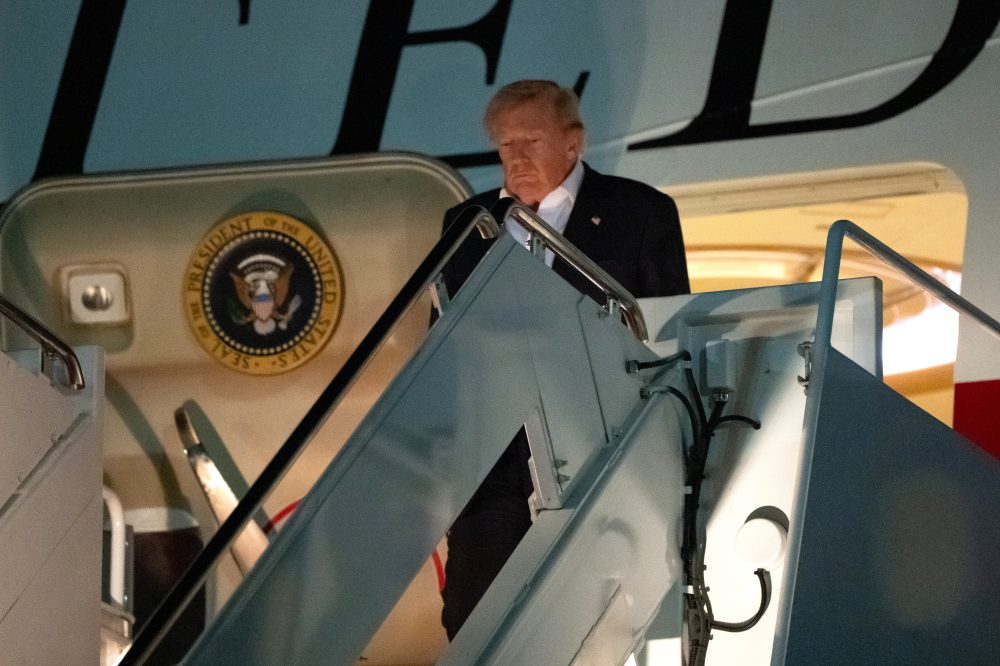

The United States carried out new airstrikes against Iran in the early hours of Thursday, just hours after President Donald Trump declared the ceasefire effectively finished, pointing to recent Iranian attacks on vessels in the Strait of Hormuz as the breaking point.
Iran hit back quickly, launching strikes against U.S.-allied Kuwait and Qatar, while also accusing American forces of targeting an area near the country’s only nuclear power plant.
The two sides have traded blows repeatedly, including on Wednesday, but Thursday’s exchange appeared to be larger in scale than previous incidents. Adding to the uncertainty, Trump has been sending mixed signals — authorizing consecutive military strikes while simultaneously insisting the U.S. is not heading back into a full-blown war.
On the diplomatic front, during a Wednesday meeting with Ukrainian President Volodymyr Zelenskyy on the sidelines of the NATO summit in Turkey, Trump announced the U.S. would grant Ukraine a long-sought license to manufacture Patriot air defense systems domestically. Trump also praised Zelenskyy as doing “an amazing job,” a notable shift from his previous sharp criticism of the Ukrainian leader.
However, an adviser to Ukraine’s defense minister, Serhii Beskrestnov, cautioned that actually building the mobile, surface-to-air missile systems would take many months. Writing on the Telegram messaging platform, Beskrestnov noted that a manufacturing license would typically include technical documentation, specialist training, supplier contacts, and foreign consultants. He said the biggest challenge would be time, not Ukraine’s technical or organizational capabilities.
In a separate development, the southern African kingdom of Eswatini confirmed Thursday it had received its fourth group of people deported from the United States under a bilateral agreement to host third-country nationals. Eleven individuals arrived this week, the government said.
Acting government spokesperson Thabile Mdluli said the group, made up mostly of people from African nations, would stay in Eswatini temporarily while their rights were safeguarded. “The government reaffirms that, during their temporary stay in the Kingdom, the fundamental rights of the third-country nationals will be respected and protected in accordance with the laws of the Kingdom of Eswatini and the Kingdom’s international obligations,” Mdluli stated.
The Trump administration has deported thousands of people to nearly two dozen countries that are not their home nations, under a series of agreements — many of them secret — that are part of a sweeping U.S. immigration crackdown, according to advocates.
On Wall Street, futures for the S&P 500 edged up 0.1% before Thursday’s opening bell, while Dow Jones Industrial Average futures slipped 0.1%. Nasdaq futures climbed 0.5%.
Oil prices continued to rise, with Brent crude — the international benchmark — gaining 64 cents to reach $78.66 per barrel on Thursday. It briefly crossed the $80 mark on Wednesday. Prior to the start of the Iran conflict, Brent crude was trading near $72 a barrel, though earlier hopes for a peace agreement had briefly pushed prices back to pre-war levels. U.S. benchmark crude rose 54 cents to $74.06 per barrel.
Trump has publicly stated he believes the ceasefire is finished and that he is no longer certain he wants a negotiated deal, suggesting the U.S. should instead “finish the job.” Yet he continues to insist the ongoing strikes do not represent a return to war or a long-term military commitment.
Analysts say Trump’s conflicting statements could be a deliberate pressure tactic aimed at forcing Tehran to halt its attacks on oil and gas tankers in the Strait of Hormuz and to yield to U.S. demands over its nuclear program — a strategy Trump has employed before. Whether it is a negotiating move or a genuine signal of escalation, international mediators are racing to salvage the interim agreement, with the risk that continued fighting could deepen the crisis further.