
(This story contains strong language in paragraph 7)
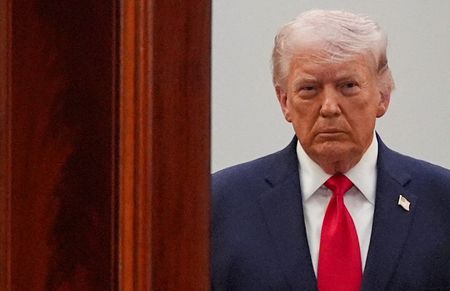
WASHINGTON/CAIRO, April 6 (Reuters) — President Donald Trump has issued an ultimatum to Iran, warning of severe consequences if the nation fails to negotiate and reopen the Strait of Hormuz by his Tuesday deadline, while simultaneously commending American special operations forces for their successful rescue of a downed airman in a dangerous mission deep within Iranian territory.
For over five weeks, American and Israeli forces have conducted sustained missile strikes and aerial bombardments against Iran, targeting what officials described as urgent threats from the nation’s nuclear weapons program, ballistic missile capabilities, and backing of regional proxy forces.
Iran has responded by effectively shutting down the Hormuz waterway, which serves as a crucial passage for approximately one-fifth of global oil and natural gas shipments, while launching attacks against American military installations and other strategic targets throughout the Gulf region.
Monday morning brought fresh explosions to Tehran, with a joint U.S.-Israeli attack on a residential structure south of the capital reportedly claiming at least 13 lives, according to an Iranian state media official. Reuters could not independently confirm this information.
Using his Truth Social platform on Sunday, Trump posted an expletive-filled message threatening additional strikes against Iranian energy and transportation infrastructure, actions that critics argue would constitute war crimes.
“Tuesday will be Power Plant Day, and Bridge Day, all wrapped up in one, in Iran,” he declared.
“There will be nothing like it!!! Open the Fuckin’ Strait, you crazy bastards, or you’ll be living in Hell – JUST WATCH! Praise be to Allah. President DONALD J. TRUMP”
Demonstrating the contradictory communication style that has confused allies, adversaries, and financial markets, Trump simultaneously told Fox News on Sunday that Iran was engaged in negotiations, with a potential agreement possible by Monday.
Sunday evening brought an Axios report indicating that the United States, Iran, and regional intermediaries are discussing terms for a potential 45-day ceasefire that could pave the way for a permanent resolution to the conflict, according to four sources with knowledge of the discussions from U.S., Israeli, and regional circles.
Reuters was unable to independently confirm this reporting. Neither the White House nor the State Department provided immediate responses to requests for comment.
According to the report, mediators are working on a two-stage agreement, beginning with a 45-day cessation of hostilities, followed by comprehensive terms for ending the war.
IRAN CONDEMNS ‘RECKLESS’ US, HITS GULF
Tehran is insisting on a complete halt to hostilities, with parliamentary speaker Mohammad Baqer Qalibaf criticizing Trump’s threats and accusing him of being influenced by Israeli Prime Minister Benjamin Netanyahu.
“Your reckless moves are dragging the United States into a living HELL for every single family, and our whole region is going to burn because you insist on following Netanyahu’s commands,” he wrote Sunday on X.
Despite the sustained U.S.-Israeli bombardment, Iran demonstrated its continued military capacity by expanding attacks on Gulf energy infrastructure, deploying drones and missiles against petrochemical facilities in Kuwait, Bahrain, and the United Arab Emirates.
The Revolutionary Guards also announced Sunday that they had struck an Israeli-connected vessel at Dubai’s Jebel Ali port.
In Kuwait, drone attacks ignited fires and caused “severe material damage” at petrochemical plants operated by Kuwait Petroleum Corporation subsidiaries, the company reported.
These attacks highlighted Iran’s continued ability to conduct cross-border operations and disrupt infrastructure across multiple Gulf nations, revealing weaknesses in energy and maritime security systems.
Israel also faced continued attacks, with media coverage showing search-and-rescue teams working through debris in the northern city of Haifa on Sunday following an Iranian missile strike on a residential building. Israeli emergency responders reported treating nine individuals, with media later confirming that rescuers had recovered two bodies from the wreckage.
COMMANDO OPERATION
Trump revealed the airman’s rescue in the early Sunday hours, characterizing the mission as “one of the most daring” operations in American military history.
The rescued airman, who served as weapons officer on an F-15 fighter jet downed on Friday, sustained injuries but “will be just fine,” Trump stated in an X message. The aircraft’s pilot had been recovered previously.
Operating under nighttime cover, American commandos penetrated deep into Iranian territory undetected, navigated a 7,000-foot (2,100-meter) mountain ridge, and successfully extracted the stranded American weapons specialist before Sunday dawn.
Two MC-130 transport aircraft that had delivered approximately 100 special operations personnel to the challenging terrain south of Tehran experienced mechanical problems and became unable to depart, a U.S. official informed Reuters.
Military commanders faced a critical decision, authorizing additional aircraft to enter Iran for a staged extraction of the forces.
The rescue teams were evacuated in phases, with U.S. forces destroying the disabled MC-130s and four additional helicopters within Iran to prevent sensitive equipment from falling into enemy hands.
Iranian officials confirmed that several American aircraft were destroyed during the operation.
The conflict, which began with coordinated U.S. and Israeli air strikes throughout Iran on February 28, has resulted in thousands of casualties, primarily in Iran and Lebanon.
Lebanese health ministry reports indicated that Israeli airstrikes claimed another 11 lives in Lebanon on Sunday.