
A manufacturing crisis unfolding in Germany’s industrial heartland offers sobering lessons for Delaware’s own manufacturing sector as global economic pressures reshape traditional industries.
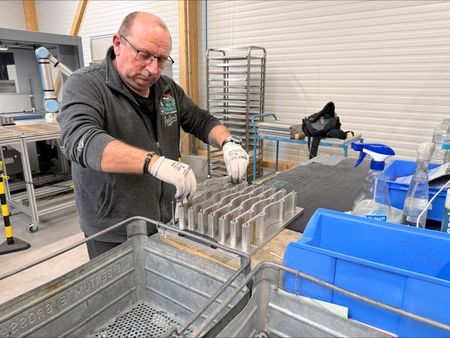
In Baden-Wuerttemberg, Germany’s premier automotive region, small supplier companies like Dostech are feeling the squeeze from a broader industry upheaval. The Moessingen-based sealant technology firm pivoted to electric vehicle projects in 2018 when automotive inquiries surged, allowing them to purchase their current headquarters facility south of Stuttgart.
However, that strategic shift has now left them vulnerable to Germany’s automotive sector crisis.
“This area is shaky,” company director and co-founder Steffen Braun explained to reporters. “It is no longer as stable and it’s hard to make investments.” The company has been forced to reduce workforce numbers while automotive-related income has declined.
These challenges are spreading throughout Baden-Wuerttemberg as the state prepares for its March 8 election, with economic concerns topping voter priorities.
The region houses Mercedes and Porsche, automotive brands that have long represented German manufacturing prowess. However, fierce competition from Chinese manufacturers, an inconsistent transition to electric vehicles, and increasing operational costs have destabilized the industry.
Decreased demand throughout the automotive supply network is pressuring hundreds of smaller manufacturing companies while threatening employment stability and local government services.
While Chancellor Friedrich Merz’s conservative party remains favored to win the upcoming election, economic anxieties and diminished regional confidence are creating opportunities for far-right political movements.
Baden-Wuerttemberg faces greater exposure to industrial transformation than most German regions. The state leads Germany in exports, representing 15.5% of national export activity, with manufacturing contributing 38.1% of the state’s total economic output compared to 28.5% nationally.
The state’s economy contracted 0.4% in 2024, exceeding Germany’s overall 0.2% decline, and analysts expect another contraction despite modest national growth.
U.S. trade tariffs have particularly impacted export-focused states with significant automotive sectors, according to Ifo economist Robert Lehmann.
“Baden-Wuerttemberg is a classic example,” he noted.
Warning signs continue mounting across the region.
Business insolvency cases in Baden-Wuerttemberg climbed for the second consecutive year to 2,445 in 2024, representing a 30% increase and the highest level since 2010, state statistics show. A third straight annual increase appears likely.
Cornelius Pleser, managing director of valuation and asset-disposition company Pleser KG, reports dramatically increased demand for his services in his home state.
“Ten years ago, there was significantly more capital in the market, and in insolvency proceedings investors or successors were often found,” he explained, adding that companies without viable succession plans are now at an “alarmingly high” number.
Restructuring efforts have swept through Baden-Wuerttemberg’s industrial corridor.
“There is a domino effect,” said Matthias Bianchi, public affairs representative for the DMB, which advocates for Germany’s small and medium-sized enterprises. “This crisis in the lead industries slowly trickles down.”
While Baden-Wuerttemberg’s unemployment remains below national levels, the rate increased to 4.8% in January 2026 from 3.9% in January 2023.
Economic analysts attribute the relatively modest unemployment increase to labor retention practices, where companies maintain staff despite weakening demand due to concerns about future worker shortages.
“The employees I’ve trained here are irreplaceable. If they leave tomorrow, I can’t replace them the day after—impossible,” Dostech’s Braun explained.
Nevertheless, staffing issues persist for his company. Reassigning employees to new positions becomes what he describes as an “odyssey” involving extensive paperwork, changing government contacts, and lengthy approval delays.
Despite the moderate unemployment increase, Hanno Kempermann, economist and managing director of IW Consult, points to other indicators suggesting labor market weakness. Job postings in Baden-Wuerttemberg have dropped 30% compared to 2022, while companies plan to eliminate 14,000 automotive positions by 2030.
“The situation is very tense,” stated Barbara Resch, Baden-Wuerttemberg head of the IG Metall trade union. “Suppliers invested a lot in electromobility and now demand isn’t coming and at some point they simply run out of air financially.”
IG Metall, the primary union representing workers at companies like Mercedes and Volkswagen, is working to preserve employment through reduced working hour agreements.
“Right now it’s hitting everyone: apprenticeship positions are being reduced and highly qualified people are also at serious risk,” Resch added.
While the automotive industry faces deep structural challenges and export-dependent industrial firms struggle, other economic sectors are experiencing strong growth, according to Bianca Schmitz, founding director of the Hidden Champions Institute at ESMT Berlin.
“It’s an asymmetry you find here,” she observed, highlighting rapid expansion in automation and robotics, medical technology, and software and information technology companies.
The state accounts for over 25% of Germany’s total research and development expenditure, demonstrating the southwest region’s heavy reliance on innovation-driven industry and applied research. Research and development investment represents approximately 5.7% of state economic output—nearly double the national average.
The economic slowdown’s impact extends beyond major cities like Stuttgart and Sindelfingen to smaller communities where automotive suppliers suddenly reduce staff or halt hiring, creating financial pressure on local governments.
“People notice when the opening hours of municipal facilities are cut and kindergarten fees go up,” explained Friedrich Heinemann, economist at the ZEW economic institute. “That hits home.”
Five economists consulted for this analysis agreed that maintaining failing companies through government subsidies would be counterproductive, a position supported by Reint Gropp, president of the Halle Institute for Economic Research.
“We need to allow a process of predatory competition, where new ideas push out old ones,” he stated.
However, if artificial industry preservation isn’t viable, what actions should the next state government take to revitalize the struggling economy?
Many business leaders provide identical responses: invest in infrastructure including high-speed internet, transportation networks, and rail systems.
Merz’s federal government approved a 500 billion euro infrastructure fund last year and reformed state borrowing regulations, though economists note the funding has yet to begin flowing.
From the 100 billion euros designated for states, Baden-Wuerttemberg will receive 13 billion euros, with 8.7 billion euros directed to municipalities, Kempermann reported.
“It’s a bit like a drop in the ocean, because it’s still too little to eliminate the infrastructure deficits that have built up over the last 20 years,” he assessed.
According to Heinemann, state governments can orient their budgets toward economically essential growth factors: quality education systems, reliable transportation infrastructure, digital networks, and research and development.
“We need to look into what Baden-Wuerttemberg is doing and whether they manage this very structural change,” Schmitz concluded. “It is at the forefront of what is currently happening in Germany.”