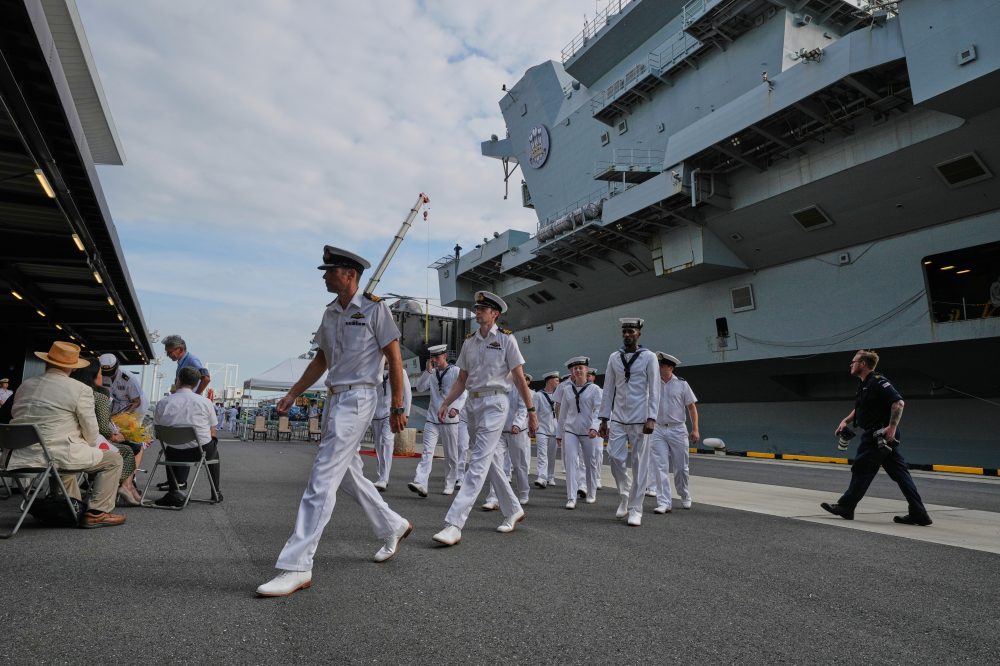

LONDON (AP) — President Donald Trump and Defense Secretary Pete Hegseth have launched sharp attacks on Britain’s naval strength, delivering criticism that has resonated painfully in a nation known for its storied maritime legacy, though experts say their comments contain elements of truth.
Britain has become a primary target of Trump’s criticism following the Iran conflict that began February 28, after British Prime Minister Keir Starmer initially denied U.S. forces access to British military installations.
While that stance has been partially modified to allow American use of British facilities, including the Diego Garcia base in the Indian Ocean, for what officials term defensive operations, Trump remains convinced he was betrayed. The president has consistently attacked Starmer and dismissed the Royal Navy’s aircraft carriers as mere playthings.
“You don’t even have a navy,” Trump stated to Britain’s Daily Telegraph in remarks released Wednesday. “You’re too old and had aircraft carriers that didn’t work.”
Hegseth added his own mocking commentary, suggesting sarcastically that the “big, bad Royal Navy” should step up to help secure the Strait of Hormuz for merchant vessels.
While the Royal Navy no longer commands the seas as it did during Britain’s imperial peak, it remains more capable than Trump and Hegseth suggest, with strength comparable to France’s naval forces.
“There’s validity to the criticism, as the Royal Navy has shrunk to its smallest size in centuries,” explained Professor Kevin Rowlands, who edits the Royal United Services Institute Journal. “However, the navy would point out it’s experiencing its first expansion since World War II, with more vessels planned for construction than we’ve seen in decades.”
Britain once assembled an impressive armada of 127 vessels, including two aircraft carriers, for the journey to the South Atlantic following Argentina’s seizure of the Falkland Islands. That 1982 operation, which received tepid support from then-President Ronald Reagan, represented the last demonstration of Britain’s naval supremacy.
Today’s Royal Navy could never mount such an operation. Since World War II, Britain’s battle-ready fleet has shrunk dramatically, driven by evolving military technology, strategic shifts, and the dissolution of the British Empire.
Analysis of Ministry of Defense and House of Commons Library data by The Associated Press shows combat vessels in the Royal Navy fleet, encompassing aircraft carriers, destroyers and frigates, have dropped by two-thirds from 466 ships in 1975 to just 66 in 2025.
While Britain operates two aircraft carriers currently, the nation went seven years in the 2010s without any. Destroyer numbers have been cut in half to six vessels, while the frigate fleet has plummeted from 60 ships to merely 11.
The Royal Navy drew criticism for the lengthy deployment time of HMS Dragon destroyer to the Middle East after the Iran war erupted. Despite round-the-clock efforts by naval personnel to prepare the ship for an unexpected mission change, many viewed the delay as evidence of how severely Britain’s military capabilities have been reduced since the Berlin Wall fell in 1989.
Throughout much of the Cold War era, Britain allocated between 4% and 8% of its national income to military spending. Following the Cold War’s conclusion, this percentage steadily declined to just 1.9% of GDP by 2018, providing ammunition for Trump’s criticisms.
Similar to other nations, Britain, particularly under Labour Prime Ministers Tony Blair and Gordon Brown, attempted to capitalize on the “peace dividend” after the Soviet Union’s collapse by redirecting defense funds to other areas like healthcare and education.
Budget cuts implemented by Conservative-led administrations following the 2008-9 financial crisis prevented any increase in defense spending, despite clear evidence of Russia’s growing aggression, particularly after Moscow’s seizure of Crimea and portions of eastern Ukraine.
After Russia’s comprehensive invasion of Ukraine in 2022, combined with ongoing Middle East conflicts, there’s growing bipartisan recognition that military cuts have been excessive.
The Conservative government began reversing military spending reductions following the Ukraine invasion. Since Labour regained power in 2024, Starmer has worked to increase British defense expenditures, partially by reducing the country’s historically significant foreign aid budget.
Starmer has committed to increasing U.K. defense spending to 2.5% of gross domestic product by 2027, with an updated target of 3.5% of GDP by 2035, fulfilling a NATO agreement championed by Trump. This translates to tens of billions of additional pounds in military equipment and capabilities.
Government officials face pressure to accelerate this timeline. However, with public finances already strained by the Iran war’s economic impact, finding additional funding sources remains unclear.
The criticism will likely continue despite being unfair and inaccurate, according to RUSI’s Rowlands, a former Royal Navy captain.
“We are dealing with an administration that doesn’t do nuance,” he observed.