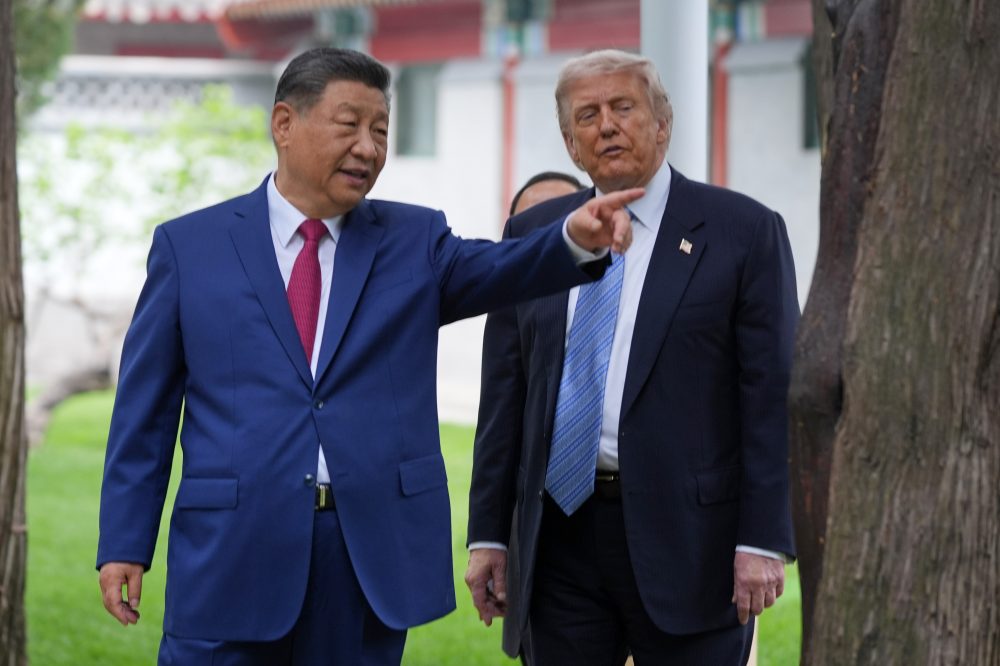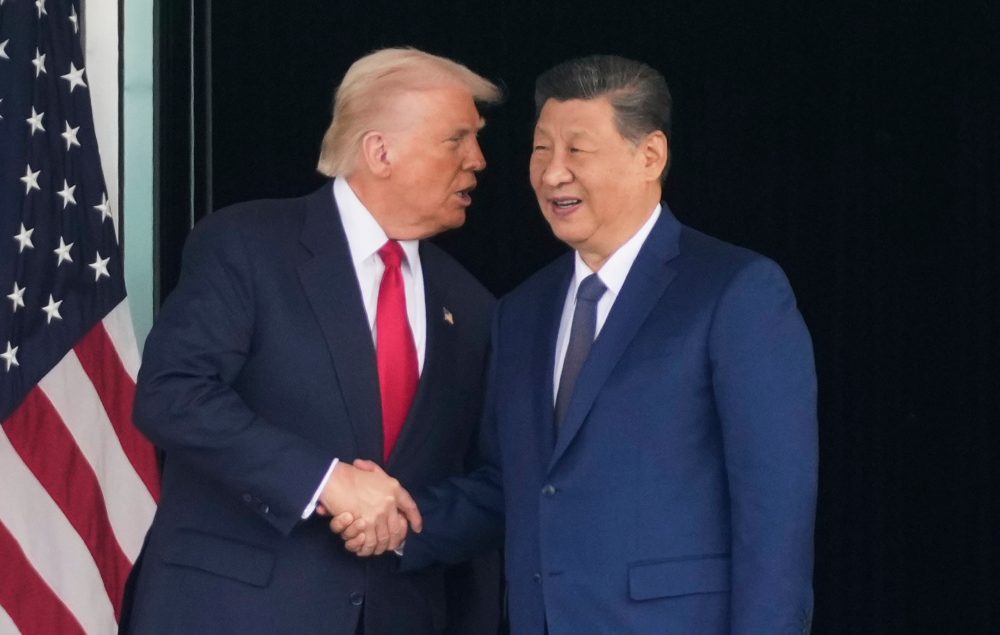

WASHINGTON — President Donald Trump is set to travel to Beijing Tuesday for discussions with Chinese President Xi Jinping, asserting that American trade relations with China have become more profitable while downplaying ongoing disputes over critical minerals, tariffs, and cutting-edge technologies like artificial intelligence that threaten to strain ties between the globe’s two economic powerhouses.
The upcoming Beijing meeting represents what could be the initial encounter of four planned discussions this year between the leaders.
“We’re doing a lot of business with China and making a lot of money,” Trump stated recently. “We’re making a lot of money — it’s different than it used to be.”
The gathering focuses mainly on maintaining economic relationship stability, with observers anticipating only minor policy revelations. The trade ceasefire established in October will likely receive an extension, while China may reveal intentions to purchase American soybeans, beef, and Boeing aircraft. American officials have also hinted at establishing a Board of Trade to maintain ongoing economic dialogue between the nations.
According to Brett Fetterly, a managing principal at consultancy The Asia Group specializing in China, some within the Trump administration believe “the outcome that matters more than any set of deliverables is stability and space for continued engagement, both to build domestic resilience and to facilitate future deal-making.”
However, continued engagement represents merely an initial move toward managing U.S.-China competition, as reciprocal tariffs, artificial intelligence and electric vehicle development, and the Iran conflict threaten to destabilize relations.
Contrary to Trump’s profit assertions, China purchased approximately $50 billion less in American goods last year compared to 2022, based on U.S. Census Bureau statistics.
Part of this decline stems from Beijing halting soybean purchases during the previous year’s trade dispute. The Trump administration has expressed clear intentions to support American agricultural and manufacturing sectors by increasing Chinese imports from the U.S., aiming to reduce a trade deficit that reached $202 billion last year.
The United States now imports more products from Taiwan than China, a shift partly driven by the AI competition that has American companies purchasing computer chips and servers from the self-governing territory.
Dating back to Trump’s initial presidency, China also started redirecting U.S.-bound merchandise through other Asian nations, while American businesses moved supply chains for computers and electronics to Vietnam and India.
China’s portion of U.S. goods imports has dropped from 22% when Trump first took office in 2017 to only 7.5% during the first quarter of this year, according to government information analyzed by Chad Bown, a senior fellow at the Peterson Institute for International Economics and co-author of “How to Win a Trade War.”
U.S. Trade Representative Jamieson Greer stated he “highlighted” during an April 30 conversation with Chinese Vice Premier He Lifeng the importance of a “new government-to-government Board of Trade.”
Greer suggested the board could enhance trade in products without national security implications. This might include agricultural items, for example, but exclude computer chips or other sensitive technologies.
The proposal could simplify trade dispute resolution and assist American efforts to increase sales to China. It might help avoid a repetition of last year when Trump increased tariff rates on Chinese products by 145% before reaching a truce during an October meeting with Xi in South Korea.
The board would also provide the Trump administration with an alternative to substantial tariff increases, which have created logistical and legal complications. The Supreme Court determined that Trump lacked authority to unilaterally impose many of last year’s tariffs, while his subsequent temporary replacement tariffs were ruled illegal by a federal court last week.
The Trump administration indicates both the U.S. and China would require domestic approval to establish the board that could oversee tens of billions in trade. Administration officials also seek to create an investment forum for discussing financing operations in each country.
The U.S. delegation to China includes approximately 17 CEOs, featuring Tesla’s Elon Musk, Apple’s Tim Cook, and Boeing’s Kelly Ortberg, according to the White House.
In certain respects, Trump’s and Xi’s administrations have been operating at cross-purposes. Trump believes America can maintain its AI advantage, viewing the trade imbalance as the primary challenge to address. However, Xi perceives a world disrupted by climate change and the Iran conflict, developments that could benefit Chinese technologies including solar panels and electric vehicles.
“Washington and Beijing are competing at different levels and different domains, with different theories of victory,” explained Michael Sobolik, a senior fellow focusing on U.S.-China relations at the Hudson Institute, a conservative think tank. “President Trump leveraged tariffs not as a weapon against China but as leverage to secure a trade deal. Xi Jinping is angling to win a cold war with the United States.”
The U.S.-Israel conflict with Iran is also creating an energy turning point, noted Ali Wyne, a senior research and advocacy adviser on U.S.-China relations at the International Crisis Group.
The Trump administration expects the world to continue depending on oil and natural gas, while China views price increases following energy shipment disruptions in the Strait of Hormuz as supporting a green energy shift that benefits its industrial approach.
“The structural frictions between the United States and China, they are growing in number and severity,” Wyne observed.
Multiple potential tensions could easily disrupt optimistic friendship discussions, questioning whether meaningful summit progress is possible on issues including:
— China’s control over most rare earth mining and nearly all processing for these minerals essential to electronics. The Trump administration is working to develop domestic rare earth production through new partnerships and company investments, a strategy requiring several years to implement.
— The U.S. effort to restrict China’s access to the most sophisticated computer chips. These processors, created by companies like Nvidia and AMD, possess the computational capability to advance AI development.
— China’s automotive manufacturing dominance. Its global vehicle exports rose 21% last year, according to the China Association of Automobile Manufacturers. China can offer EVs at significantly lower prices than manufacturers in the U.S., Germany, Italy, Japan, and South Korea.
— Tariffs. Following the Supreme Court’s rejection of Trump’s tariffs, the administration initiated national security investigations under Trade Act of 1974 provisions to impose new tariffs based on excessive industrial capacity and efforts to prevent forced labor that could potentially survive legal challenges.
— U.S. sanctions on a Chinese oil refinery and numerous tankers and shipping companies for participating in Iranian oil transportation. Beijing responded to the earlier this month action by demanding non-compliance with U.S. penalties against Chinese enterprises. The countries are also competing over Panama Canal management.