
President Trump has escalated his threats against Iran, declaring that American forces have barely begun targeting the country’s remaining infrastructure as international efforts intensify to reopen the crucial Strait of Hormuz shipping route.
The conflict, now in its fifth week since beginning with coordinated U.S.-Israeli airstrikes, continues spreading instability throughout the Middle East while disrupting global financial markets and mounting pressure on the administration to resolve the crisis quickly.
Trump has intensified his public statements recently as behind-the-scenes negotiations through third parties with Iran’s new leadership have shown minimal advancement.
In a late Thursday social media post, Trump declared the American military has barely begun demolishing Iran’s remaining assets. He wrote that bridges would be next, followed by electrical power facilities, emphasizing that Iranian leadership understands what must be accomplished quickly.
Earlier, the president shared footage of U.S. forces destroying a recently built bridge connecting Tehran with Karaj, a major northwestern suburb. The structure was set to begin handling traffic this year. Iranian state media reported eight fatalities and 95 injuries from the American strike.
Iranian Foreign Minister Abbas Araqchi responded in a statement, saying that attacking civilian infrastructure, including incomplete bridges, would not force Iranians to capitulate.
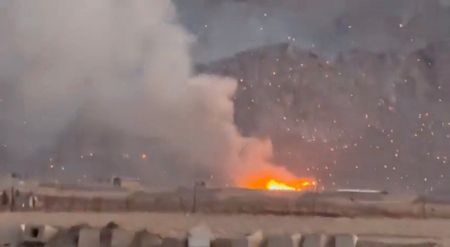
Satellite imagery additionally revealed smoke billowing from facilities at Qeshm port, located on an Iranian island with strategic importance in the Strait of Hormuz, during this week’s operations.
More than 100 American international law scholars issued a statement Thursday expressing grave concerns about potential violations of international human rights and humanitarian law by U.S. forces and officials, including possible war crimes.
The experts’ letter specifically highlighted Trump’s mid-March statement suggesting potential strikes on Iran conducted purely for entertainment. They also referenced Pentagon Secretary Pete Hegseth’s early March remarks about American forces not operating under restrictive engagement rules.
During Wednesday evening remarks, Trump reiterated his threats against Iran’s civilian electrical infrastructure without providing any clear timeline for concluding military operations. This prompted Iranian retaliation promises, negatively impacted global stock markets, and drove oil prices higher amid concerns the Strait of Hormuz would remain mostly inaccessible.
Britain organized a virtual conference Thursday involving approximately 40 nations to explore methods for restoring navigational freedom, though no concrete agreements emerged. Participants did agree that all countries should enjoy unrestricted waterway access, according to one official.
The U.N. Security Council plans to vote Saturday on Bahrain’s resolution protecting commercial vessels in and around the strait, diplomats confirmed. However, China, which holds veto power, clearly opposed authorizing military force.
Chinese U.N. representative Fu Cong told the Security Council Thursday that any military intervention would legitimize unlawful and indiscriminate force usage, inevitably escalating tensions with serious ramifications.
Iran has effectively closed the strait, which typically handles approximately one-fifth of global oil commerce, as retaliation for U.S.-Israeli attacks that commenced February 28.
Tehran presented an alternative framework for future strait management, announcing it was developing protocols with neighboring Oman requiring vessels to secure permits and licenses.
European Union foreign policy leader Kaja Kallas rejected Tehran’s proposal, stating Iran cannot charge nations fees for ship passage. She wrote on social media that international law does not recognize pay-for-passage arrangements.
Concerns are mounting that the conflict could grant Iran control over Middle Eastern energy supplies after demonstrating its ability to block the Strait of Hormuz by targeting oil tankers and striking Gulf nations hosting American military personnel.
Gulf states maintain their self-defense rights but have avoided military responses to repeated Iranian attacks over recent weeks, hoping to prevent escalation into a broader Middle Eastern war.
Kuwait reported its air defense systems worked to intercept missiles and drones twice on Friday.
Thousands have died and tens of thousands suffered injuries across the Middle East since hostilities began. The International Federation of Red Cross and Red Crescent Societies delegation head said Thursday that medical requirements were increasing exponentially while supplies could become scarce.
Fuel shortages have already created economic pressures throughout Asia and are anticipated to affect Europe soon. A joint U.N. agencies report warned that sharp economic decline could trigger cost-of-living crises in Africa.