
Leading Chinese solar panel manufacturers are expanding their operations into battery storage production as traditional photovoltaic sales experience a downturn, according to industry reports from Shanghai.
Major companies in the solar sector are facing challenges from reduced domestic installations, declining export numbers, and historically low pricing, with industry leaders anticipating a drop in worldwide demand by 2026.
This market pressure has prompted companies such as JinkoSolar, JA Solar, LONGi Green Energy and Trina Solar to speed up their entry into battery storage markets, according to company representatives speaking with Reuters.
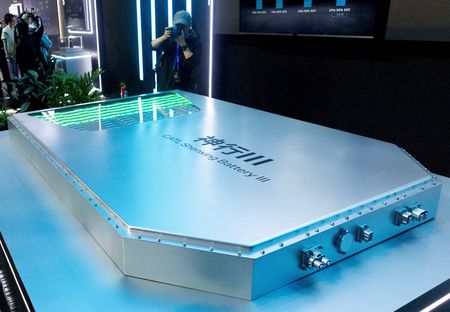
JinkoSolar is planning to expand its battery production capacity nearly threefold, growing from 5 gigawatt-hours (GWh) to 13-14 GWh before year’s end, as energy developers work to solve renewable energy’s intermittency challenges, according to a company representative at SNEC, a solar industry conference that drew over half a million attendees.
“We are seeing some goodwill from our company’s directors’ point of view, in that we are having massive investments,” Titus Koech, a regional technical head for energy storage systems, told Reuters.
Nations with significant renewable energy adoption, such as Japan, Vietnam and India, along with Germany, the Netherlands, the U.S. and Australia, ranked among the top battery importers from China in 2025, based on data from energy research organization Ember.
Energy storage products dominated JA Solar’s exhibition space, representing a departure from the photovoltaic-centered presentations of past conferences, according to Gloria Gao, marketing director of its storage division.
“If you only own a solar business, it’s not helping your business grow because the margins are really small. That’s why we started our energy storage business, because we foresee the future,” Gao told Reuters.
Export sales of solar panels, which generally provide higher profit margins than domestic transactions, increased by 4.7% in 2025, marking the most sluggish growth rate since 2018, according to Ember statistics. Growth during the May through December period is projected to fall short of the performance seen in the year’s opening four months, noted Rystad Energy analyst Fei Chen.
In contrast, battery exports for energy storage applications are projected to surge 30% to reach 150 GWh in 2026, according to Rystad projections.
Chinese solar manufacturers are moving into a sector currently controlled by battery industry leaders including CATL and BYD, but are counting on their supply chain knowledge and capacity to provide combined solar-and-storage systems.
This integration approach has transformed energy storage into “the second growth curve” following photovoltaics, according to a Trina Solar representative.
The company’s energy storage deliveries during the March quarter, with approximately 90% going to export markets, increased more than four times compared to the previous year, the representative noted, though they requested anonymity as they lacked authorization to speak with media.
CATL, the global leader in battery manufacturing, anticipates energy storage will represent half of its worldwide sales by 2030, rising from the current 25%, fueled by requirements to support variable renewable energy sources.
LONGi’s combined solar-and-storage initiative was featured on a massive, curved LED display that spanned nearly the full width of its exhibition space, taking priority over individual PV products at SNEC.
Research firm Wood Mackenzie indicated this trend demonstrates changing purchasing behaviors.
“When you’re buying solar and storage, you’re getting married to these companies for the next 20 years,” said Yana Hryshko, head of solar supply chain research.
“LONGi and JA just joined (the energy storage business) because you don’t buy your solar from one manufacturer and your storage from another. In the next two years, we’re not going to talk about solar without storage.”