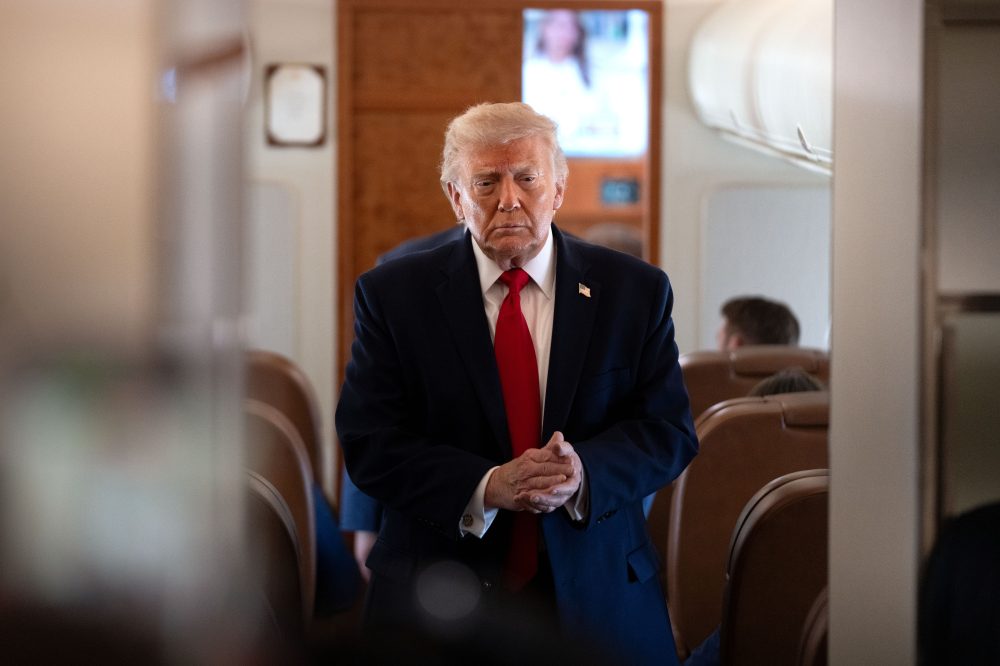

President Donald Trump stated Friday that he remains open to speaking directly with Taiwan’s President Lai Ching-te, despite China’s public warnings against such contact with the leader of the island nation that Beijing considers its territory.
Speaking to reporters aboard Air Force One, Trump initially floated this possibility last month following his meeting with President Xi Jinping in Beijing. He mentioned wanting direct communication with Lai while considering whether to approve a $14 billion weapons package for Taipei that received congressional authorization earlier this year.
When questioned Friday about his plans to contact Lai, Trump responded, “I’ll always talk to him,” indicating the phone conversation remains under consideration.
A direct conversation between current American and Taiwanese presidents would represent the first such communication in many decades, prompting Beijing to discourage Trump from pursuing this course of action.
In a statement to the Associated Press this week, the Chinese embassy in Washington warned that such contact could damage progress in the sensitive U.S.-China relationship. They called on the Republican administration to “handle the Taiwan question with utmost prudence” and “avoid sending wrong signals” to leaders of the democratically governed island that China considers a breakaway province.
Trump previously angered China when he accepted a congratulatory phone call from Taiwan’s then-President Tsai Ing-wen following his 2016 election victory but before assuming office.
While Trump has discussed potential direct contact with Lai, he has shown more caution regarding the major weapons package for Taiwan after hearing Xi’s concerns during their Beijing meeting. Although Congress approved the arms deal in January, it still requires Trump’s final authorization.
Last month, the president described arms sales with Taiwan as a “negotiating chip” in his administration’s Pacific region strategy.
During their recent Beijing summit, Xi cautioned Trump that the “Taiwan question” represents the most critical issue in China-U.S. relations, warning that the two countries will “have clashes and even conflicts” without careful management of this matter, according to Chinese officials.
Trump’s discussions with Xi regarding Taiwan arms sales appeared inconsistent with U.S. policy guidelines known as the Six Assurances. These non-binding principles, established in 1982 under President Ronald Reagan, have helped shape the U.S. relationship with Taipei, according to policy experts.
The second principle of the Six Assurances declares that the U.S. “did not agree to consult with the People’s Republic of China on arms sales to Taiwan.”
Secretary of State Marco Rubio told lawmakers during congressional hearings earlier this week that the United States’ Taiwan policy remains unchanged.
However, Trump’s statements have introduced uncertainty into the U.S.-Taiwan relationship, according to Craig Singleton, a China expert at the Foundation for Defense of Democracies.
“Trump’s comments about Taiwan arms sales as a negotiating chip, combined with uncertainty around a possible Lai call, have created more ambiguity than Taipei would like,” Singleton explained. “The real test is not the rhetoric. It is whether the pending arms package moves, and on what timeline.”
Should the phone call occur, Lai has indicated he would stress to Trump that peace and stability in the Taiwan Strait are vital for global security, while arguing that China acts as the “destroyer” of the strait’s peace.
Lai also said he would inform Trump that Taiwan’s growing defense spending responds to threats, and that purchasing U.S. weapons would be essential for maintaining strait stability.
Washington severed diplomatic relations with Taiwan in 1979 as part of recognizing the People’s Republic of China, and the Chinese have responded forcefully to other high-level U.S. engagements with Taiwan’s leadership.
Following an August 2022 visit to Taipei by then House Speaker Nancy Pelosi and five other Democratic lawmakers, China conducted extensive military exercises that included firing short-range ballistic missiles over the island.
Under the “One China” policy, the United States acknowledges the Chinese position that Taiwan belongs to China, while maintaining informal U.S. relations with the self-governing island.
Simultaneously, the U.S. has committed to ensuring Taipei has defensive capabilities, though Washington maintains strategic ambiguity about how far it would go militarily to counter Beijing if it chose to take Taiwan by force.
Following Trump’s Friday remarks, the Taipei Economic and Cultural Representative Office in Washington restated its position that it plans to “maintain close contact” with the U.S. on arms sales and other matters.
“We will leave it up to the U.S. to announce if there’s any arrangements for President Trump to speak with President Lai,” the office stated.
China would consider a phone conversation between Trump and Lai more provocative than proceeding with the proposed arms sale to Taiwan, said Edgard Kagan, a former U.S. ambassador to Malaysia and senior State Department official handling East Asia policy issues under Trump and President Joe Biden.
Kagan noted the significance of Trump continuing to publicly suggest such a call remains possible after China warned the U.S. administration against a Trump-Lai engagement.
If Trump decides against phoning Lai, he might create opportunity to advance new arms sales for Taipei while reducing backlash from Beijing, said Kagan, who now serves as the China Studies chair at the Center for Strategic and International Studies in Washington.
“This could give him the room to announce an arms sale, defuse the criticism that the U.S. is turning its back on Taiwan, and do it in a way that leaves the Chinese feeling there was some respect for their views,” Kagan explained.