
President Donald Trump was warned about the possibility of significant American casualties before authorizing military strikes against Iran, while also being told the operation could reshape Middle East power dynamics for generations, according to a U.S. official speaking to Reuters.
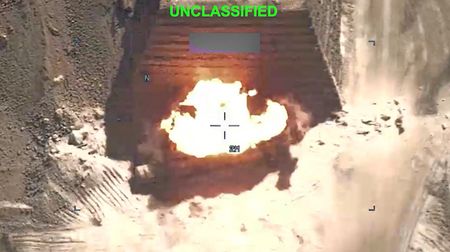
The Pentagon’s ‘Operation Epic Fury’ launched Saturday has thrust the Middle East into an uncertain new phase of conflict. Combined U.S. and Israeli forces targeted multiple locations throughout Iran, prompting Iranian counterstrikes against Israel and neighboring Gulf nations.
According to the anonymous official, military advisers presented the mission to Trump as carrying both substantial dangers and potentially transformative benefits.
The president seemed to acknowledge these stakes when he stated that ‘the lives of courageous American heroes may be lost.’
‘But we’re doing this not for now, we’re doing this for the future, and it is a noble mission,’ Trump declared during a televised announcement of the combat operations.
‘For 47 years, the Iranian regime has chanted death to America and waged an unending campaign of bloodshed and mass murder … We’re not gonna put up with it any longer.’
These intelligence assessments from Trump’s security advisers shed light on the decision-making process behind what may be America’s most dangerous military venture since the 2003 Iraq invasion.
Before authorizing the strikes, Trump met with key officials including CIA Director John Ratcliffe, Joint Chiefs Chairman General Dan Caine, Secretary of State Marco Rubio, and Defense Secretary Pete Hegseth.
Admiral Brad Cooper, who commands U.S. Middle East operations through Central Command, traveled to Washington Thursday for White House Situation Room consultations.
A second U.S. official revealed that pre-strike briefings outlined numerous potential threats, including overwhelming Iranian missile barrages against multiple American bases and proxy force attacks on U.S. personnel in Iraq and Syria.
Despite America’s substantial military deployment, the official noted limitations in regional air defense capabilities that had been rapidly positioned.
Military analysts warn the developing conflict could spiral dangerously, with the first official noting Pentagon plans offer no guaranteed outcomes.
While Trump has urged Iranians to overthrow their government, Nicole Grajewski from the Carnegie Endowment for International Peace expressed skepticism about such prospects.
‘The Iranian opposition is pretty fragmented. It’s unclear what the population is willing to do in terms of rising up,’ Grajewski explained.
Both officials demanded anonymity given the classified nature of internal deliberations.
Neither the White House nor Pentagon provided immediate responses to comment requests.
In preparation for the assault, Trump authorized massive military reinforcements across the Middle East. Reuters previously reported on extensive planning for sustained Iranian operations, including targeting specific officials.
An Israeli source indicated that Iran’s Supreme Leader Ayatollah Ali Khamenei and President Masoud Pezeshkian were both targeted, though strike results remain unclear.
Trump outlined ambitious goals Saturday, vowing to eliminate Tehran’s threat to America while enabling Iranians to remove their current leadership. His strategy includes dismantling Iran’s military capabilities and preventing nuclear weapons development, though Iran denies pursuing such weapons.
‘We are going to destroy their missiles and raze their missile industry to the ground… We’re going to annihilate their navy,’ he announced. ‘We’re going to ensure that the region’s terrorist proxies can no longer destabilize the region or the world and attack our forces.’
This decision reflects Trump’s growing willingness to accept military risks, surpassing even last month’s special operations raid that captured Venezuela’s president.
The Iranian campaign also exceeds the risk level of Trump’s June order to bomb Iran’s nuclear facilities.
Iran’s Revolutionary Guards have threatened all American regional assets, promising continued retaliation until ‘the enemy is decisively defeated.’
Security experts highlight Iran’s diverse retaliatory options, spanning missile attacks, drone warfare, and cyber operations.
Former Pentagon Middle East official Daniel Shapiro, who also served as U.S. ambassador to Israel, cautioned that Tehran retains significant strike capabilities despite the allied assault.
‘Iran has many more ballistic missiles that can reach U.S. bases than the U.S. has interceptors … some Iranian weapons will get through,’ Shapiro warned. ‘(The strikes are) a major gamble.’