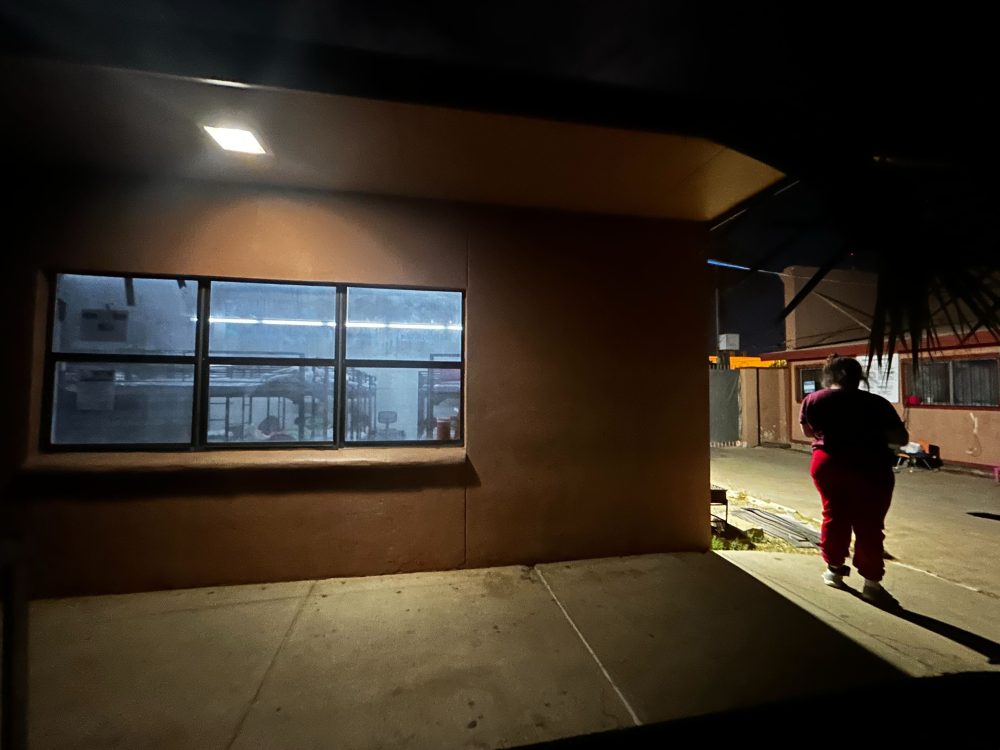

LAREDO, Texas — After spending a month at a Texas immigration detention facility located 1,300 miles from their Minnesota residence, an Ecuadorian mother and her 7-year-old child finally gained their freedom.
However, as their bus arrived at a border town shelter in Laredo in mid-February, the trauma from their recent experience at the Dilley Immigration Processing Center continued to weigh heavily on both mother and daughter.
During countless nights confined alongside hundreds of other families at the south Texas facility, the young girl cried repeatedly, desperately seeking answers about their imprisonment.
“She would tell me, ‘Mom, what crime did I commit to be a prisoner?’ I didn’t know what to tell her,” explained the 29-year-old mother, who requested anonymity to protect their ongoing immigration proceedings. Her spouse was removed to Ecuador shortly after their detention began.
Last month, widespread concern emerged when images showed Immigration and Customs Enforcement officers in Minneapolis apprehending 5-year-old Liam Conejo Ramos, who was photographed wearing a bunny hat and carrying a Spiderman backpack. Public attention followed Liam and his father to Dilley, a facility encircled by chain-link barriers on barren land roughly 75 miles south of San Antonio.
However, Liam’s situation represents just one case among many. ICE currently detains hundreds of minors at Dilley, with many confined for extended periods.
“We are all Liam,” stated Christian Hinojosa, a Mexican immigrant speaking by telephone from Dilley, where she and her 13-year-old son remained detained for over four months. They gained release this month and returned to San Antonio, where she works as a healthcare assistant.
Hinojosa observed that Liam and his father were freed after just 10 days following intervention by congressional members and a judge.
“My son says, ‘That’s unfair, Mama. What’s the difference between him and us?’”
Originally opened during the Obama presidency in 2014, Dilley initially housed families who had recently entered from Mexico. The Biden administration reduced operations at the facility in 2021 before shuttering it three years later.
Since President Trump’s administration reopened the compound of trailers and prefabricated structures last spring, conditions at Dilley have been influenced by three significant modifications.
Family detention numbers have increased dramatically since autumn. Officials are holding numerous children well past the 20-day maximum established by longstanding court orders. Additionally, many detainees had established lives in American communities for years, maintaining connections to neighborhoods, jobs, and schools, according to legal representatives and observers.
“Just imagine that you’re a child and you’re taken out of your surroundings,” explained Philip Schrag, a Georgetown University law professor who authored “Baby Jails: The Fight to End the Incarceration of Refugee Children in America.”
Suddenly children find themselves in “a completely strange environment with the doors locked and guards in uniform roaming around,” said Schrag, who provided legal assistance to Dilley detainees as a volunteer attorney during the Obama years.
During the initial nine months of the current Trump administration, ICE processed over 3,800 children into detention, based on Associated Press analysis of University of California, Berkeley’s Deportation Data Project information. Daily averages exceeded 220 detained children, with most held beyond 24 hours transferred to Dilley. Children comprised more than half of Dilley’s population during this timeframe.
Nearly two-thirds of detained children were ultimately deported, while almost 10 percent departed when parents accepted voluntary removal, according to AP analysis of comprehensive data. Approximately one-quarter received release within the U.S., requiring parents to maintain regular ICE contact during legal proceedings.
Dilley’s population has surged dramatically since the data period, nearly tripling from fall through late January to exceed 1,300 individuals, according to Relevant Research, which analyzes immigration enforcement statistics.
“We’ve started to use 100 days as a benchmark because so many children are exceeding 20 days,” said Leecia Welch, chief legal director at Children’s Rights, who conducts regular Dilley visits for compliance monitoring. During a recent visit, Welch documented over 30 children held beyond 100 days.
Expanded child detention coincides with the Trump administration’s elimination of a Department of Homeland Security office responsible for overseeing conditions at Dilley and similar facilities.
“It’s a particular concern that family detention is being increased,” said Dr. Pamela McPherson, a child and adolescent psychiatrist contracted by DHS from 2014 until last year for inspecting and investigating conditions at Dilley and other ICE facilities housing children.
“Just who’s providing that check-and-balance now?”
Representative Tony Gonzales, whose congressional district includes Dilley, said multiple facility visits have convinced him that criticism is unwarranted.
Gonzales expressed admiration for Dilley’s facilities and staff professionalism. “They’re not doing policy. They’re just fulfilling a duty,” said the Republican representative.
DHS did not respond to detailed AP inquiries about Dilley. However, both DHS and ICE strongly disputed allegations regarding inadequate care and conditions.
“The Dilley facility is a family residential center designed specifically to house family units in a safe, structured and appropriate environment,” ICE Director Todd M. Lyons stated this week. Available services include medical screenings, infant care packages, classrooms, and recreational areas.
Concerns about Dilley became personal for Venezuelan immigrant Kheilin Valero Marcano, who was detained with her husband and 1-year-old daughter Amalia in December and held nearly two months.
When the child developed high fever, Valero Marcano said Dilley personnel dismissed it as merely viral. Two weeks later, Amalia began vomiting and losing weight. Despite at least eight visits to Dilley’s medical office, Valero Marcano said staff only offered Tylenol and ibuprofen.
The infant was eventually hospitalized twice, where physicians diagnosed COVID, bronchitis, pneumonia, and stomach virus, she reported.
ICE challenged Valero Marcano’s version, stating the baby “immediately received proper medical care” at Dilley before hospital transfer. Upon returning to Dilley, “she was in the medical unit and received proper treatment and prescribed medicines,” officials said.
The family’s Dilley return coincided with a measles outbreak. They gained release earlier this month after legal petitions to the court.
“I’m so worried for all the families who are still inside,” Valero Marcano said.
Following over two months in cramped Dilley quarters shared with three other families, a 13-year-old girl’s depression deepened significantly.
The eighth-grader refused food after discovering a worm in her meal, family members reported. Staff occasionally withheld medications she had long received for anxiety management and sleep assistance.
During a complete lockdown, a guard prevented the teenager from leaving their crowded room to accompany her mother and sister to the bathroom. She entered crisis mode and used a plastic cafeteria knife to cut her wrist.
“She said she didn’t want to live anymore because she preferred to die rather than having to keep living in confinement,” her mother, Andrea Armero, told AP via video call from Colombia, where the family was deported this month. AP typically avoids identifying individuals who attempt or complete suicide.
The girl’s difficulties predated Dilley arrival. Shortly after beginning Colombian middle school, she learned a family member had sexually abused her younger sister. Armero said departure seemed the only option, and in early 2024 she and her daughters traveled to the U.S.-Mexico border seeking asylum.
While living with Florida relatives, the 13-year-old performed well academically but occasionally experienced panic attacks about potential return to Colombia. Under psychiatric care, she received anti-anxiety and antidepressant prescriptions and regular therapy. Then in December, ICE agents detained Armero and her daughters during routine check-in.
At Dilley, the 13-year-old found comfort in drawing, creating disturbing images of a girl trapped behind gates. However, when she and other detainees participated in protests after 5-year-old Liam and his father arrived at Dilley, guards confiscated art supplies and ordered everyone inside.
The teenager’s mental health deteriorated completely. She attempted self-harm with the plastic knife and repeatedly struck her head, Armero said. The family was placed in isolation without medical evaluation, then deported to Colombia on February 11 following a judge’s removal order.
Dilley discharge documents listed “active problems,” including “suicide attempt by cutting of wrist” and “self-harm,” plus “history of post-traumatic stress disorder” and “history of anxiety.” AP also interviewed detainees and attorneys who independently confirmed the girl’s suicide attempt.
Addressing AP questions, a DHS official acknowledged “a case of self-harm” within the facility but provided no specifics about the incident or staff response. DHS did not respond to follow-up inquiries seeking details.
“No child at Dilley has been denied medical treatment or experienced a delayed medical assessment,” said Ryan Gustin, spokesman for CoreCivic, the for-profit prison company operating the facility under ICE contract. Gustin declined specific questions about the 13-year-old, citing privacy regulations.
During a phone call from inside Dilley, 13-year-old Gustavo Santino-Josa introduced himself to a reporter by name and the nine-digit identification number ICE assigned when he and his mother were detained.
“Until today I don’t know what we did wrong to get detained,” Gustavo said. “I’ve seen my mom cry almost daily and I ask God that we can go out and go home soon.”
He expressed concern they might never gain release.
“My mom says that as long as there is hope it is worth fighting for,” Gustavo said before transferring the phone to his mother, Christian Hinojosa, the healthcare aide originally from Mexico.
“All his friends have left already,” his mother explained. “Some were deported. Some got released recently. And it hurts. It hurts to see people leaving and you’re staying here.”
Built to accommodate 2,400 individuals, Dilley houses families in clusters ICE terms “neighborhoods.” Bunk beds are positioned side-by-side for up to four families, frequently placing parents with young children in close proximity.
At full capacity, Dilley is projected to generate approximately $180 million in annual revenue for CoreCivic, according to the company’s recent securities filing.
A CoreCivic website video describes Dilley’s “open campus layout allows residents to move freely and unescorted throughout the day.”
The video omits mentioning that parents and children are locked inside.
Responding to AP questions, CoreCivic’s Gustin said Dilley staff includes a pediatrician, pediatric nurse practitioner, other trained medical professionals, and mental health services to “meet the needs of children and families in our care.”
However, discussions with parents of Dilley-detained children reveal recurring issues, said Welch, the children’s rights attorney.
Children frequently cry and experience sleep deprivation, partly due to 24-hour lighting, she noted. The water tastes awful and causes stomach problems and rashes, leading some families to rely on commissary purchases.
Children eat inadequately and have lost weight, Welch reported. While classrooms exist, instruction is limited to one hour daily, primarily completing worksheets.
A 14-year-old girl, identified in court documents as NVSM, reported tensions with up to 12 people sharing their room. At night when she and her mother attempted sleep, others insisted on loud television.
“I feel very sad and stressed to be here,” the teenager stated in court filings related to the binding settlement governing child detention and release. “My nerves are so high. I don’t know what is happening. My muscles will twitch because I’m so nervous and on edge.”
As government detention of parents and children faced scrutiny in 2014, an ICE official claimed that family detention centers, featuring basketball courts and medical clinics, were “more like a summer camp.”
This characterization frustrated McPherson, the child psychiatrist who, with another physician, was hired in 2014 by DHS to inspect family detention centers. The Trump administration did not renew their contracts last year after announcing extensive staff reductions.
“Having a clean place to sleep, having food, that’s not the same thing as having family and community,” McPherson said.
The physicians’ family detention center investigations revealed consistently inadequate staffing and administrative disregard for detention-caused trauma, concerns they reported in 2018 to a Senate caucus established for whistleblower testimony.
At Dilley, the doctors documented persistent pediatrician shortages and inability to hire a child psychiatrist throughout their inspection period until alerting senators.
Employees uncertain about managing 2-year-olds who bit and hit each other placed children and parents in medical isolation for days, McPherson and her colleague told senators. Without supervision, a Dilley nurse administered adult-strength hepatitis A vaccines to approximately 250 children in 2015, the American Immigration Lawyers Association reported.
DHS addressed many findings through changes before a special committee recommended in late 2016 that government discontinue family detention except in rare circumstances. The first Trump administration expanded family detention before the Biden administration began phasing it out in 2021.
The Trump administration’s decision to again hold families at Dilley after numerous warnings feels “dystopian,” McPherson said.
“The decision to knowingly traumatize children and subject them to chronic stress, I just have no words for it,” she said.
Gathered around picnic tables at the Laredo migrant shelter, parents released from Dilley searched frantically for flights to the homes they left behind. They contacted relatives, friends, teachers, anyone who might provide financial assistance for travel.
The young Ecuadorian mother discussed returning to Minneapolis, where her 2-year-old daughter, born in the U.S., was staying with a friend. With her husband deported, she faces sole parenting responsibilities.
This means re-enrolling her 7-year-old in school. Then the woman, who held a work permit and restaurant job in Minneapolis before detention, must provide for her children.
“Let’s go home, Mom, but don’t go back to work because ICE is going to pick you up again,” the little girl said. Her mother attempted reassurance.
That won’t happen, she explained, because they now possess special documentation instructing ICE to leave them alone.
She hopes that’s a promise she can maintain.