
WASHINGTON — President Donald Trump on Thursday presented the Medal of Honor to three military veterans, recognizing their remarkable acts of bravery that saved lives and drove back enemy forces during combat in Vietnam and Afghanistan.
The nation’s highest military honor was awarded to Marine Corps Maj. James Capers Jr. and Army Maj. Nicholas Dockery. A third medal was presented posthumously to Marine Corps Col. John W. Ripley, who passed away in 2008.
“These are great men, great people,” Trump said during the ceremony. “We thank you and we will never, ever forget you.”
Capers, now 88 years old, earned the honor for putting his own life at risk to protect fellow Marines after their unit was ambushed during a mission in Vietnam in 1967. What began as a reconnaissance operation to locate a suspected North Vietnamese base camp quickly turned into days of brutal combat in thick jungle terrain, according to his official citation.
On the fourth day of fighting, enemy forces ambushed his team, and Capers suffered a broken leg and serious abdominal wounds from a mine explosion.
“After a shot of morphine, Jim asserted command of the firefight,” Trump said, recounting the events. “He took over like nobody’s ever seen before.”
Despite his injuries, Capers coordinated air support to push back the attack. When a rescue helicopter finally arrived, he made sure every wounded Marine was loaded onto the aircraft before boarding himself.
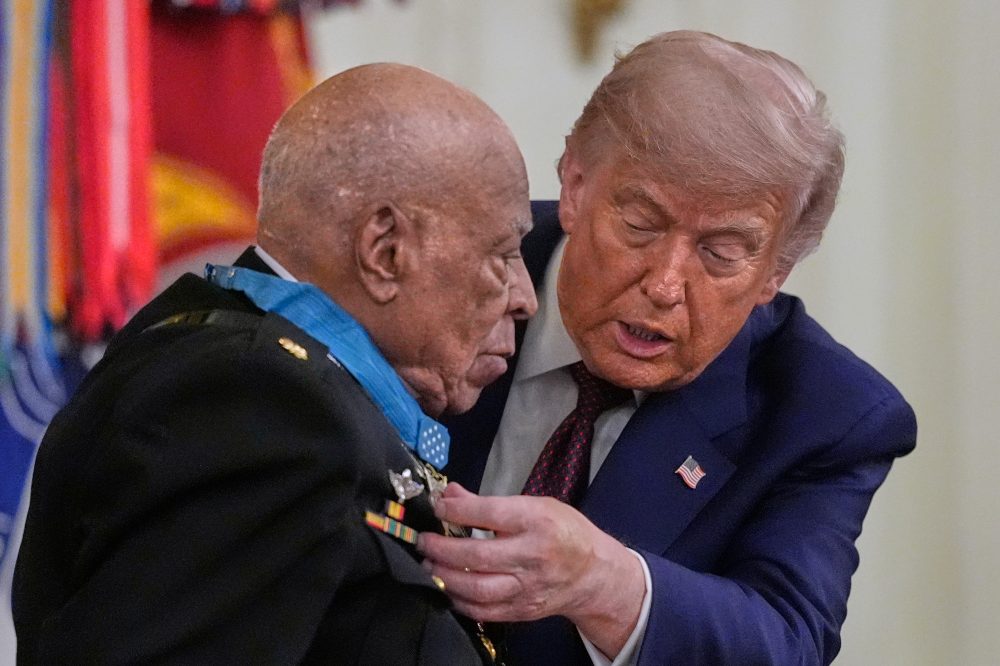
Trump shared a personal moment with Capers at the ceremony, carefully pinning the medal around the veteran’s neck and adjusting it by the shoulders to ensure it hung properly. Capers had held a stoic expression throughout, but broke into a wide smile when Trump grinned at him.
Col. Ripley was honored for a daring solo effort to stop the advance of North Vietnamese forces by destroying a critical bridge in 1972. According to his citation, a force of more than 30,000 enemy soldiers and 200 tanks was closing in on a bridge in the village of Dong Ha when Ripley single-handedly positioned 500 pounds of explosives to bring the structure down.
The effort took five hours, during which Ripley repeatedly climbed along the bridge’s steel beams while exposed to enemy fire to place the explosive charges.
“John completed not one, not two, but five such trips,” Trump said, describing Ripley as a “very strong guy.”
After saying a prayer, Ripley detonated the bridge, collapsing it into the water and stopping the North Vietnamese advance, Trump recounted. Ripley’s three sons and other family members were present at the ceremony to accept the honor on his behalf.
Maj. Dockery’s medal recognized his actions in 2012, when his platoon was guarding a compound in Afghanistan’s Kapisa Province and came under attack by an estimated 150 Taliban fighters. Dockery sprinted across open ground to regroup his scattered soldiers and then went searching for missing members of his unit, according to his citation.
After carrying a wounded soldier out of the line of fire, Dockery spotted two enemy combatants moving toward another injured American soldier in an alley. He eliminated both threats before performing CPR on the wounded soldier to restore his breathing. Dockery then called in mortar support and used his own body to shield the injured soldier from the blasts.
After hours of close-quarters urban combat, Dockery used smoke grenades to mark enemy positions for American gunships overhead. He refused to leave until every wounded soldier had been safely evacuated.
“You were the last man to depart the battlefield that day,” Trump told Dockery, “and you left it a legend and a hero.”