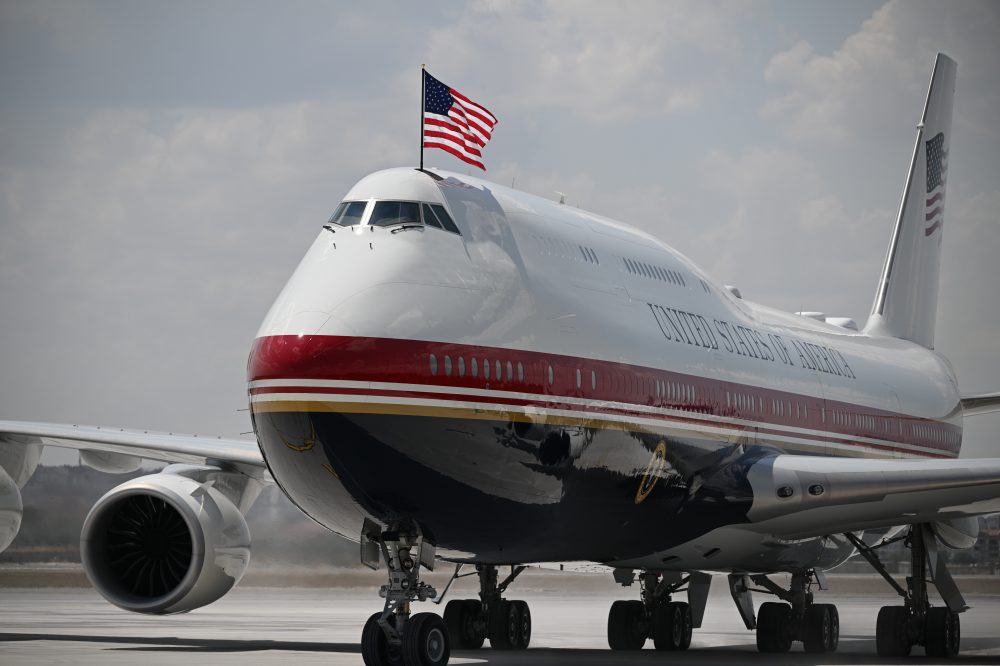

WASHINGTON — The Trump administration served subpoenas Friday to multiple journalists at The New York Times in response to the newspaper’s recent coverage of security questions surrounding the new Air Force One aircraft, according to the paper.
The new presidential jet, which President Donald Trump received as a gift from Qatar, only entered service last week. Federal agents personally delivered some of the subpoenas to the reporters at their residences.
The subpoenas are demanding that the reporters appear before a federal grand jury in Manhattan on Wednesday, the Times reported. The White House and the Department of Justice had not responded to requests for comment at the time of publication, and the Times’ account could not be independently verified.
The newspaper’s attorney, David McCraw, issued a sharp response Friday, stating: “The appearance of federal law enforcement agents on the doorstep of news reporters should shock the conscience of any American who believes in the Constitution and the press freedom it protects.”
The situation unfolded after Trump flew aboard the new Air Force One to a NATO summit held in Turkey. However, when he departed Wednesday for Mildenhall — a Royal Air Force installation in Suffolk, England — he boarded one of the older presidential aircraft instead. Both jets made the trip to Mildenhall, and Trump then switched back to the newer plane for the return flight to Joint Base Andrews.
The sudden change in aircraft raised eyebrows, particularly given that a fragile cease-fire with Iran had fallen apart around the same time, with the U.S. carrying out airstrikes on Iran and Tehran striking three Gulf Arab nations. Because Iran and Turkey share a border, observers speculated that the Qatar-donated jet — which received a $400 million retrofit — may be missing certain advanced security and defensive systems.
The Times had reported Wednesday that the Secret Service pushed for the plane switch. A follow-up report Thursday said the newer aircraft lacked some protective capabilities found on the older jets, including systems designed to counter missiles. Both stories relied on unnamed sources.
President Trump dismissed any suggestion of security concerns at the time, posting on social media that the stop in England was simply to let military personnel stationed there get a look at the new aircraft. While flying home, Trump told reporters on board that Iranian threats played no role in the decision to fly two planes back. When asked whether he knew of any specific Iranian threats against Air Force One, Trump downplayed the question.
“I have a threat all the time. I’m No. 1 on their list,” Trump said.
The White House subsequently pushed back on any claims of security deficiencies with the new plane. Spokesman Steven Cheung released a statement saying: “The new Air Force One is a state-of-the-art aircraft that has been fitted with high-level security protocols that ensure the safety of the President and his staff. As the President has said recently, there are many enemies of America who have their sights on him, and we use every tool at our disposal — including distraction and misdirection — to address those threats.”
The Times identified the journalists who received subpoenas as Julian E. Barnes, Eric Lipton, Tyler Pager, and Eric Schmitt.
This is not the first time the Justice Department has taken this approach in recent months. Earlier this year, the DOJ issued subpoenas targeting reporters at The Washington Post and The Wall Street Journal, though in both of those instances, the subpoenas were eventually withdrawn.