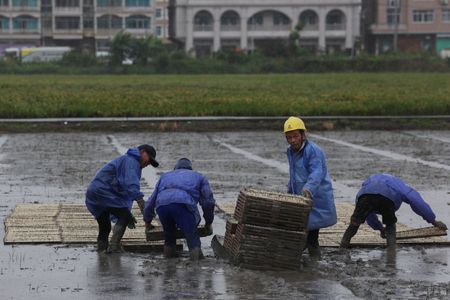

Chinese authorities have ordered the evacuation of more than 1.8 million people as Typhoon Bavi churns toward Wenzhou, a major eastern city, after hammering Japan’s southern Sakishima island chain with fierce winds and torrential rain and skirting past northern Taiwan.
Although Bavi has been gradually slowing and losing strength as it travels over cooler ocean waters on a northwesterly track, meteorologists warn the storm remains a serious threat. Its rain bands stretch an area roughly the size of France, carrying an enormous amount of moisture capable of causing widespread flooding.
As of 0808 GMT, the National Meteorological Center reported that Bavi was carrying maximum sustained winds of 144 kilometers per hour — equivalent to a Category 1 hurricane on the Saffir-Simpson scale — and was positioned approximately 200 kilometers southeast of Wenling in the eastern province of Zhejiang. The storm is projected to come ashore near Wenzhou, a city of around 10 million people, in the early hours of Sunday.
State media reported that more than 1.7 million residents had been moved out of harm’s way across Zhejiang province, where Wenzhou is situated, while an additional 100,000 people were evacuated from the neighboring province of Fujian.
Wenzhou resident Huang Xinghuan, 50, was spotted purchasing groceries at a local wet market before it closed ahead of the storm’s arrival. “I’m a little worried, but I think it’ll be OK. We’ve been through typhoons before. We’ll get through it,” he said.
Huang noted that his family had set aside roughly two to three days’ worth of water. He added, “I think supplies are well guaranteed now. There’s no need to panic or stockpile a lot of food or other supplies.”
While neither Japan nor Taiwan has reported any deaths directly from the typhoon, the storm’s influence worsened a southwest monsoon in the Philippines, where 17 people were killed by the resulting heavy rainfall. Taiwan’s fire department reported 87 injuries on the island, most of them involving people falling from motorcycles or bicycles, or being struck by objects.
In Taiwan, the government relocated more than 14,000 residents — primarily from mountainous regions — as the island braced for Bavi’s approach. Though the typhoon did not make direct landfall in Taiwan, officials took extensive precautions given forecasts calling for nearly one meter, or about three feet, of rain in certain areas.
The majority of those evacuated were from northern and eastern parts of the island. Around 920 international flights were cancelled, effectively shutting down the main international airport at Taoyuan, located outside the capital city of Taipei. All 282 domestic flights were also grounded. Nearly every city and county across Taiwan declared a typhoon holiday for Saturday, closing offices and schools, though some restaurants and convenience stores in Taipei remained open. The main north-south high-speed rail line kept running but with reduced service.
In downtown Taipei, some residents ventured outside despite the blustery conditions. “It’s OK, it’s not that serious,” said Yeh Mao-hsiung, 68, who was taking his dog for a morning walk. “It’s just a little bit more wind.”
However, in Taipei’s Beitou neighborhood, nestled in the foothills of the mountains surrounding the city, gusts reaching around 100 kilometers per hour toppled trees and caused rivers to swell.
Back in Wenzhou, a woman in her 60s named Chen Qiuqin was walking through steady rainfall on her way to check on her elderly parents. She said she wanted to help them prepare but wasn’t overly alarmed, citing the government’s response efforts. “I was worried about the flowerpots on my mother’s balcony, so I’m going to help move them inside. My parents are both elderly and they’re home alone, so I wasn’t at ease,” she explained.