
TAIPEI, April 12 – America’s highest-ranking official in Taiwan called on Beijing to cease its intimidation tactics and military coercion against the island nation, urging instead for direct communication with Taiwan’s democratically chosen leadership to prevent misunderstandings and promote stability.
Raymond Greene, who serves as the United States’ de facto ambassador through his role directing the American Institute in Taiwan – the organization managing U.S.-Taiwan relations without formal diplomatic recognition – emphasized America’s longstanding commitment to supporting cross-strait dialogue during a Saturday appearance on a Taiwanese political program.
Speaking in Mandarin, Greene stated: “However, we also expect China – Beijing – to maintain open communication channels with all of Taiwan’s political parties, especially the leaders elected by the Taiwanese people, in order to avoid misunderstandings and to stabilise cross-strait relations.”
“We further expect China to abandon threats against Taiwan or military pressure. I believe this would help ease cross-strait tensions,” Greene added.
China’s Taiwan Affairs Office has not yet provided a response to requests for comment regarding Greene’s remarks.
Beijing considers the democratically governed island as part of its territory and has consistently refused to rule out military action to achieve unification. Taiwan’s administration firmly disputes China’s territorial assertions.
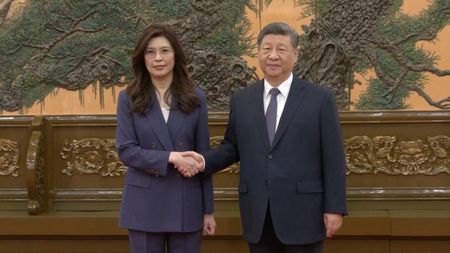
Chinese leadership declines to engage with Taiwan’s President Lai Ching-te, labeling him a “separatist.” However, Chinese President Xi Jinping held talks Friday with Cheng Li-wun, who leads Taiwan’s primary opposition party, the Kuomintang, during her self-described peace mission to China.
Chinese military forces conduct regular operations in Taiwan’s vicinity, activities that have persisted throughout Cheng’s current visit to China.
Taiwan’s opposition-controlled parliament has blocked government defense spending initiatives, including a special $40 billion defense package designed to purchase American military equipment – a plan supported by Washington.
Although formal diplomatic relations don’t exist, the United States remains Taiwan’s primary weapons provider and most significant international ally.
Greene emphasized that while America encourages diplomatic engagement, such efforts cannot substitute for military deterrence.
“I don’t think there is a conflict here, because if there is sufficient deterrence capability, it will lead to a more equal dialogue,” he explained.
“There are three ways to resolve cross-strait differences: the first is dialogue, the second is coercion and the third is war. So if Taiwan can have sufficient deterrence capability, it can take the option of war off the table.”