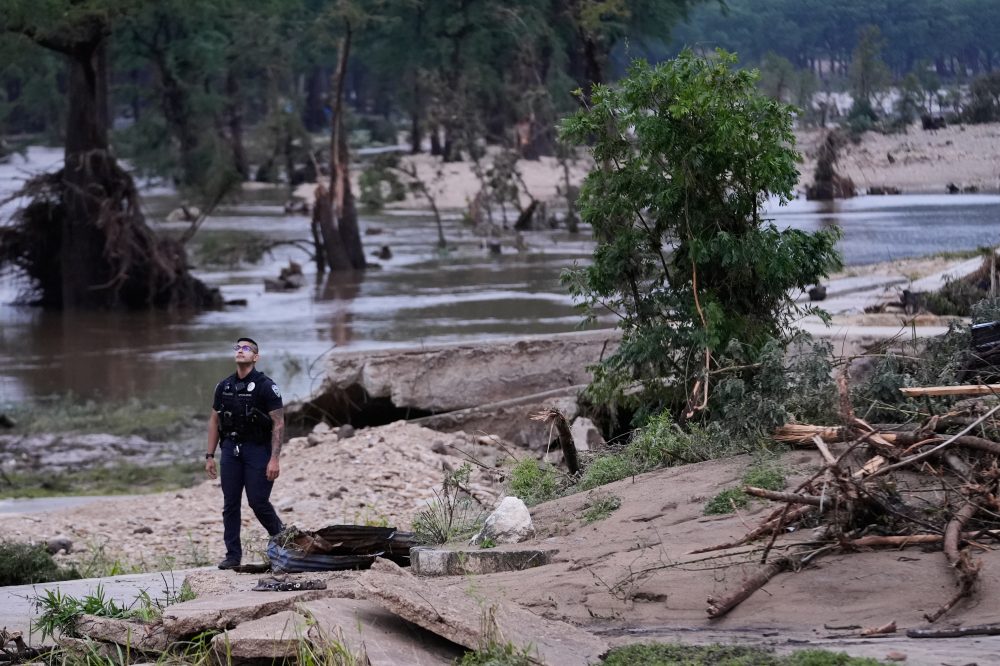

Less than a year after catastrophic flooding claimed more than 100 lives across Texas’ Hill Country, a fresh round of powerful storms unleashed devastating flash floods this week in many of the same communities — putting newly installed warning systems to the test for the first time.
At least two people lost their lives in the latest disaster, and hundreds of others had to be rescued from rising waters. But unlike the deadly floods of July 2025, many residents said they received timely warnings that gave them a chance to reach safety.
New flood sirens wailed in the middle of the night. Cell phones buzzed with emergency alerts that never came during last year’s disaster. For some, that made all the difference.
Still, the flooding exposed ongoing challenges. Some residents were caught completely off guard, underscoring how difficult it remains to build a reliable early warning network across a vast, rural stretch of Texas long known as Flash Flood Alley.
An Associated Press investigation following last summer’s floods — which killed 136 people, including 28 children at a sleepaway camp for girls — found that state and local agencies had missed multiple opportunities over the past decade to put flood warning systems in place along the Guadalupe River.
That reporting helped spark action. In Kerr County, local officials had acknowledged being hesitant to “cry wolf” during last year’s disaster and failed to send wireless emergency alerts. This time around, Kerr County issued four alerts and the city of Kerrville issued one early Thursday as flood conditions developed, according to an AP review of available data. Residents near Quinlan Creek were told to evacuate to higher ground and warned of “extremely dangerous” flash flooding. The National Weather Service also pushed out flood watches, warnings, and emergency messages through broadcast stations, weather radios, and mobile phones. Those who had signed up for Kerr County’s CodeRED notification system received text message warnings as well.
Kerrville resident Suzanne Sutphin Gschwind said the contrast with last year was striking. “Last year, we got no alarms. We had no idea what was going on,” she said. “This year, very different” — with texts and calls arriving from local authorities, a weather channel, and even her doorbell camera. On one night, alerts came in “about every two hours.” She added, “I think we would all like to err on the side of too much.”
Between early Tuesday morning and approximately 9 a.m. Thursday, the National Weather Service sent 38 alerts to residents in certain southwest Texas communities, including 14 tornado warnings and 24 flood warnings describing conditions as occurring or imminent and potentially “life threatening.”
However, those National Weather Service alerts often lack the highly specific local information that county and city emergency agencies can provide — and those local alerts can be more critical for people deciding whether to evacuate.
An AP review of wireless emergency alert data found no alerts listed as sent by agencies in Uvalde County, which was heavily impacted by flooding, though local agencies there may have used other methods to notify residents.
Jaclyn Gonzales was jolted awake at 2 a.m. Wednesday by a friend calling to warn about a possible tornado near her Uvalde-area home. When she got out of bed, the floor was already wet. “It was the shock of the water to my feet that made me really wake up,” she said.
Kat Sprawls, who lives in Batesville, only found out floodwaters were approaching after a friend called her at 3:30 a.m. Friday. It took five or six calls before she woke up — her phone had been set to do-not-disturb mode. “There’s no warning system at all. It’s just like the flood in Kerrville last year — we had no warnings,” Sprawls said. “Over half of Batesville is under water now.”
Jessica Belmarez, secretary of the Zavala County Sheriff’s Department, said the department was posting evacuation information on Facebook and that officers were going door-to-door in flooded areas, including Batesville.
State Sen. Paul Bettencourt, who authored legislation in 2025 to help fund flood sirens, said newly installed sirens in Ingram and in Kerr and Kendall counties were activated this week. He noted that 28 additional counties are eligible for flood warning funding and that most are working on implementation plans for review by the Texas Water Development Board. “Between the outdoor sirens, and the cellphone alerts, the response was very positive in getting people out of the way and to higher ground,” Bettencourt said. “It’s an enormous improvement over a year ago.”
Tara Bushnoe, manager of the Upper Guadalupe River Authority, said three of the six newly installed sirens in Kerr County were activated to alert people to seek higher ground. The remaining three were located in areas that experienced only minor flooding.
In the small town of Comfort, the volunteer fire department recently added two more sirens to the single one that had been in place for years. Assistant Fire Chief Danny Morales said some residents were reluctant to leave even after the sirens sounded. “Some people just don’t want to leave — that’s our problem here,” he said. “But we did set them off twice, probably an hour from one to another, just because we had people just lingering, and not wanting to move.”
Ian Cunningham launched a company called River Sentry following the 2025 floods, building siren towers for privately owned locations such as RV parks, camps, and hotels. The sirens are triggered automatically by rising water levels. The company has now installed 104 sirens along the Guadalupe River, Cunningham said, including several near the site of an RV park where more than three dozen people perished in 2025. “We installed them about three months ago and did not expect them to be used so soon,” he said.
A company called Hononu, which developed water-level sensor technology and a real-time data network, was awarded a state contract making it easier for agencies to purchase its flood warning technology. The fire-tracking app Watch Duty, used by millions of people, also expanded earlier this year to help monitor flood conditions.
Texas Gov. Greg Abbott credited the lessons learned from 2025 with improving this year’s emergency response. “Everybody in Texas has been far more prepared to deal with what has happened this year,” Abbott said at a news conference in Uvalde. “Lives have been saved.”