
A devastating livestock pest not seen in Texas for decades has returned, leaving cattle ranchers frustrated with federal officials’ handling of the crisis.
Federal agriculture officials confirmed this week that New World screwworm has been detected in two Texas locations – marking the state’s first confirmed cases since the 1970s. The announcement has divided local ranchers and residents, with many questioning whether the government agency’s response measures are adequate or swift enough.
Susan Storey, now 62, remembers the horror of previous screwworm invasions from her childhood in South Texas. She can still recall watching writhing maggots burrow into live animals and the stench of burning calf carcasses that were beyond saving.
“We’re fighting for this so our grandchildren can keep what we have,” Storey explained while driving her pickup along a dusty ranch road lined with cattle and green fields. “I don’t want my herd threatened.”
Cattle producers across the nation have been preparing for a domestic screwworm case for more than a year as the parasite moved northward through Mexico. Agricultural experts warn that a major outbreak could inflict $1.8 billion in economic losses on Texas and devastate the state’s wildlife populations. For ranchers like Storey who survived the previous outbreak, this latest development has damaged their confidence in federal agriculture officials and spurred them to seek independent solutions.
The screwworm is a parasitic fly species whose females deposit eggs in wounds on any warm-blooded creature. After hatching, hundreds of larvae consume living tissue with razor-sharp mouths, ultimately killing their host without treatment. The parasites primarily spread when infected animals move to new locations and present no food safety risks while rarely affecting people, according to specialists. When screwworm was last widespread in America, the cattle industry required three decades to fully recover, Agriculture Secretary Brooke Rollins noted.
Federal and Texas authorities established a restricted area around the outbreak sites while increasing trap deployment and monitoring activities, sending response teams, and continuing to release sterilized flies. Rollins expressed confidence that the agency will successfully contain the Texas discoveries and prevent the pest from establishing itself permanently in America.
“Well before the first U.S. detection of New World Screwworm, since February of 2025, USDA has worked around the clock with our state, local, industry, and ranchers on the ground. The secretary herself made four trips to South Texas, more than anywhere else in the country,” a USDA spokesperson told Reuters. “The idea that this department has not been transparent is absurd and does not match what ranchers are telling the department and our partners directly.”
Previous reporting revealed that hundreds of veterinarians, support personnel, and laboratory workers at the federal agriculture department’s animal health division departed after the Trump administration requested resignations, reducing the number of specialists available to address animal disease emergencies and heightening preparedness concerns.
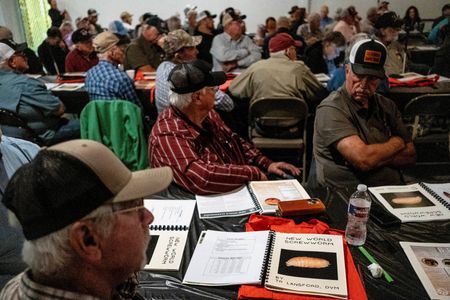
Last Friday, approximately 100 ranchers wearing muddy boots and cowboy hats filled a small high school cafeteria for a Texas Animal Health Commission presentation about screwworm, bombarding officials with questions and expressing anger over what they perceived as sluggish federal action.
“As Texans, we’re not afraid to take this on,” declared John Paul Schuster, a 55-year-old rancher and Kinney County judge, drawing applause and supportive gestures from attendees.
Several ranchers have suggested collecting funds to construct a privately financed sterile fly production facility, with initial costs estimated at approximately $4 million. Screwworms were initially eliminated from America when scientists began releasing enormous quantities of sterilized male screwworm flies that breed with wild females to create sterile eggs. Present sterile fly production falls well below levels needed to control the outbreak, although two additional facilities are being built.
Following the meeting, Schuster criticized what he considered the sluggish pace of sterile fly facility construction, warning that a broader infestation could threaten the ranching and hunting sectors vital to Kinney County’s 3,000 residents’ economy.
“If it’s not controlled in two years and eradicated in five years, my little county will be done,” Schuster stated.
While federal agriculture officials have outlined their screwworm containment approach, some ranchers have objected to what they consider insufficient transparency, including the agency’s choice not to reveal precise locations where sterile flies are being deployed.
“We need to know what’s being done because it’s our financial investment. It’s our livelihood that’s on the line,” Storey explained. “They’re not betting their herd – they’re betting ours.”
Additional ranchers rejected the federal agency’s guidance – including daily animal inspections and preventive treatments – as unrealistic for operations covering thousands of acres, facing serious labor shortages, and lacking experienced cowboys.
“It’s not really feasible. There’s no more cowboys anymore and there’s no good ranch horses,” said DJ Rubio, a 62-year-old rancher and Storey’s husband.
Monty Martin, a 61-year-old rancher living near both confirmed screwworm cases in Zavala County, Texas, adopted a more balanced approach and commended federal and Texas Animal Health Commission teams working in the field.
“People need to stop politicizing this, stop finger pointing, it doesn’t do anyone any good,” he stated. “Those people that are on the front lines have been tremendous, and I have the utmost respect and admiration for them.”
All main roads entering the approximately 12-mile-wide infected area surrounding the original detection location display flashing orange warnings directing livestock-carrying vehicles to stop at checkpoints where state workers inspect animals for screwworm, though staff had left by early evening.
The duty of identifying new screwworm cases, however, rests primarily with ranchers themselves. Anthony Gallegos, a 43-year-old rancher in Zavala County, said the outbreak has increased his vigilance in monitoring his cattle.
“Come on, girls,” he called out, shaking a container of feed as a group of Black Angus cattle ran toward him. “They just pretty much run to me like their dad’s here.”
Gallegos explained that his close bond with his animals and relatively small herd enables him to carefully watch for concerning symptoms and administer preventive medications as federal officials recommend.
Despite preventive steps, Gallegos remains concerned about potential widespread screwworm transmission.
“If it is widespread and it starts infecting animals, it’s going to hurt our bottom line,” he said. “Every time I see a buzzard, my heart sinks.”