
KYIV, Ukraine — Ukraine pressed forward in its war against Russia on Wednesday under a new military command structure, following President Volodymyr Zelenskyy’s decision to remove his top general in response to mounting public pressure.
The country has made notable gains on the battlefield this year, but tensions between the departing army chief and the former defense minister threatened to undermine those efforts. Both officials lost their positions as part of a sweeping government shake-up Zelenskyy carried out last week.
The leadership changes, finalized late Tuesday, were meant to put an end to a nearly week-long bout of political instability that had drawn celebrations from Russia.
The incoming army chief, 43-year-old Maj. Gen. Mykhailo Drapatyi, represents a younger generation of Ukrainian military officers who rose through the ranks while fighting Russian aggression. He first gained recognition for his boldness and bravery in 2014 — the year Russia seized and illegally annexed Ukraine’s Crimean Peninsula, eight years before Moscow launched its full-scale invasion of the country.
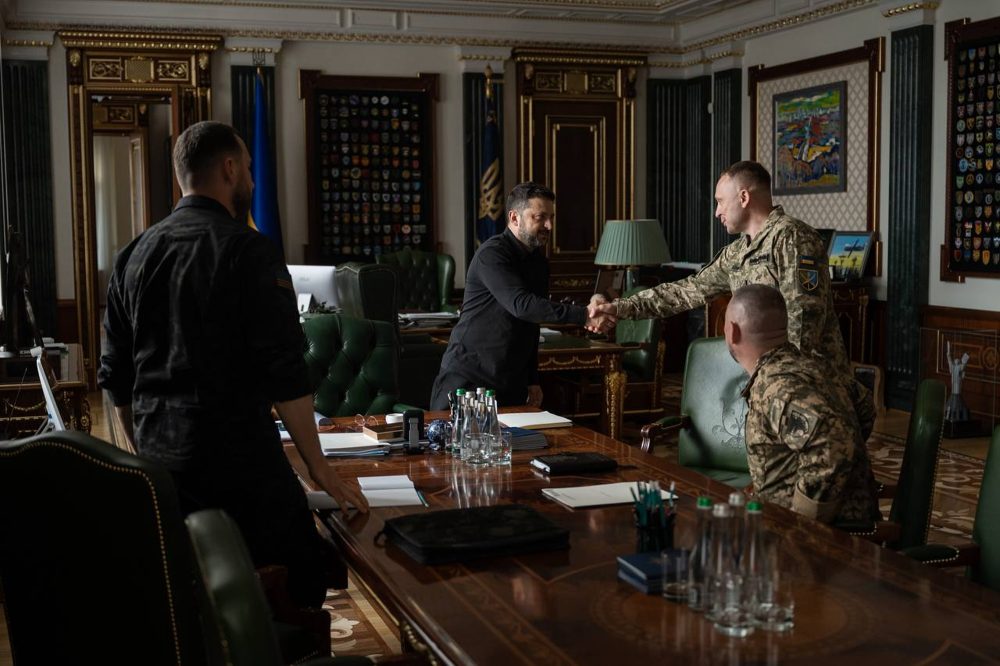
Zelenskyy directed Drapatyi and other military commanders to deliver an updated defense strategy. That plan must include continued reform of the corps system, faster delivery of weapons and drones, improved air defenses against Russian attacks, and a clearer plan for military mobilization.
On Tuesday, Zelenskyy also held a separate meeting with outgoing Defense Minister Mykhailo Fedorov, a 35-year-old tech entrepreneur who is widely credited with rapidly advancing Ukraine’s drone capabilities and giving its forces a tactical edge on the battlefield.
Fedorov had clashed with outgoing Commander-in-Chief Gen. Oleksandr Syrskyi, a 60-year-old military veteran whose training dates back to the Soviet era, before Ukraine gained its independence.
Protests erupted in Kyiv and other Ukrainian cities, with demonstrators calling for Fedorov to be reinstated, viewing him as a critical force for military modernization. They also demanded that Zelenskyy remove Syrskyi, whom many saw as a relic of the old guard.
Zelenskyy offered Fedorov what he described as a respected government position that would bring Ukraine’s technology sector together. Whether Fedorov accepted that offer — and whether the leadership changes would be enough to satisfy protesters and restore calm — remained unclear.
Fedorov expressed support for Drapatyi’s appointment, describing it as a “new hope in the fight of free people for freedom and justice” and “a voice for change that could not go unheard.”
Before his own dismissal, Fedorov had openly criticized Syrskyi, accusing the general of obstructing his modernization efforts and warning that Ukraine’s resistance against Russia could falter if Syrskyi remained in command.
Syrskyi, however, pushed back on Wednesday, defending his record during the war. He stated that Ukrainian forces had recaptured 743 square kilometers — roughly 287 square miles — of Russian-held Ukrainian territory this year. He also said he was leaving his successor an army capable of both defending and carrying out offensive operations. Those claims could not be independently verified.
Fedorov reached out to Syrskyi to acknowledge his military achievements, including the defense of the Kyiv region during Russia’s full-scale invasion in February 2022, the Kharkiv counteroffensive later that year, and other key battles. He called those efforts “already an important part of Ukraine’s history,” but stressed that the country must “move even faster and write new chapters, correcting all previous mistakes.”
The political crisis began last Thursday when Zelenskyy announced a major reshaping of his wartime government, which included replacing his prime minister and dismissing Fedorov after just six months in office.
The announcement quickly drew thousands of Ukrainians into the streets of Kyiv and other cities. Many protesters framed Fedorov’s removal as Zelenskyy choosing to side with an entrenched military establishment over a reformer.
On another front, Ukrainian drones struck two large warehouses belonging to Russia’s major online retailer, Wildberries, in the southern Russian regions of Krasnodar and Stavropol overnight, according to Wildberries founder Tatyana Kim and Russian officials speaking Wednesday.
Those strikes came just four days after Ukrainian long-range drones hit massive Wildberries warehouses in the Moscow region and in the Tambov region, killing eight people and wounding dozens more, officials said.
Zelenskyy stated Saturday that the warehouse facilities were being used by Russia to store sanctioned components for the manufacturing of drones and navigation equipment.