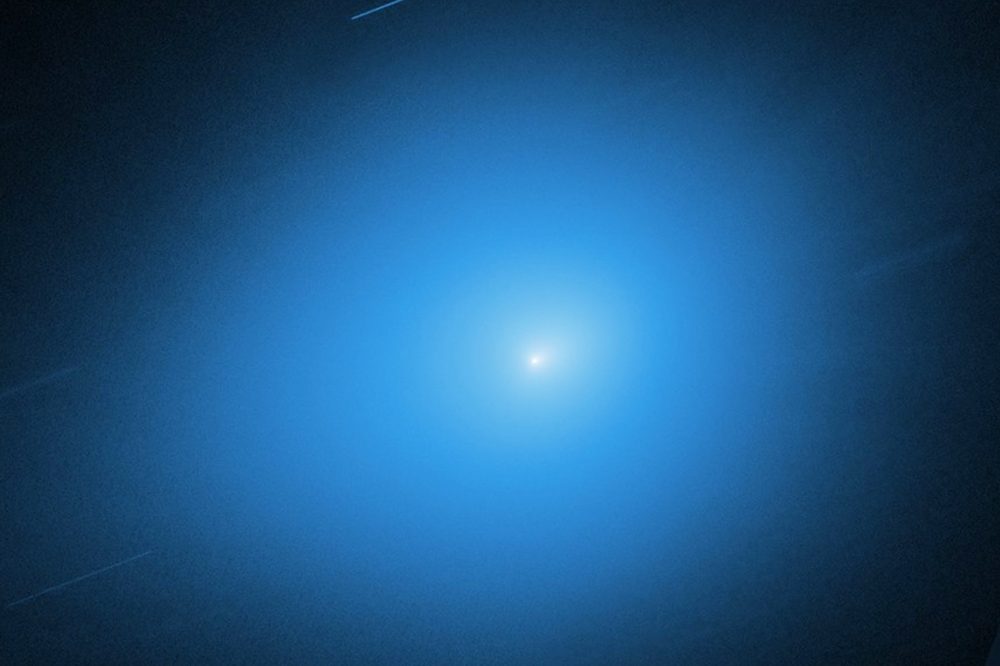

Scientists have concluded that a comet from another star system contains no evidence of alien technology after conducting detailed radio telescope observations.
The SETI Institute announced Wednesday that comprehensive radio monitoring using their Northern California telescope detected no indicators of extraterrestrial technology from the interstellar visitor currently passing through our solar system.
The celestial body, designated 3I/Atlas, was first spotted last summer as it traveled through our cosmic neighborhood. Researchers rapidly determined it originated from another star system, though some speculated without proof that it could be linked to intelligent life forms.
This marks just the third confirmed object from a distant star to enter our sun’s domain — with all three determined to be naturally occurring phenomena.
Multiple NASA spacecraft monitored the icy space object during its approach near Mars in October, coming within 19 million miles of the red planet. Its nearest point to Earth occurred in December at a distance of 167 million miles.
According to SETI, researchers spent more than seven hours in July conducting observations shortly after the comet’s discovery, analyzing a broad spectrum of radio frequencies. The investigation detected nearly 74 million narrow-band radio transmissions.
After eliminating human-generated interference and signals that corresponded with the object’s trajectory, just over 200 signals remained for analysis, all of which “traced back to technology on the surface of the Earth or our own Earth-orbiting satellites,” SETI reported.
The findings appeared in the Astronomical Journal.
“These results show how realistic it is to detect a signal with the technology we have today,” stated co-author Valeria Garcia Lopez of Furman University. “That is why it is important to keep searching for technosignatures, even from objects we might not expect to have signals.”
Lead researcher Sofia Sheikh from SETI and her colleagues noted that NASA’s Voyager spacecraft will eventually become extraterrestrial objects in distant star systems. The twin probes, launched during the 1970s, represent Earth’s most distant spacecraft as they drift through interstellar space.
“Voyager and similar probes will eventually become interstellar objects in other stellar systems. We thus know that no extrapolation is needed for the idea of interstellar technological objects, as we have a proof by existence,” the research team explained.
Currently positioned almost 1 billion miles away as it returns to interstellar space permanently, the comet measures an estimated 1,444 feet to 3.5 miles across. Scientists believe it could be approximately 11 billion years old, making it twice the age of our sun.