
ATLANTA (AP) — A Georgia prosecutor has filed a constitutional challenge against legislation mandating nonpartisan elections for most local positions in the five largest counties surrounding Atlanta while exempting the remainder of the state from this requirement.
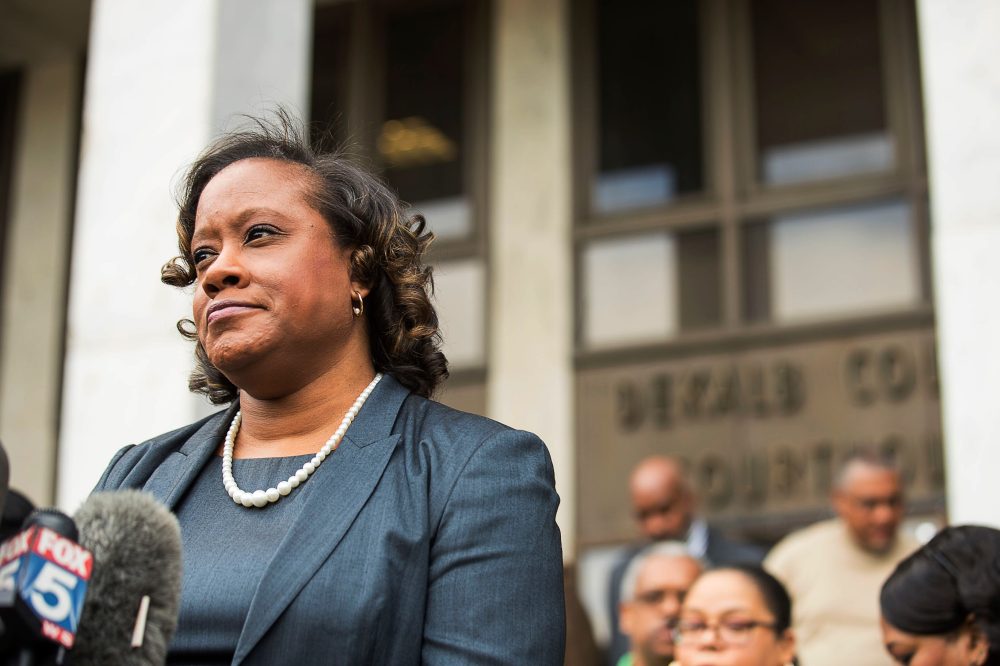
DeKalb County District Attorney Sherry Boston — joined by Fulton County District Attorney Fani Willis, Clayton County District Attorney Tasha Mosley and Cobb County District Attorney Sonya Allen — declared Wednesday from a park located across from the state Capitol that she was submitting a legal challenge to the legislation. Boston, who serves as the sole plaintiff in the case, claimed the legislation breaches both state and federal constitutional protections and singles out Democratic strongholds while pretending to eliminate politics from these elections.
“Republicans here at the state Capitol want to make it harder for voters in our counties to choose the people who best represent us and our values,” Boston said. “But today we are here at the state Capitol to tell those lawmakers that we will not shy away from speaking up for the people of Clayton, Cobb, DeKalb, Gwinnett and Fulton counties.”
She rejected claims that the legislation aims to enhance public safety or eliminate political considerations from the process.
“I think the intent of the law when you look at who they’ve targeted is very clear,” Boston said. “They have chosen to go after Democratic strongholds where Democratic DAs and Democratic officials have been successful in these races.”
The legal action targets the state of Georgia. Through an emailed response, Kara Murray, a spokesperson for state Attorney General Chris Carr, stated, “We will defend the law as enacted and signed by the Governor.”
Willis and Boston had earlier warned of potential litigation regarding the law after Republican Georgia Gov. Brian Kemp approved it last month. They indicated that one motivation for Republicans focusing on these five counties was that all currently have Black women serving as their elected district attorneys.
Willis has faced repeated criticism from Republican state legislators following her prosecution of President Donald Trump and associates regarding efforts to reverse Democrat Joe Biden’s victory in Georgia’s 2020 presidential contest. That legal proceeding was thrown out last year.
State Sen. John Albers, a Republican from the Atlanta suburb of Roswell who championed the legislation, stated during the legislative session that he expected it would enhance public safety, although the counties’ elected sheriffs will remain under partisan election systems. Albers did not respond immediately Wednesday to a message sent through his legislative office seeking comment regarding Boston’s lawsuit.
The legislation, scheduled to begin in 2028, would mandate nonpartisan elections for district attorneys, solicitors general, county commissioners, court clerks and tax commissioners.
It will shift elections for all impacted positions except district attorneys to May, when voters select nonpartisan judges. This creates a smaller voting pool than in November, with participation primarily influenced by partisan office primaries conducted simultaneously. Should no candidate secure a majority, nonpartisan runoffs would occur in June.
The policy affects Fulton County, which encompasses most of Atlanta, along with the suburban areas of Clayton, Cobb, DeKalb and Gwinnett counties. Fulton, DeKalb and Clayton counties represent the three most significant Democratic jurisdictions statewide. Cobb and Gwinnett, previously reliable Georgia Republican territories, have shown increasing Democratic support since 2016.
Boston argued the law breaches Georgia’s uniformity clause, which she stated demands laws function identically statewide. It also violates equal protection provisions in both state and federal constitutions because legislators provided no legitimate justification for treating these five counties and their voters and elected officials differently, she stated. Additionally, she claimed lawmakers violated procedural requirements during the voting process.