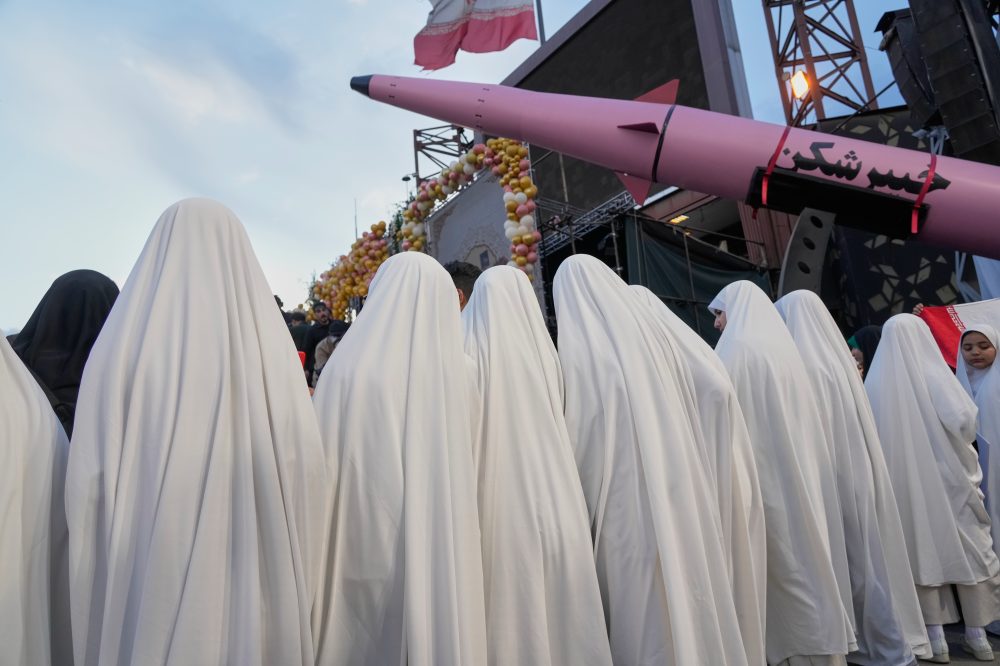

DUBAI, United Arab Emirates (AP) — Civilians in Tehran are now being taught how to use Kalashnikov-style assault rifles by members of Iran’s Revolutionary Guard in public demonstrations. Military parades through the city showcase vehicles equipped with Soviet-era machine guns, while a ballistic missile similar to those used against Israel was recently displayed at a mass wedding ceremony.
These public displays of armaments have become commonplace in Tehran, serving as a bold statement of resistance as U.S. President Donald Trump warns he might resume military action against Iran if diplomatic talks fail and the nation continues controlling the Strait of Hormuz.
The military exhibitions underscore real security concerns Iran is grappling with: Trump has hinted that American troops might forcibly seize Iran’s enriched uranium supplies and has previously acknowledged providing weapons to Kurdish forces for distribution to anti-government demonstrators.
However, these shows also serve to bolster and inspire hardline supporters while providing rare public spectacle during uncertain times, as citizens deal with widespread job losses, business shutdowns, and soaring costs for food, medicine, and essential items. The implication that more hardliners will be armed could also help prevent future uprisings against Iran’s religious government, which brutally crushed nationwide protests in January through a crackdown that activists claim resulted in more than 7,000 deaths and tens of thousands of arrests.
“This is necessary for all our people to get trained because we are in a war situation these days,” said Ali Mofidi, a 47-year-old Tehran resident at a weapons training Tuesday night. “If necessary, everyone should be available and know how to use a gun.”
For months, state-controlled television and government text messages have flooded citizens with appeals to join the “Janfada,” meaning “ones who sacrifice their lives.” At one time, hardliners urged families with sons as young as 12 to send them to Revolutionary Guard checkpoint duties — a practice Amnesty International condemned as a war crime.
Government leaders claim more than 30 million Iranians — in a nation of approximately 90 million — have signed up through online registration or at public events to give their lives for Iran’s theocracy. This number cannot be independently verified, and there has been no evidence of large-scale mobilization similar to what Ukraine experienced before Russia’s 2022 full-scale invasion, when authorities distributed weapons and citizens collaborated to create gasoline bombs.
Nevertheless, there have been multiple public announcements and television presenters have appeared with weapons during live state TV broadcasts as part of efforts to stoke enthusiasm.
“Looking back at the moment I registered my name, I realize I wasn’t truly contemplating the dangers of fighting on the front lines. In that moment, like everyone else, my thoughts were solely on Iran,” wrote journalist Soheila Zarfam in a column for the state-owned Tehran Times newspaper. “My life might end, but Iran would endure, and that was all that truly mattered.”
Iranian Nobel Peace Prize laureate Shirin Ebadi has criticized the public weapons demonstrations, particularly footage of young boys handling assault rifles, saying: “Scenes like these are reminiscent of child hostage-taking and arming by groups such as Boko Haram in Nigeria, and militias in Sudan and Congo.”
A recent government-organized demonstration by nomads in Iran saw them carrying everything from bolt-action Lee–Enfield rifles of the British Empire to a blunderbuss, a predecessor of the shotgun more familiar to the age of pirates on the high seas.
But during weeks of an unsteady ceasefire, most of the weapon demonstrations appear focused on Tehran, not the rural areas where there is a tradition of keeping rifles and shotguns at home.
At a demonstration Tuesday night in Tehran, male and female participants divided into separate classes. Hadi Khoosheh, a member of the Revolutionary Guard’s all-volunteer Basij force and trainer, demonstrated how to handle a folding-stock Kalashnikov-style assault rifle.
“At the end of the training those who completed the course will receive a card titled ‘Janfada,’ proving they have received basic and preliminary training for this type of gun and they are able to use it if, God forbid, something happens to our country,” Khoosheh said.
However, the weapons training was rudimentary at best for the young boys and older men gathered. One struggled to insert the rifle’s magazine and inadvertently pointed the barrel of the unloaded weapon at others — a major safety breach that people are taught to avoid in basic firearms training.
“Definitely we will stand against (the Americans) and won’t give up even an inch of our soil,” said Mofidi, the man at the training. “No matter if they come from the sea or land, we will stand by our flag.”