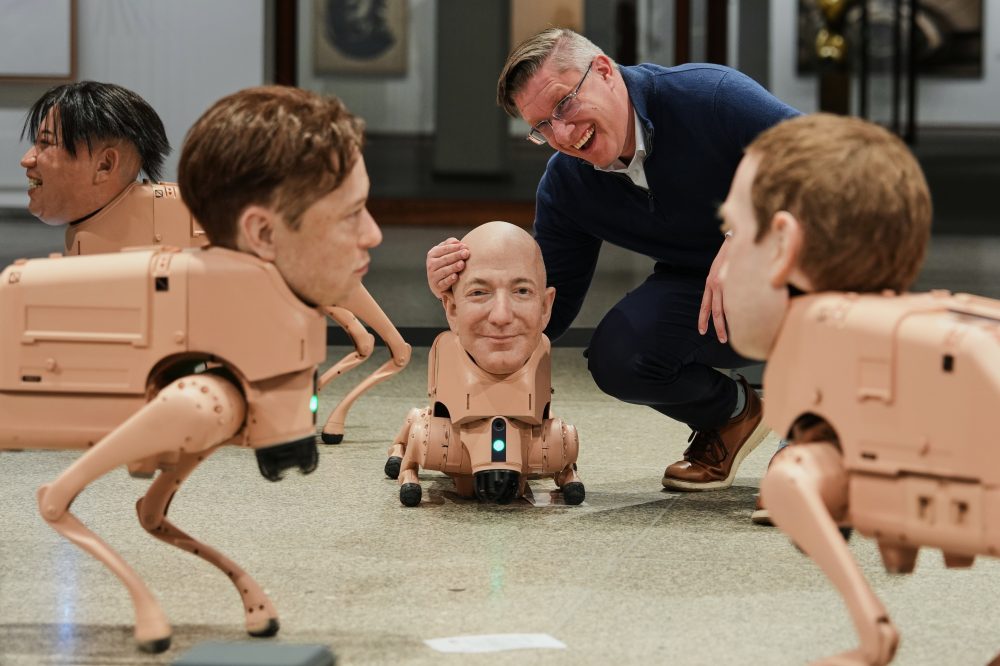

BERLIN — Mechanical canines bearing incredibly lifelike silicone replicas of famous personalities’ faces are wandering through a German art gallery, periodically “defecating” printed photographs of their environment that they’ve captured using built-in cameras.
The robotic creatures feature heads modeled after tech titans Elon Musk, Mark Zuckerberg, and Jeff Bezos, along with artistic legends Andy Warhol and Pablo Picasso, as part of an interactive art piece by American creator Beeple (Mike Winkelmann) currently on display at Berlin’s New National Gallery.
Every printed photograph displays a slice of reality altered by artificial intelligence to mirror the character of each mechanical dog — essentially representing how the human figure attached to each robot might view the world. For instance, the Picasso-headed canine generates images in a Cubist aesthetic, while Warhol’s version produces pop art-style prints.
Exhibition organizers describe the installation as a statement about how algorithms and digital platforms influence our understanding of reality.
“In the past, our view of the world was shaped in part by how artists saw the world,” Beeple explained to the Associated Press. “How Picasso painted changed how we saw the word, how Warhol talked about consumerism, pop culture, that changed how he saw those things.”
Today, however, technology executives who control sophisticated algorithms determine what information we encounter and what remains hidden from view, the artist explained.
“That’s an immense amount of power that I don’t think we’ve fully understood, especially because when they want to make a change, they don’t need to lobby the U.N. They don’t need to get something through Congress or the EU, they just wake up and change these algorithms.”
Some of the mechanical animals also sport heads resembling Beeple himself.
Lisa Botti, who curated the Berlin exhibition, explained that artificial intelligence represents one of today’s most significant influences on daily life, and “museums are the places where society can reflect” on such changes, which motivated her decision to showcase Beeple’s creation.
The installation, called “Regular Animals,” made its debut at Art Basel Miami Beach 2025.
Beeple, a graphic artist from South Carolina, produces various forms of digital artwork and helped establish the “everyday” movement in 3D graphics by creating and sharing one image daily online for years without interruption.
Christie’s auction house ranks him as the third most valuable living artist by auction sales, trailing only David Hockney and Jeff Koons.
In spring 2021, Christie’s began accepting bids for Beeple’s digital compilation titled “Everydays: The First 5000 Days,” which eventually sold for more than $69 million. The auction house characterized the piece as “critiques of modern society, the government and social media” presented through “grotesque, dystopian futures, often featuring celebrities like Donald Trump and Kanye West.”
Christie’s noted this sale represented the first occasion a major auction house sold a purely digital artwork authenticated by a non-fungible token, and the first time cryptocurrency served as payment for an auctioned artwork.
Non-fungible tokens, or NFTs, function as digital certificates that verify the authenticity of digital collectibles by storing information on a blockchain digital ledger. These tokens have recently gained popularity in online collecting circles, emerging alongside the cryptocurrency surge.
During the Art Basel 2025 event, Beeple distributed the photographs produced by his robotic dogs to attendees, including certificates labeled “100% organic GMO-free dog shit.” Several prints contained QR codes providing access to complimentary NFTs, effectively allowing Beeple to distribute his digital creations at no cost for potential future monetization by recipients, including sometimes the photograph subjects themselves.