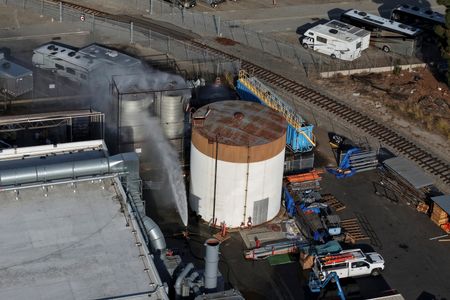

Emergency responders battling to prevent a dangerous chemical explosion in Southern California received encouraging news Sunday when specialists discovered what appears to be a crack in the pressurized tank.
The container holds methyl methacrylate, a combustible substance used in plastic production and manufacturing processes. Officials have warned since Friday that the tank could burst, releasing as much as 7,000 gallons of poisonous material, or detonate and threaten additional storage units at the GKN Aerospace facility.
Evacuation directives went into effect Friday for Garden Grove residents, a community located approximately 30 miles south of Los Angeles. The mandatory evacuation zone encompasses tens of thousands of people.
TJ McGovern, interim fire chief of the Orange County Fire Authority, announced through a social media video that expert teams Saturday evening identified “a potential crack in the tank, which could potentially be relieving some of the pressure in there.”
McGovern characterized finding the possible fissure as “positive intel.”
Emergency officials continue working to confirm whether the suspected crack has actually decreased tank pressure, according to an Orange County Fire Authority spokesperson who spoke with Reuters. Reducing internal pressure would help prevent a catastrophic blast, the spokesperson explained.
While authorities currently concentrate on pressure monitoring, the spokesperson noted the crack might eventually enable officials to slowly remove the hazardous chemicals.
Craig Covey, division chief of the Orange County Fire Authority, reported Saturday that the tank’s interior temperature was climbing approximately one degree hourly and had peaked at 90 degrees. However, EPA Administrator Lee Zeldin stated early Sunday on CNN’s “State of the Union” that local teams were working to maintain tank stability by keeping temperatures below 85 degrees Fahrenheit.
“I’m being told this morning that the most likely scenario is one of a low-volume release, where the local authorities are going to be able to monitor, neutralize and contain the threat,” Zeldin told CNN.
Response teams prepared for potential spillage by identifying methods to construct barriers and redirect the liquid into containment areas at the industrial location, preventing it from reaching storm drainage systems, waterways or coastal areas, Covey explained.
Public health authorities expressed concerns that chemical vapors could trigger serious breathing complications during extended exposure. Environmental monitoring equipment positioned throughout Garden Grove detected no hazardous substances or contaminants Sunday, the EPA reported.
Detection devices placed near the tank have not registered any airborne chemical releases, the fire authority spokesperson confirmed.
Neither the Orange County Fire Authority nor the Garden Grove mayor’s office responded to Sunday comment requests. Saturday briefings revealed firefighters were investigating whether increased cooling water flow could slow internal chemical reactions sufficiently to lower pressure and avoid explosion.
The emergency situation started Thursday at the GKN Aerospace plant, which manufactures and tests aircraft windows and canopies for civilian and military aviation, the company’s website states.
California Governor Gavin Newsom declared a state of emergency for Orange County on Saturday.