
TAIPEI – The head of Taiwan’s main opposition political party declared Monday that strengthening diplomatic relationships with Beijing doesn’t require taking an anti-American position, emphasizing that Taiwan’s future hinges on maintaining stable connections with China.
Cheng Li-wun, a former legislator who secured the leadership of the Kuomintang (KMT) party last October, has indicated she plans to pursue even stronger Beijing relationships than her predecessor Eric Chu, who never traveled to China during his leadership tenure starting in 2021.
Beijing considers democratic Taiwan part of its territory and refuses diplomatic contact with President Lai Ching-te’s administration, labeling him a “separatist.” However, Chinese officials routinely host high-ranking KMT representatives, though Cheng hasn’t made the trip since winning her election.
This approach has drawn sharp criticism from Lai’s Democratic Progressive Party, which accuses the KMT of attempting to sacrifice Taiwan’s democratic values and freedoms to appease Beijing while following Chinese directives to obstruct defense funding and distance Taipei from Washington.
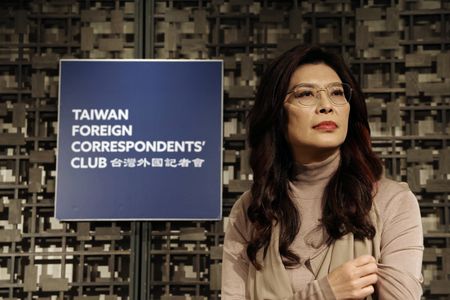
During remarks to the Taiwan Foreign Correspondents’ Club, Cheng defended her party against what she called “misunderstanding and prejudice” regarding their political positions, reaffirming her backing for U.S. weapons purchases while noting such proposals need proper financial analysis.
“In terms of the overall narrative, the KMT has long maintained very good relations with the United States. This does not affect our desire to improve relations with the mainland,” she stated.
“There is no contradiction between the two, and there is no need to choose one over the other,” Cheng continued. “Why does improving relations with mainland China have to mean being less pro-American?”
She emphasized the critical importance of maintaining positive China relationships “whose relationship with Taiwan directly affects Taiwan’s survival.”
While Cheng has publicly stated her interest in meeting with Chinese President Xi Jinping, she avoided giving specifics about progress on those potential discussions.
The KMT and its smaller partner, the Taiwan People’s Party, control a legislative majority, providing them significant political influence to halt government initiatives and advance their own agenda.
All three major political parties are preparing for mayoral and county leadership races scheduled for late November, which will serve as an important indicator of public support before the 2028 presidential contest.
Beijing has intensified military pressure against Taiwan and continues to maintain that military action remains an option for bringing the island under Chinese authority.
When questioned about her views on potential future unification across the Taiwan Strait, Cheng indicated the timing isn’t appropriate for such discussions.
“What we need to deal with now is how to create peaceful and stable cross-strait relations.”
Lai’s administration continues to reject Beijing’s territorial claims over Taiwan.