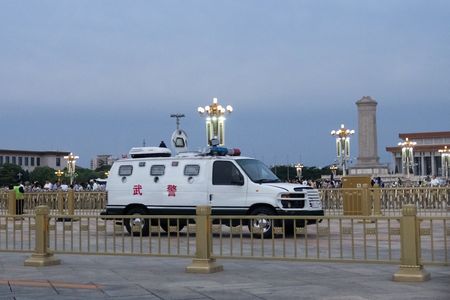

Taiwan’s leadership called on China Thursday to acknowledge the violent suppression of pro-democracy demonstrators in Beijing’s Tiananmen Square 37 years ago, marking an anniversary that China continues to treat as forbidden territory.
Taiwan President Lai Ching-te used social media to address the sensitive milestone, writing: “I sincerely hope that China can face up to the June 4 incident of 37 years ago, acknowledge the truth, soothe the pain, and open the door to reconciliation and dialogue.”
The June 4, 1989 incident, when Chinese military forces fired on student-led democracy advocates in and around the Beijing square, remains off-limits for public discussion in China with no official recognition of the anniversary.
Memorial events now occur in cities outside China’s borders, including Taipei, where Taiwan’s government officials regularly use the date to criticize China. Beijing considers the democratically-run island nation part of its territory.
In his social media statement, Lai cautioned against “blindly believing” in military force and argued that responsible governments and societies should work to improve future generations’ prospects rather than employ “violence, surveillance, and other means to strangle their dreams and erase their opinions.”
China’s Taiwan Affairs Office had not provided a response to requests for comment regarding Lai’s statements.
Beijing labels Lai a “separatist” and has rejected his repeated attempts at dialogue. Lai maintains that Taiwan’s citizens alone should determine their nation’s path forward.
U.S. Secretary of State Marco Rubio also marked the anniversary Wednesday, stating that Beijing’s censorship efforts cannot eliminate recollections of the military attack. This continues the American tradition of the nation’s chief diplomat recognizing the date, which consistently angers Beijing.
“Those who sacrificed to uphold their unalienable rights of free expression and peaceful assembly will be vindicated someday,” Rubio stated.
China’s foreign ministry had not responded to requests for comment on Rubio’s remarks. Last year, Beijing condemned Rubio for his Tiananmen commentary, claiming he was “distorting” historical reality and attacking China’s governing structure.
Chinese military tanks entered Tiananmen Square in the early morning hours of June 4, 1989, ending weeks of democracy demonstrations by students and laborers.
Beijing has never released complete casualty figures, though human rights organizations and eyewitnesses estimate deaths could number in the thousands. China characterized the demonstrations as counter-revolutionary efforts to topple the ruling Communist Party.
In Hong Kong, where annual candlelight ceremonies in Victoria Park once attracted tens of thousands annually, public memorial events ended after Beijing enacted a national security law in 2020.
These vigils previously symbolized the financial center’s greater freedoms compared to mainland China, but the anniversary there now features heavy police deployment with minimal visible remembrance activities.
Multiple memorial events were planned for Thursday in various global cities, including four locations in Germany and one in Australia.