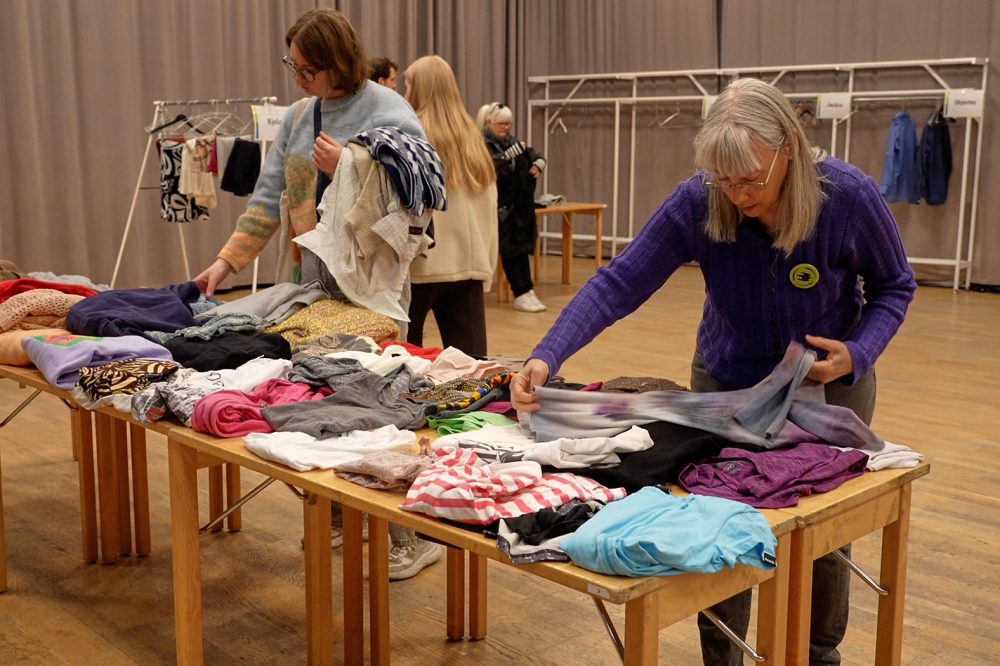

STOCKHOLM (AP) — Art student Alva Palosaari Sundman spent hours browsing through racks of pre-owned clothing in Stockholm, searching for the perfect pair of used jeans.
The 24-year-old joined hundreds of others at Sunday’s yearly clothing exchange event held at a community center in Sweden’s capital city. Participants brought their own garments to trade for different items from other attendees. These types of gatherings attracted thousands of people nationwide, all working to minimize the environmental impact of clothing manufacturing.
Palosaari Sundman expressed satisfaction watching other participants select items she had contributed to the exchange.
“It’s like, ‘Oh, OK, it gets a new life with this person,’” she said. “It just feels a bit more humane.”
According to the UN Environment Programme, the fast fashion industry stands as a significant contributor to environmental harm, generating as much as 10% of global carbon emissions. Thrown-away garments fill landfills that damage landscapes in developing nations, while synthetic fibers from inexpensive clothing materials contaminate marine environments.
UNEP reports that manufacturing just one pair of jeans requires approximately 2,000 gallons (7,571 liters) of water.
The clothing exchange program in Sweden launched in 2010 and has continued expanding. During the previous year, approximately 140,000 individuals took part in 140 exchange gatherings and brought home more than 44,000 previously owned pieces.
While Sweden maintains a reputation for environmental leadership, the situation proves more complex. Research from Mistra Future Fashion shows that clothing purchases account for roughly 3% of an individual Swede’s total carbon footprint.
Swedish residents faced a ban last year on disposing of clothing in regular garbage as part of a European Union effort to increase recycling rates. However, the policy created problems when municipal collection points became overloaded with textile stockpiles, prompting the government to partially reverse the regulation in October.
The Swedish Society for Nature Conservation coordinates these exchange events. Chair Beatrice Rindevall noted that each Swedish citizen discards approximately 9-10 kilograms (20-22 pounds) of clothing annually.
The organization reports that Swedish consumers purchase around 25 new clothing pieces yearly on average, with 90% of wardrobe items going unused.
“We have to be more careful and we have to think about our consumption,” said Cecilia de Lacerda, one of the society’s volunteers in Stockholm.
Professional tailors attended the exchange events to assist participants with clothing repairs that extend garment lifespan.
“A lot of people don’t have sewing machines anymore, or they don’t quite know how they should fix that buttonhole that broke,” said Meg Goldmann, another volunteer.
High school student Alice Dundeberg, 19, finds that pre-owned clothing helps her develop a distinctive personal style.
“You don’t find multiple types of the same shoes, pants or sweater,” she said. “No one has the same clothes as the others.”