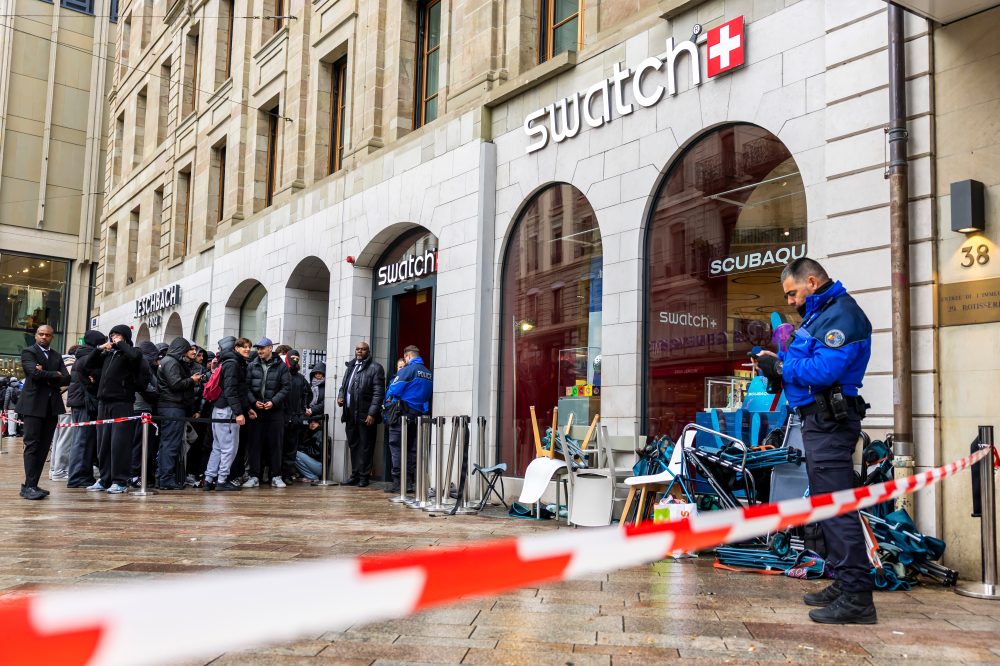

Chaos erupted worldwide when Swatch released its newest timepiece, with authorities using tear gas in Paris, brawls breaking out in Milan, and overnight lines forming from New York to Singapore as consumers desperately sought the coveted Royal Pop watch.
The Swiss timepiece manufacturer acknowledged Monday that the situation had gotten out of hand, emphasizing that supplies of the Royal Pop — a partnership with luxury brand Audemars Piguet — are plentiful and urging customers to remain calm.
The frenzy centers around a “bioceramic” watch priced at approximately $400, though its potential resale value reaches into the thousands. By Monday, the colorful timepieces were flooding eBay, with one listing demanding 3,055.58 British pounds ($4,092.31) “or Best Offer” and advertising “IN HAND!!! Swatch x AP Royal Pop.”
This incident represents the newest chapter in decades of consumer hysteria that has impacted brands from Nike to Apple, as people scramble to capitalize on trending products and their resale potential.
“It looks like people got crazy to get a Royal Pop to make money through resale, not because they are fans of the Swatch,” explained Pierre-Yves Donze, a business history professor at Osaka University Graduate School of Economics. “People want money, especially. Royal Pop is not like a cool product, but a way to make easy money.”
This represents a shift from previous product launches, Donze noted in an email, when consumers purchased hyped items because “they wanted to have it in their collection.”
While Swatch declined to address questions about the massive markup on resold products, the company told The Associated Press that difficulties occurred at roughly 20 of its 220 global locations where “challenges arose on launch day because the queues of interested customers were exceptionally long and the organization of some shopping malls was not sufficient to handle this level of turnout.”
According to the company’s statement, the Royal Pop has generated more than 11 billion social media views since its debut.
Swatch drew parallels to the MoonSwatch release in March 2022, created with sister brand Omega during the pandemic, which triggered similar scenes of masked customers racing toward stores from Singapore to Sydney.
The company has navigated product hysteria for over forty years. In 1984, it suspended a massive 13-ton yellow Swatch from a Frankfurt building, coinciding with the popularity of its revolutionary mass-produced, budget-friendly timepieces that differed dramatically from traditional watches. Consumers began sporting models like “White Memphis” and “Chrono-tech” with its bold primary-colored hands.
This weekend, London’s Carnaby Street Swatch location again attracted lengthy queues ahead of the Royal Pop debut. Dozens of people crowded the sidewalk outside the Oxford Street store Sunday before opening, prompting authorities to shutter all London Swatch outlets and several others throughout the U.K. Similar scenes unfolded globally, with closed stores in the Netherlands and what was described as a “mosh pit” atmosphere in New York’s Times Square.
French authorities deployed both tear gas grenades and spray to scatter crowds gathering outside the nation’s Swatch locations, according to the national police service.
Officers used gas grenades at the massive Westfield Parly 2 shopping center west of Paris, where television footage captured riot police with shields and helmets positioned outside the shuttered watch store. In Lyon, officers deployed a gas grenade when crowds refused multiple dispersal orders at the city’s Bellecour public square, while Montpellier municipal police used tear gas spray. The police service noted that crowds remained peaceful at other Swatch locations.
Swatch France announced on Instagram that “because of public security considerations,” stores in six French cities would remain closed that day.
The company subsequently released a statement guaranteeing that the Royal Pop would remain available for months.
The timepiece debuted exclusively in physical stores without online availability — a questionable decision according to some observers, given the heightened atmosphere created by substantial resale profits motivating those waiting in line. Scattered injuries, arrests, and property damage were reported.
Many companies consider the liability risks of such hype too dangerous.
“A lot of the streetwear drops and sneaker drops that used to happen when I was younger, all of them have moved online because of safety concerns,” observed Odunayo Ojo, a London-based fashion and cultural critic, on his YouTube channel Fashion Roadman. Either Swatch “didn’t get the memo,” underestimated the product’s appeal, or deliberately amplified the launch to boost sales.
“Swatch already has a track record of understanding how these things go,” Ojo noted.
By Monday, the lines had disappeared, possibly because, as observers near a Paris Swatch store reported, no Royal Pop watches remained in stock. Word was that fresh shipments were expected soon.