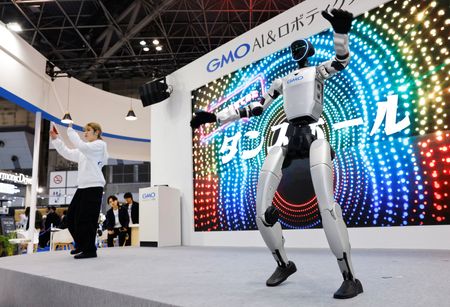

A recent survey conducted by Reuters indicates that approximately one-third of Japanese businesses have either implemented or are exploring the use of artificial intelligence-powered robotics technology.
The research, released Thursday, shows that manufacturers of transportation equipment and automobiles are at the forefront of this technological adoption trend.
Japanese officials view the integration of AI robotics in business operations as essential for addressing the nation’s ongoing workforce shortages while maintaining its status as a premier supplier of industrial robotics worldwide.
Japan houses major robotics companies including Fanuc, Yaskawa Electric and Kawasaki Heavy Industries, establishing the country as a dominant force in traditional industrial robotics manufacturing.
However, the nation now encounters increased competition from China and the United States in the development of AI-enhanced robots, which possess autonomous capabilities to assess their surroundings and make independent decisions, moving beyond simple repetitive programming.
Survey results indicate that 4% of participating companies currently utilize AI robots, while 5% have definite deployment plans and 25% are evaluating potential implementation. The remaining 66% reported no current plans for AI robot adoption.
Transportation equipment manufacturers demonstrate the highest adoption rates, with 80% either currently using or investigating AI robot implementation. Conversely, 94% of wholesale sector respondents indicated no intentions to deploy AI robotics.
Among companies that are using, planning to use, or considering AI robots, 71% identified manufacturing as their primary application, 19% selected hazardous task operations, and 11% chose customer service functions. Respondents were permitted to select multiple applications.
The polling was executed by Nikkei Research on behalf of Reuters between May 1-15. Researchers contacted 492 companies, receiving responses from 220 businesses under anonymity agreements.
The survey also addressed government recommendations encouraging publicly traded companies to utilize their appreciated financial holdings more effectively for growth initiatives. Sixty percent of respondents believed individual companies should maintain decision-making authority on asset utilization, while 44% suggested corporate size should influence policy application.
Additionally, 24% indicated that maintaining certain financial asset levels remains necessary to enable salary increases. Multiple responses were allowed for this question.
Last month, the Financial Services Agency and the Tokyo Stock Exchange developed a preliminary revision to Japan’s corporate governance standards, requiring companies to demonstrate efficient asset utilization for growth purposes.
Japanese companies with capital exceeding 1 billion yen ($6.9 million), excluding financial and insurance sectors, held cash and deposits totaling 83 trillion yen in 2024, representing a 54% increase from ten years prior, prompting discussions about improved asset deployment for economic growth.
“What the draft revision is calling for is to make checks and explain if business resources are at appropriate levels. A rise and fall in cash and deposits itself should not come under scrutiny,” an official at a ceramics maker wrote in the survey.
The proposed revision also encourages listed companies to file securities reports at least three weeks before shareholder meetings.
In the previous year, approximately 58% of companies with March fiscal year-ends submitted securities reports prior to general shareholder meetings, but 80% of those submissions occurred just one or two days before the meetings.
When asked about the feasibility of submitting securities reports three weeks ahead of shareholder meetings, 33% described meeting this timeline as challenging and burdensome, while 26% indicated they would need to implement measures such as rescheduling shareholder meeting dates to meet the requirement.